Physical AI infrastructure is fragmenting into five specialized layers—compute substrate, validation engineering, data operations, open-source coordination, and continuous learning—rather than organizing around raw computing capacity.
Each platform addresses a different bottleneck in the development cycle that spans real-world demonstrations, simulation, policy training, structured evaluation, and deployment.
The question is not which single platform wins, but whether these five can remain reusable across robot makers and embodiments, or whether they bifurcate into proprietary ecosystems.
What happened
Five infrastructure platforms are emerging as distinct control points in the physical AI stack—NVIDIA (accelerated computing and simulation), Applied Intuition (validation engineering), Scale AI (data collection and annotation), Hugging Face LeRobot (open-source coordination), and Lightwheel (continuous learning loops)—each addressing a critical bottleneck beyond traditional GPU-centric compute.
Why it matters
Physical AI requires robots to perceive environments, reason about motion and contact, act through specific bodies, and recover from failures—a development cycle far more complex than training text or image models. These platforms represent horizontal infrastructure reusable across robot makers and industries, not tied to a single embodiment or manufacturer, meaning the stack they build will shape how robotics developers work for years to come.
What to watch
Each platform faces a critical test—NVIDIA must prove its ecosystem remains open as it expands; Applied Intuition must translate autonomous-vehicle validation expertise into manipulation and humanoid robotics; Scale AI must industrialize robot data without losing the information models need; LeRobot must stay accessible while supporting larger, production-grade workflows; and Lightwheel must close its Real2Sim2Real loop in live operations, relying on customer trust to return real-world feedback.
Physical AI infrastructure is shifting from a single center of gravity—compute—to a system of interdependent layers. Robots do not simply run a model; they must perceive a changing environment, reason about contact and motion, act through a specific body, and recover when their actions fail. The development cycle spans real-world demonstrations, synthetic data, physics simulation, policy training, structured evaluation, deployment, and the collection of new failure cases. This complexity demands specialized infrastructure across five distinct control points.
NVIDIA remains the most foundational company in the physical AI stack. Its importance begins with accelerated computing but extends upward into robot development, simulation, synthetic data, foundation models, and policy evaluation. NVIDIA Isaac now spans multiple products: Isaac Sim for physically based simulation, Isaac Lab for robot learning and foundation-model training, Isaac GR00T for general-purpose humanoid development, and Isaac Lab-Arena for large-scale, GPU-accelerated policy evaluation. Newton, developed with Google DeepMind and Disney Research and managed by the Linux Foundation, is an open-source, GPU-accelerated physics engine built for robot learning, covering contact, friction, rigid and soft-body dynamics, actuators, and sensors. The strategic advantage is NVIDIA's ability to connect computation, world generation, physics, synthetic data, model training, evaluation, and edge deployment inside one developer ecosystem, the closest thing physical AI has to a common development substrate. The critical question is whether that ecosystem remains open as it expands, or whether NVIDIA pulls the physical AI workflow toward its own compute and software.
Applied Intuition represents the infrastructure required to prove an autonomous machine is ready for the real world. Physical AI cannot stop at model training; cars, trucks, drones, mining vehicles, and industrial systems must be tested across operating conditions that are costly, dangerous, rare, or impossible to reproduce repeatedly in the physical world. Applied Intuition built its position during the autonomous vehicle era and now positions its end-to-end physical AI platform across automotive, defense, trucking, mining, construction, agriculture, and robotics. Its platform combines simulation and evaluation, large-scale data ingestion, closed-loop data collection, autonomous-system development, fleet operation, and vehicle operating software. The company converts real-world sensor data into curated segments for training, simulation, and evaluation, with continuous metrics feeding the next development cycle. Its value lies in turning real-world requirements into structured test systems: scenario libraries, varied environmental and sensor conditions, parallel simulation, and evaluation wired into continuous integration. The open question is whether strength in autonomous mobility translates equally well to manipulation and humanoid robotics, where behavior depends on language instructions, contact dynamics, and long-horizon interactions, and failures involve dexterity, force, and task interpretation rather than navigation alone.
Scale AI represents the foundational layer of data operations. Robotics data cannot be collected from the internet the way text or images can; trajectories must be produced through physical systems or human demonstrations, one interaction at a time, then synchronized, calibrated, cleaned, annotated, and evaluated. Scale built its reputation industrializing those processes for autonomous vehicles and frontier AI models and is now extending the same approach into physical AI. Its platform combines centralized data factories, distributed human collectors, real robot systems, and robotless egocentric collection, with multimodal annotation and internal policy fine-tuning intended to verify that a dataset produces measurable model improvements. The company reported delivering over 150,000 hours of physical AI data during 2025 and adding 10 robotics customers, with publicly named partners including Generalist AI and Physical Intelligence. Its network collects more than 1,000 hours of demonstration data per day. That makes Scale more than a labeling provider; it is building the operational system for specifying tasks, managing contributors, enforcing quality, and validating datasets against downstream policies. The central challenge is whether Scale can reproduce in robotics the scale advantage it built in autonomous driving and generative AI, given that robot data is fragmented across embodiments, sensors, control frequencies, and deployment settings.
Hugging Face LeRobot represents an open-source coordination layer that physical AI cannot afford to leave entirely inside proprietary platforms. During the large-model era, open-source frameworks, model repositories, standardized formats, and shared datasets substantially lowered the cost of experimentation. Robotics needs a similar public commons, particularly because many laboratories and startups cannot build their own end-to-end data and training infrastructure. Hugging Face describes LeRobot as an open-source collection of models, datasets, and tools for real-world robotics, focused on imitation learning and reinforcement learning. Its ecosystem includes pretrained policies, human-collected demonstrations, simulated environments, robot integrations, and tools for recording data, training policies, evaluating them, and deploying them onto hardware. Its importance is especially visible at the data layer. LeRobotDataset v3.0 introduced a standardized format for multimodal robot-learning data, including sensorimotor time series, actions, multi-camera video, task metadata, indexing, visualization, and Hub-native streaming, redesigned to support datasets with very large numbers of episodes without forcing every laboratory to invent its own storage and access system. Version 0.6.0 added a unified evaluation command, additional simulation benchmarks, reward-model interfaces, human-in-the-loop corrections, and new vision-language-action and world-model policies. LeRobot is increasingly becoming a point of integration for other physical AI platforms; NVIDIA's GR00T models and Isaac Lab-Arena environments are available through LeRobot workflows, allowing developers to train and evaluate different policies through common dataset, simulation, and hardware interfaces. The strategic role of LeRobot is therefore larger than providing sample code; it can become a coordination layer through which robot datasets, models, hardware interfaces, simulation environments, training recipes, and benchmarks become portable, keeping physical AI from fragmenting into isolated ecosystems. The critical question is whether LeRobot can preserve its accessibility while becoming reliable enough for larger datasets, more complex embodiments, and production-oriented workflows.
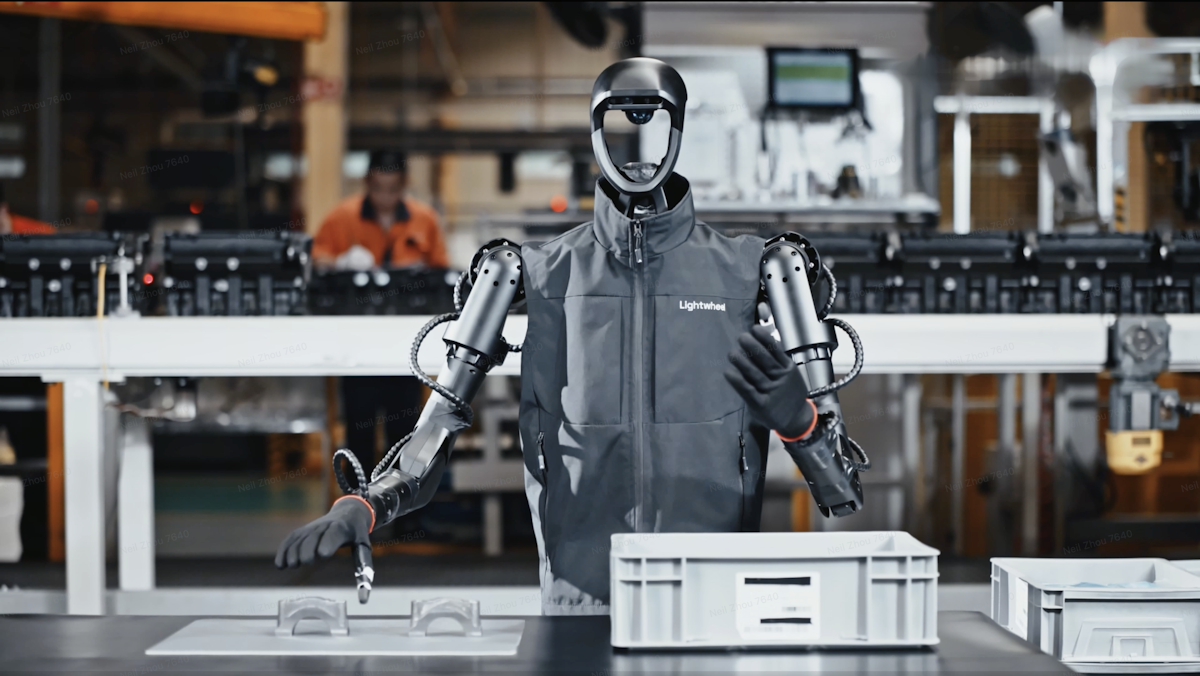
Lightwheel represents the final layer: continuous learning infrastructure that turns robot learning from a one-time pipeline into a continuous loop. The need traces to two hard problems. Robots have no fleet continuously generating training data the way autonomous vehicles do, and no internet-scale archive of physical interaction; nearly every demonstration is produced by people, one interaction at a time. Evaluation is just as hard; real-world trials are slow and labor-intensive, unable to keep pace with model evolution, while robot learning needs evaluation that is scalable, low-cost, and diverse in scenario coverage. So the loop robot learning needs never forms; failures in testing or deployment rarely change what gets collected or simulated next, and capability stops compounding. Physical AI training today runs open-loop. Lightwheel builds a closed Real2Sim2Real loop in which simulation does the work that physical trials cannot. EgoSuite captures large-scale human demonstrations and physical interaction data that transfer across robot embodiments and feed SimFoundry as real-world inputs. SimFoundry turns real tasks, objects, and physical properties into reusable simulation environments, with a physics measurement factory calibrating solvers and generated assets against measured contact, friction, and dynamics. RoboFinals tests policies across those Real2Sim scenes through repeatable, massively parallel rollouts, with failures diagnosable as missing behavior coverage, weak physical calibration, or new scenarios to add to training. RoboStack takes validated policies into deployment and returns rollout results, edge cases, and failures, triggering targeted collection, updated simulation assets, and harder evaluations. Deployment is not the end of the pipeline; it becomes the beginning of the next learning cycle. Together, the four products create a compounding loop: EgoSuite captures experience, SimFoundry reconstructs and expands it, RoboFinals measures capability and diagnoses failure, RoboStack deploys policies and returns feedback, and the next cycle begins. That makes Lightwheel less a data supplier than the connective tissue of robot learning; its value rests on making each cycle improve what gets collected, simulated, and tested next. The critical question is whether the loop closes as cleanly in operation as in architecture, since deployment feedback comes from inside customer operations and everything depends on robotics teams trusting the platform enough to let real-world results flow back.
The emergence of these five platforms reflects a fundamental shift in how physical AI infrastructure is organized. For most of the modern AI boom, infrastructure centered on compute—larger models required more GPUs, and the industry built itself around accelerators, cloud clusters, and training frameworks. That model sufficed when AI outputs were text, images, video, or code. Physical AI breaks that logic: a robot cannot simply run a model and return text; it must operate in a changing physical world, reason about contact and dynamics, act through a specific embodiment, and learn from failures. The development pipeline is correspondingly more complex, spanning real-world demonstrations, synthetic data generation, physics simulation, policy training, evaluation against structured scenarios, deployment, and continuous collection of failure cases.
Each of the five platforms addresses a distinct layer in this emerging stack, and together they suggest that physical AI infrastructure will remain fragmented by function rather than consolidating around a single provider. NVIDIA occupies the foundational layer—accelerated computing, simulation, and physics engines—but has extended upward into robot learning frameworks, foundation models, and policy evaluation. Applied Intuition brings validation engineering expertise from autonomous vehicles into broader robotics, converting real-world requirements into structured test systems. Scale AI industrializes the labor-intensive process of turning physical interactions into usable training data. Hugging Face LeRobot provides an open-source coordination layer, preventing each laboratory or startup from inventing its own storage format, dataset interface, and evaluation pipeline. Lightwheel closes the loop between deployment and retraining, enabling continuous learning rather than one-time training cycles.
The critical question is whether these platforms can remain horizontal—reusable across different robot makers, embodiments, and industries—or whether they will fragment into proprietary ecosystems. NVIDIA's dominance in compute gives it enormous leverage, but the company also has an incentive to pull the physical AI workflow toward its own software and hardware. LeRobot's openness creates a coordination mechanism, but open-source infrastructure requires durable governance and long-term maintenance. Applied Intuition's strength in autonomous vehicles may not translate equally well to manipulation and humanoid robotics, where behavior depends on language, contact dynamics, and long-horizon task reasoning. Lightwheel's loop depends on customers trusting the platform enough to return live deployment data. The outcome of these tensions will determine whether physical AI fragments into isolated ecosystems or coalesces around shared, reusable infrastructure.
AI-summarized, only the topics you pick — one digest a day via Email, Slack, or Discord.
Free · takes 30 seconds · unsubscribe anytime
The TAIONE Open Source Foundation was officially launched and will deploy NT$300 million(約480億円) in private-se…

China Steel Corporation affiliate CSCC has developed 6N high-purity isotropic graphite blocks for 8-inch and 1…

The 2026 World Artificial Intelligence Conference (WAIC) revealed that the automotive industry is moving away…

Central Taiwan Science Park's Erlin Park will begin operations of its first standard factory building in the s…

Hitachi announced the Agentic AI Integration Platform, which applies AI agents across the entire systems integ…

Amazon reported second-quarter net sales up 20%, with AWS cloud revenue rising 37% year over year to $42 billi…

The AI news that matters, in one minute each morning.
Sign up free