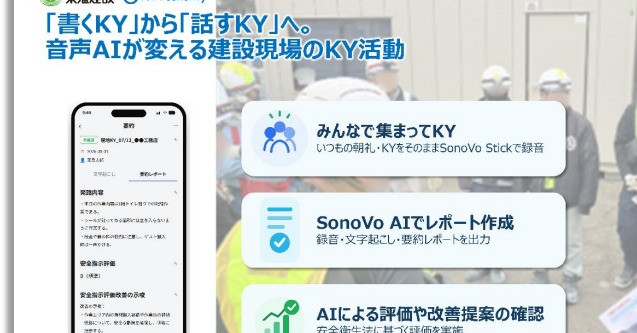
What happened
Tokyu Construction announced on August 31, 2026, that it will use NTT ConoSurf's voice AI and generative AI to digitize KY (hazard prediction) activities, with a pilot in fiscal 2026 and full rollout across all sites by fiscal 2027.
Why it matters
The move addresses issues where handwritten records lacked detail and were burdensome. In a trial from March to June 2026, the AI recorded and analyzed safety briefings, and workers rated the system highly for ease of use, with 100% confirming they would use it.
What to watch
The rollout hinges on whether the fiscal 2026 pilot leads to a full deployment across all sites by fiscal 2027, with worker adoption as the key test. Watch for the 100% confirmation rate from the March–June 2026 trial.
Summaries like this, in your inbox every morning.
The digitization of KY activities addresses a common problem: handwritten records were often incomplete and time-consuming to write, leading to missed details. By using voice AI to automatically record and transcribe safety discussions, Tokyu Construction aims to ensure accurate records and enable better analysis of hazards. The trial results suggest that workers find the system easier to use and that it encourages more careful attention to safety protocols.
The company plans to expand the system gradually, starting in fiscal 2026 and reaching all construction sites by fiscal 2027. This aligns with broader efforts to modernize construction site management through digital tools. While the article notes potential benefits like reducing time for safety confirmations and improving learning, it also mentions that some workers felt the AI might encourage over-reliance on its suggestions, missing details not in the manual. Overall, this move represents a step toward more efficient and data-driven safety management in construction.
For the industry, this adoption could signal a shift toward using AI not just for automation but for enhancing safety culture. The integration with other digital tools, such as DX (digital transformation) initiatives, suggests that construction firms are looking to leverage AI for more than just compliance—it may help in training and continuous improvement. However, the success will depend on how well the AI interprets nuanced conversations and whether workers fully trust its assessments.
Pick your industry and the AI tools you use, and get news related to your work every day.
Free · 30 seconds with Google · unsubscribe anytimeWhat is AIToday? →
Ask AI anything about this article. The AI reads this article, earlier AIToday articles, and Wikipedia, and cites its sources. Q&As are published on this page for other readers too.
Taiwan-based iBase Solution is expanding from industrial computers (IPCs) and energy storage into liquid-coole…

Setagaya Ward tested Genspark, an AI agent tool, and cut roughly 2,900 hours of work, according to Sho Miyama…

Anthropic said it will place 5% of its stock in the Anthropic Public Benefit Fund, pending shareholder approva…

Asian stocks mostly fell Monday after Wall Street's tech-led selloff, with the Nasdaq more than two percent do…

Mercedes-Benz and NVIDIA are expanding their partnership to jointly develop next-generation driver-assistance…

DeepSeek released Search and Fetch APIs on October 17, 2026, with each endpoint priced at $0.75 per 1,000 call…