What happened
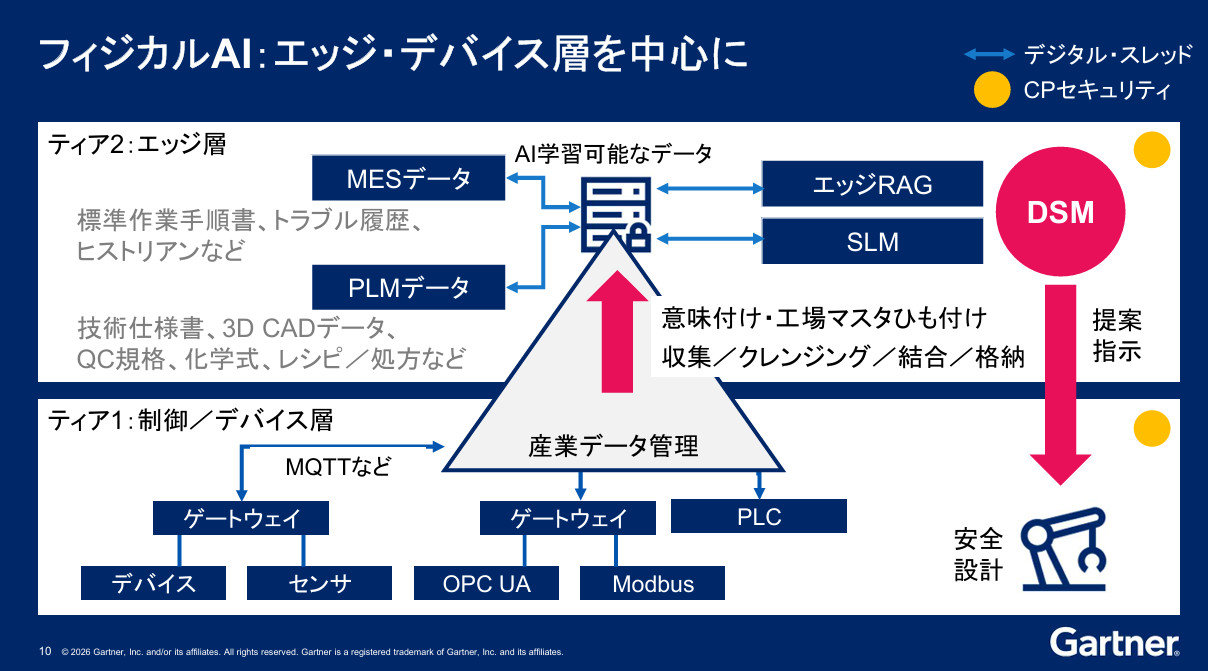
Gartner's Shikauchi described a three-layer physical AI stack (cloud, on-site device, edge) and a path from Human in the loop to Human on the loop to full autonomy, saying four human roles remain even after that.
Why it matters
The four roles he names — judgment and context, ethical judgment and empathy, creativity, and technical intuition — are the tasks AI cannot handle, so companies planning automation need to keep people in them.
Summaries like this, every morning.
Gartner's Shikauchi frames physical AI as a three-layer problem rather than a single technology. The cloud layer is where world models would be developed, the device layer puts AI directly into machines and requires safety measures, and the edge layer is where IT and OT meet for federated learning and local LLMs. He notes that the edge layer often stalls because it is unclear whether the IT or OT side should take the lead, and that this is not a Japan-only issue but appears globally.
A second difficulty he raises is the handoff from R&D to business. Some companies use physical AI only as an add-on or upsell to existing customers, while others that have built a methodology for moving from in-house proof-of-concept to commercialization hand it to business units or partners for external rollout. Gartner has grouped these approaches based on advanced companies' efforts, but Shikauchi says it is still unclear which path is correct.
On people, he describes a progression from Human in the loop to Human on the loop to full autonomy, while arguing the four remaining roles are exactly the inefficient-seeming ones that lead to new innovation. He also urges companies to fix their data foundations first, and compares preserving good old procedures to the periodic rebuilding of Ise Jingu, where old parts are renewed and passed on.
Pick your industry and the AI tools you use, and get news related to your work every day.
Free · 30 seconds with Google · unsubscribe anytimeWhat is AIToday? →
Ask AI anything about this article. The AI reads this article, earlier AIToday articles, and Wikipedia, and cites its sources. Q&As are published on this page for other readers too.
BlackRock's Jean Boivin said a slowdown in AI buildout would have a material real-economy impact, while Morgan…

Amphenol shares have climbed 15.8% year to date versus a 7.1% gain for the Zacks Computer and Technology secto…

Verizon CEO Dan Schulman said AI in customer service delivers a 1,200-basis-point or more improvement in custo…

Uber Engineering detailed a framework with three layers — provisioning through its Uber AI Registry, with sour…

QTS, backed by Blackstone, cut its planned private debt sale by about 60%, raising roughly $300 million instea…

ServiceNow selected Copilot Studio and launched a Microsoft AI Agent Creation Portal, where its makers can bui…