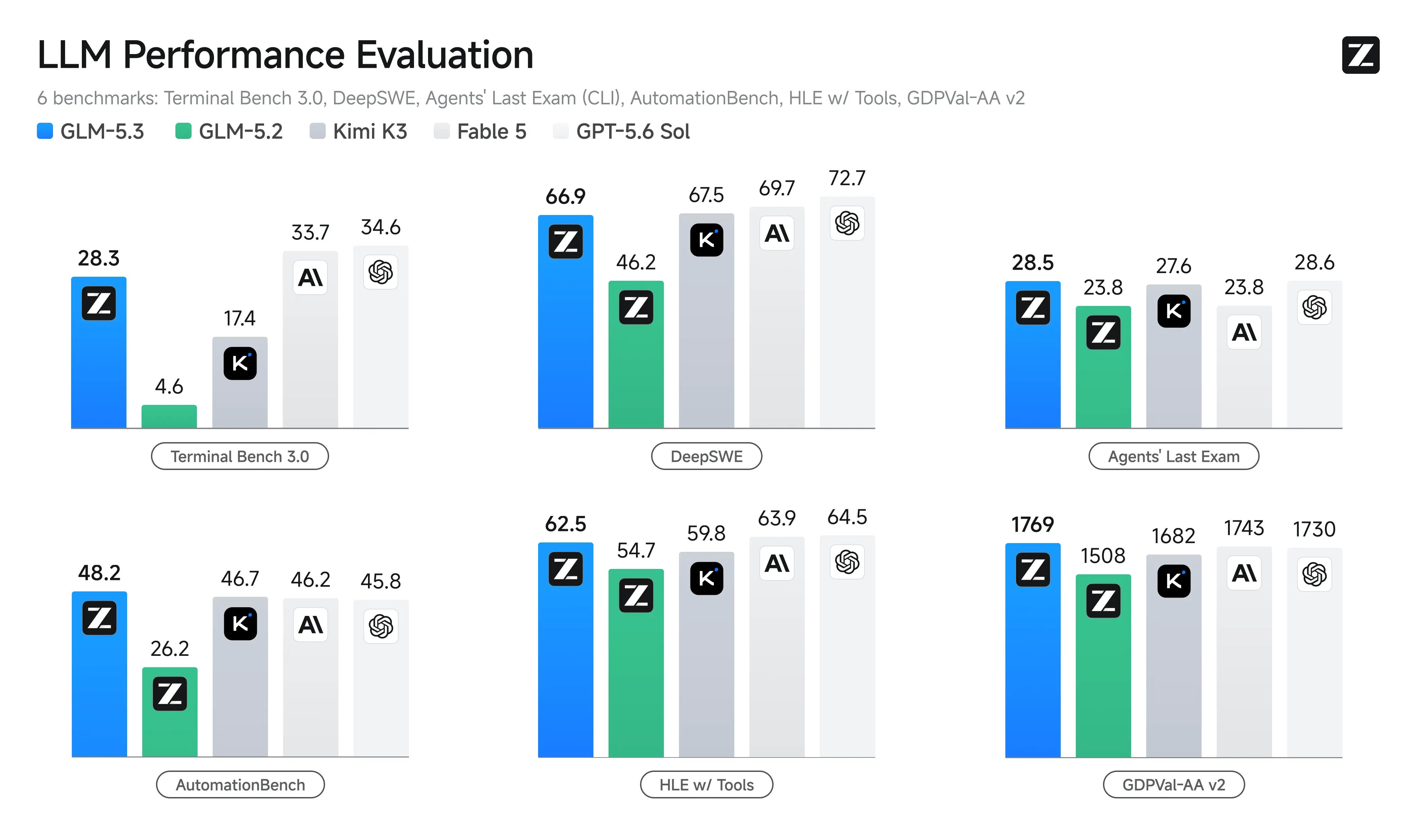
Z.ai released GLM-5.3, a ~750B-parameter model that matches leading American frontier models on many benchmarks despite being roughly a third the size of comparable competitors. The company achieved this by extending post-training rather than scaling the base model.
Industry observers attribute Chinese labs' ability to keep pace to their faster release cycles—they optimize on benchmarks during the months American companies spend on pre-release testing—rather than to distillation or other technical shortcuts.
The model's strong cybersecurity capabilities have prompted Z.ai to stage its public release through selected security partners before broader availability.
What happened
Z.ai announced GLM-5.3, a model with ~750B parameters that has surpassed Moonshot AI's Kimi K3 and matched or surpassed Claude Fable 5 or GPT-5.6-Sol on many benchmarks. The model is currently available only in the coding plan, coming to the API soon and to Hugging Face (open weights) in two weeks' time. Z.ai built GLM-5.3 by extending post-training on the same base model as GLM-5.2, with no change to the underlying architecture.
Why it matters
Z.ai achieves frontier-level agentic coding performance with roughly a third of Kimi K3's parameters, raising questions about how Chinese labs sustain competitive parity despite American companies' commanding resource lead. The article suggests speed of release—days rather than months—is the primary advantage: Chinese labs use the time American labs spend on pre-release testing to continue benchmarking optimization. As model self-improvement loops rely more on user data, faster release cycles could give Chinese models longer practical lifespans before displacement.
What to watch
Z.ai is taking a staged approach to GLM-5.3's availability due to its cybersecurity capabilities. Selected security partners will evaluate the model in controlled settings first; broader API access and full model weights will follow once safety evaluations are complete. The article notes that true open-weights release will eventually make staged safety measures less effective, as capability diffusion tends to follow the lowest common denominator across all labs.
Z.ai announced GLM-5.3 on the day of publication, marking a significant milestone in its ongoing GLM model line, which began at Tsinghua University in March 2021. The new model is remarkable for its efficiency: with approximately 750B parameters—roughly a third the size of Moonshot AI's Kimi K3—GLM-5.3 has surpassed Kimi K3 on many benchmarks and matched or surpassed Claude Fable 5 or GPT-5.6-Sol on some, placing it at the frontier of agentic coding benchmarks. Currently, the model is available only through Z.ai's coding plan. It will reach the API soon and arrive on Hugging Face as open weights in two weeks' time.
Z.ai's blog post emphasizes simplicity in its development approach: "Scaling post-training is all we did for GLM-5.3." The model uses the same base architecture as GLM-5.2 (released June 22 of this year), which itself was widely praised by AI researchers for its speed and lack of rollbacks when deployed on internal clusters. The post-training extension followed an RL-dominated training regime, with Z.ai using "more environments, more diverse tasks, and more compute spent training on them." This approach differs sharply from distillation—the extraction of knowledge from frontier models—which the article argues is neither feasible at scale for RL environments nor the primary mechanism driving Chinese labs' competitive standing.
The article identifies release speed as the decisive factor in Chinese labs' ability to keep pace with American competitors. Z.ai typically releases models within days of completion, while OpenAI and Anthropic take months between final development and public availability. During these months, Chinese labs use the time to conduct extensive benchmarking optimization, hillclimbing on test-set performance without access to the final American model's full capabilities. The author notes that SpaceX's AI efforts (referenced as "SpaceXAI") may operate on a similar faster cycle. As model development increasingly incorporates user-generated feedback loops, this timing advantage could compound significantly: Chinese models with faster release cycles would accumulate more user data before displacement by the next American generation, extending their practical market lifespans and market share.
The article acknowledges that Z.ai likely engages in subtle benchmaxxing—the industry-standard practice of prioritizing optimization on public benchmarks such as the Artificial Analysis Intelligence Index, which directly affect stock valuation, fundraising, and team morale. However, the author distinguishes this from intentional overfitting that renders models unusable in practice. Every lab operates under rough edges of scaling RL; Anthropic's Opus 5 and Sonnet 5 models have received "very mixed reputations" outside of their advertised benchmark scores, yet "the benchmark scores in their release blogs are the real deal." GLM-5.3 is described as a narrower model than Claude Fable or GPT Sol—lacking visual capabilities and focused on coding and cybersecurity—which makes optimizing its post-training "far easier" despite stronger overall models requiring support for countless use-cases. Z.ai, however, reportedly reached $1B in annual recurring revenue on the strength of on-premises deployment, indicating substantial real-world demand beyond benchmark optics.
A critical development noted in the article is the rapid growth of the RL data industry in China, driven by American data companies selling RL environments and training infrastructure to Chinese model labs. This market allows labs like Z.ai potentially to acquire the same RL environments and infrastructure used by American frontier labs, then release the downstream RL'd model sooner—further compressing the effective gap in model quality perception. The scale and impact of this market remain uncertain, but the trend is becoming important.
GLM-5.3's cybersecurity capabilities represent both a capability milestone and a safety concern. Z.ai states that GLM-5.3 "delivers substantial improvements in vulnerability discovery, exploit analysis, and complex multistep security tasks" and can "help defenders identify weaknesses earlier, validate risks, and accelerate remediation." However, the company acknowledges clear dual-use risks. Z.ai is implementing a staged release: selected security partners will evaluate GLM-5.3 in controlled settings first, with broader API access and full model weights following once safety evaluations and release preparations are complete. In the interim, Z.ai monitors inference via request classifiers and chain-of-thought monitoring on top of model alignment. The author notes that this staged approach becomes less effective once open weights are published, as downstream users can freely deploy the model without safeguards. The article concludes that industrial-scale guidance led by government or industry coalitions will be necessary to prepare for capability diffusion across the software ecosystem, as no single company can manage the transition alone.
Z.ai's announcement of GLM-5.3 has reignited debate about how Chinese labs sustain competitive parity with American frontier AI companies despite the latter's far larger resource bases. The article identifies the key differentiator not as technical superiority or distillation (the commonly cited explanation), but as release speed. Chinese labs, including Z.ai, operate on a cycle measured in days or weeks from completion to public availability, whereas OpenAI and Anthropic typically take months between model completion and public release. This gap allows Chinese labs to conduct extensive benchmarking optimization during periods when American labs are performing internal safety testing and validation. Critically, as model development increasingly relies on user-generated feedback loops to improve capabilities, this timing advantage could compound: longer product lifespans due to faster initial release would give Chinese models more time to collect real-world usage data before the next-generation American model arrives.
The article also acknowledges secondary factors that likely contribute to Z.ai's performance-per-parameter efficiency. Z.ai is described as an "extremely skilled LLM organization" with deep ties to Tsinghua University and a long development history on the GLM model line (dating to 2021). The company likely benefits from what the author calls "subtle benchmaxxing"—a common industry practice where labs weight their optimization efforts toward public benchmarks that directly affect capital-raising and team morale. The article distinguishes this from egregious overfitting, noting that GLM-5.3's benchmark scores "are the real deal." Additionally, GLM-5.3 is narrower in scope than American flagship models: it lacks visual capabilities and appears optimized for coding and cybersecurity tasks, whereas Claude and GPT models serve diverse use-cases across many industries and modalities. This narrower focus makes the final post-training assembly "far easier."
The cybersecurity dimension introduces a new consideration. Z.ai explicitly positions GLM-5.3 as its "most capable model to date for cybersecurity tasks" and is staging its release through security partners first. However, the article closes with a sobering note: once open weights are published, staged safety measures become largely symbolic, as the model can be freely deployed without safeguards by any downstream user. The author argues that individual company efforts, however diligent, cannot manage capability diffusion in the long run—only industry-wide coordination or government-led guidance can address the transition toward smaller, more easily modified models with dual-use capabilities.
AI-summarized, only the topics you pick — one digest a day via Email, Slack, or Discord.
Free · takes 30 seconds · unsubscribe anytime
Ask AI anything about this article. Q&As are published on this page for other readers too.
Anthropic will offer a watermark detection API allowing third-party developers to identify text created by Cla…

A developer released Dictata v0.1.0, a Windows application that transcribes speech locally using Whisper (an A…

WeaveScope, a tracing and monitoring platform for Elixir-based AI agents, entered early access

Osaurus, an MIT-licensed application, launched version 0.22.22 today

An essay compares large language model (LLM) training to baking bread, specifically cold-proofed focaccia

A GitHub repository has released a modular Python framework implementing classical AI algorithms—including sea…

The AI news that matters, in one minute each morning.
Sign up free