Reports have surfaced of Claude Code (Anthropic's AI coding assistant feature) producing lower-quality code in production scenarios than expected. Users and developers have documented cases where Claude generates code that looks correct on the surface but contains logic errors, security vulnerabilities, or fails to handle edge cases when actually run.
The gap appears between how Claude performs in controlled benchmarks (test environments) versus how it behaves when writing code for real applications. This mirrors a known challenge in AI: models that ace test scores sometimes struggle when faced with messy, unexpected real-world requirements—like handling unusual input formats or integrating with existing legacy systems.
For developers considering Claude Code as a primary coding tool, this signals you still need to carefully review and test any generated code, rather than trusting it as a drop-in productivity multiplier. For companies evaluating AI-assisted development platforms, this is a reminder that benchmark performance alone doesn't predict production reliability—human code review remains essential.
Ask the AI about this article →
For example, today's edition would include:
AI-summarized, only the topics you pick — one digest a day via Email, Slack, or Discord.
Free · takes 30 seconds · unsubscribe anytimeWhat is AIToday? →
Ask AI anything about this article. Q&As are published on this page for other readers too.
CrowdStrike is introducing Falcon Guardian, its flagship solution for the AI Detection and Response (AIDR) cat…

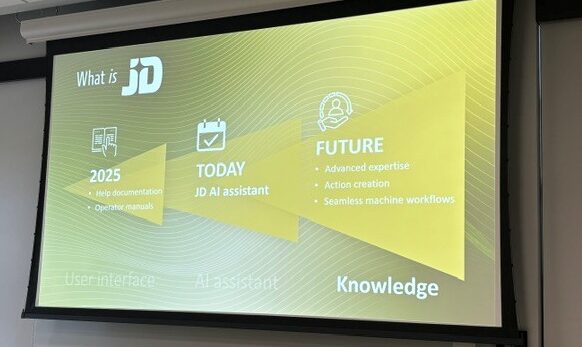
John Deere introduced its AI assistant, 'JD,' on Monday, embedded in its Operations Center

John Deere is introducing an AI assistant called JD
AT&T, Dell Technologies, and AMD have announced OTel 2.0, the largest and best-performing open-source model bu…

AT&T's legal department built an in-house center of expertise called Legal Edge, described as an AI-first lega…

Studio Inc. announced Agentic Web Platform Studio.Drop and opened pre-registration today for a closed beta sta…