What happened
KDDI Group's ELYZA released ELYZA-Thinking-1.0-llm-jp-4-33b and ELYZA-Thinking-1.0-llm-jp-4-32b-a3b for free on October 2 via Hugging Face, built on NII's LLM-jp-4 series.
Why it matters
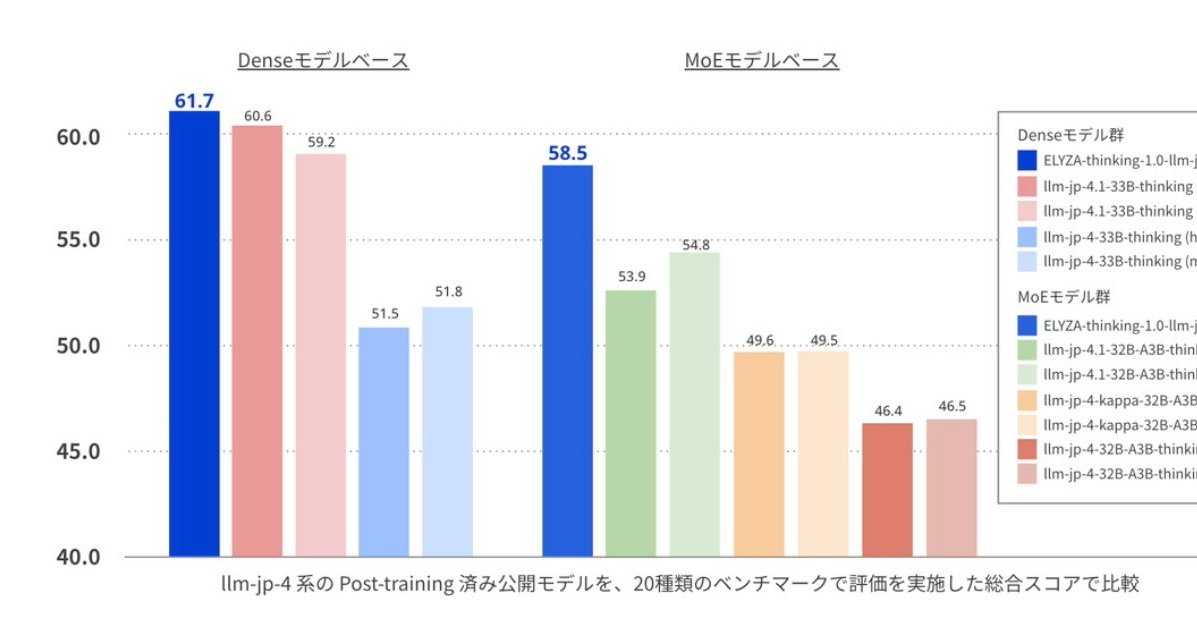
ELYZA said the two models scored above NII's improved LLM-jp-4.1 on some benchmarks, suggesting outside customization can lift a base Japanese model's results.
What to watch
The models' practical value hinges on which benchmarks and tasks they were measured against, since only 'some benchmarks' are cited. The same release also launched ELYZA RSI Research, whose recursive self-improvement goal is still described as pre-stage.
WHO IT HITSJapanese enterprises and public-sector teams that want to run or fine-tune domestic AI models for Japanese-language tasks gain a free, commercially usable option under Apache 2.0. Researchers tracking Japan's domestic model ecosystem will watch whether ELYZA's post-training gains hold up outside the benchmarks it cited.
Summaries like this, in your inbox every morning.
ELYZA built these models by taking the LLM-jp-4 series—an open model developed by Japan's National Institute of Informatics—and running additional intermediate and post-training focused mainly on Japanese-language processing. That approach matters because it lets a company specialize an existing open base rather than train from scratch.
The claim that the two models outperform NII's own improved version, LLM-jp-4.1, on some benchmarks is notable because LLM-jp-4.1 was only announced on September 28, just days before. It suggests the gap between a research institute's base model and a corporate post-trained version can be narrow, though the benchmarks in question are not named here.
The release is also tied to ELYZA's new ELYZA RSI Research organization, which pursues recursive self-improvement. ELYZA describes that effort as still at an element-research stage, so readers should treat the RSI framing as a long-term direction rather than an achieved capability. The practical test will be how the two models perform on real Japanese tasks, not just on the cited benchmarks.
Pick your industry and the AI tools you use, and get news related to your work every day.
Free · 30 seconds with Google · unsubscribe anytimeWhat is AIToday? →
Ask AI anything about this article. The AI reads this article, earlier AIToday articles, and Wikipedia, and cites its sources. Q&As are published on this page for other readers too.
Intel jumped as much as 14% intraday to $123.82 and gained over 11% after Meta's Muse AI agent boosted expecta…
Bank of America shares fell about 1.3% to $53.72 on October 1 after Reuters Breakingviews raised the possibili…

Morgan Stanley reinstated Nvidia as its Top Pick in semiconductors after meetings with CEO Jensen Huang and CF…
GE Vernova expects to raise gas-turbine production from about 20 gigawatts a year today to 24 gigawatts in 202…

Apple researchers' RLTL;DR method has a policy write a TL;DR insight after each failed attempt, then backpropa…

Johnson & Johnson advanced its gene therapy candidate Botaretigene sparoparvovec for X-linked retinitis pigmen…