AIToday

AI farm tech cuts fertilizer use 30%, market headed to $17.20B by 2033

Top Companies AI — US (2/2)4h agoSend on LINE
AI farm tech cuts fertilizer use 30%, market headed to $17.20B by 2033

Key takeaway

Artificial intelligence is automating how tractors and farm equipment apply inputs—fertilizer, pesticide, water—by analyzing soil conditions, moisture, and pest pressure field-by-field rather than applying uniform rates across an entire farm. Field research shows this variable-rate approach cuts fertilizer use by 10–30% while maintaining or boosting yield. The Global Precision Farming Market is expected to grow from USD 11.38 billion in 2025 to USD 17.20 billion by 2033, driven by rising fertilizer costs, environmental regulations, and major equipment makers embedding AI directly into machinery.

Summaries like this, in your inbox every morning.

Sign up free →

3 Key Points

  • What happened

    Variable-rate application (VRA)—AI that uses satellite imagery, soil sensors, and real-time data to apply seed, fertilizer, and water precisely to each patch of a field—is driving growth in the Global Precision Farming Market, projected to expand from USD 11.38 billion in 2025 to USD 17.20 billion by 2033 at a CAGR of 5.5%. Equipment makers including John Deere, AGCO, CNH Industrial, and Trimble are embedding this technology directly into tractors and sprayers.

  • Why it matters

    Field studies show AI-driven VRA cuts fertilizer use by 10–30% while maintaining or improving yield, and pesticide use drops up to 20%. For growers, fertilizer cost volatility and environmental pressure to reduce nutrient runoff make this efficiency critical; for manufacturers, it marks a shift from precision farming as an add-on service to a built-in machine capability that improves farm economics at scale.

  • What to watch

    The U.S. leads with 31.2% market share, followed by China at 13.8%, while India (3.8% share) represents an emerging growth opportunity through drone subsidies and digital agriculture programs. Variable Rate Technology (14.7% share) and IoT (13.4%) are expanding fastest as growers seek to optimize input costs.

In Depth

The Global Precision Farming Market is expected to grow from USD 11.38 billion in 2025 to USD 17.20 billion by 2033, with a compound annual growth rate of 5.5%, driven by a fundamental shift in how farmers apply inputs to their fields. Rather than treating an entire cornfield uniformly—a practice that persists despite soil types, moisture levels, and pest pressures varying across each field—AI-powered variable-rate application (VRA) calculates exactly how much seed, fertilizer, pesticide, or water a specific patch actually needs by analyzing satellite imagery, drone-based multispectral imaging, soil nutrient mapping, weather forecasts, GPS guidance, and IoT sensor data.

Field studies and academic research document the measurable impact. AI-driven VRA can reduce fertilizer usage by 10–30% while maintaining or improving yield, according to research from the International Society of Precision Agriculture. Pesticide application decreases by up to 20% under variable-rate systems, irrigation water needs drop 15–25% with precision water management, and yield increases of 5–15% have been recorded depending on crop type and field variability. The USDA has tracked steady growth in precision agriculture adoption—yield monitors, GPS guidance, and variable-rate systems—particularly among large-scale corn and soybean operations where input savings at scale translate into meaningful cost reduction.

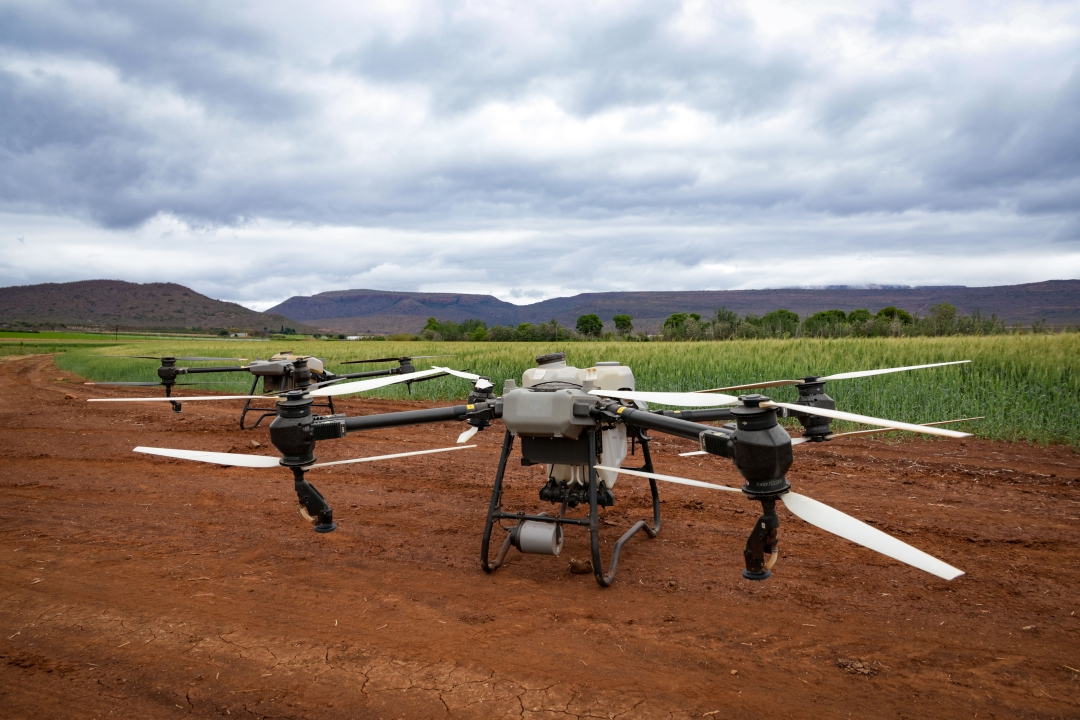
Major agricultural equipment manufacturers are racing to embed this capability directly into machines rather than waiting for third-party software to catch up. John Deere, AGCO, CNH Industrial, and Trimble are all building machine learning and real-time analytics into sprayers, seeders, and autonomous machinery to automate variable-rate decisions on the fly. This represents a meaningful shift from precision farming as an add-on service toward precision farming as a built-in machine capability, driven by fertilizer price volatility, government pressure to reduce nutrient runoff and greenhouse gas emissions, and grower demand for input efficiency.

Geographically, adoption is concentrated but spreading. The United States leads decisively with a 31.2% market share, driven by widespread GPS-guided tractors and AI farm management platforms across large commercial operations. China holds second place at 13.8%, propelled by substantial government investment in digital agriculture through national smart farming initiatives. Canada's 7.9% share rests on large-scale wheat and canola cultivation suited to variable-rate techniques, while Germany (6.8%) and France (5.4%) lead European adoption, pushed partly by environmental regulation rewarding input optimization. Australia's 5.9% share reflects a distinct driver: water scarcity makes IoT-enabled irrigation especially valuable. Brazil (4.9%) continues expanding precision technology use across soybean, corn, sugarcane, and coffee production, Japan (4.3%) is leaning heavily into robotics to offset an aging agricultural workforce, and India (3.8%) is an emerging growth story built on drone subsidies and digital agriculture programs, despite limited smallholder penetration. Across the technology stack, GPS holds an estimated 18.5% share as the foundational technology for navigation and auto-steering, but the fastest growth is in Variable Rate Technology (14.7%) and IoT (13.4%) as growers optimize inputs against rising costs. Artificial Intelligence itself—predictive analytics, computer vision, autonomous decision-making—has captured a 9.8% share as manufacturers build these capabilities directly into equipment, while Machine Learning (5.9%), Big Data Analytics (5.3%), Remote Sensing (11.8%), GIS (10.2%), Robotics & Automation (4.7%), and emerging technologies like cloud computing, edge computing, blockchain, and 5G (together under 6%) are positioned to expand as connected farm ecosystems mature.

Context & Analysis

Precision farming has long promised field-by-field optimization, but the technology to deliver it at scale is only now maturing. Variable-rate application—the practice of applying different amounts of inputs to different patches based on real-time soil and weather data—historically required manual field zoning and labor-intensive mapping. AI changes that equation by automating the analysis of satellite imagery, drone multispectral scans, soil nutrient maps, and IoT sensor readings in real time, then directing equipment to adjust application rates on the fly. This integration directly into equipment rather than as a separate software layer is the key shift: John Deere, AGCO, CNH Industrial, and others are embedding the decision-making into tractors and sprayers themselves, making precision farming a default capability rather than an add-on.

The economic and regulatory tailwinds are substantial. Fertilizer price volatility creates immediate pressure on grower margins, while environmental rules targeting nutrient runoff and greenhouse gas emissions reward input efficiency. Field evidence supports the payoff: research shows 10–30% fertilizer cuts while yield holds or improves, plus pesticide reductions up to 20% and irrigation water savings of 15–25%. For large-scale corn and soybean operations in the U.S.—which account for much of the current 31.2% market share—those savings compound across thousands of acres. Emerging markets like India, where government subsidies for drones and digital agriculture are spreading, represent significant upside, even though smallholder penetration remains limited today.

FAQ

How much fertilizer can be saved with AI variable-rate farming?
Field studies and academic research show AI-driven variable-rate application can reduce fertilizer usage by 10–30% while maintaining or improving yield, according to research from the International Society of Precision Agriculture.
Which companies are building this technology?
Major agricultural equipment manufacturers John Deere, AGCO, CNH Industrial, and Trimble are embedding machine learning and real-time analytics directly into sprayers, seeders, and autonomous machinery. Specialist firms include Farmers Edge, CropX Technologies, Taranis, Arable Labs, DJI, and AgEagle Aerial Systems.
Which countries lead in adoption?
The United States leads with 31.2% market share, followed by China at 13.8%, Canada at 7.9%, Germany at 6.8%, and France at 5.4%. India, at 3.8% share, is an emerging growth story built on drone subsidies and digital agriculture programs.

Get the latest Robotics news every morning

AI-summarized, only the topics you pick — one digest a day via Email, Slack, or Discord.

Free · takes 30 seconds · unsubscribe anytime

Discussion

No comments yet. Be the first to share your thoughts!

Log in to join the discussion

Related Articles

Stay ahead with AI news

Get curated AI news from 200+ sources delivered daily to your inbox. Free to use.

Get Started Free

Free · takes 30 seconds · unsubscribe anytime