AIToday
Large Language ModelsTechCrunch AIPublished: Aug 4, 2026, 04:00 JST4 min read

Apple's AI-powered Siri finally arrives—but the moment has passed

Apple's AI-powered Siri finally arrives—but the moment has passed

Key takeaway

  • Apple released a redesigned, AI-powered Siri in iOS 27's beta in July after years of delays.

  • The assistant now understands personal context stored on your iPhone, answers general questions, and completes tasks like finding photos or playing music—finally delivering what Apple promised years ago.

  • While the update is genuinely useful, it arrives at a time when the broader AI industry has moved well beyond functional chatbots to agents that code, reason, and tackle complex multi-step problems, making Siri's debut feel incremental rather than groundbreaking.

3 Key Points

  1. What happened

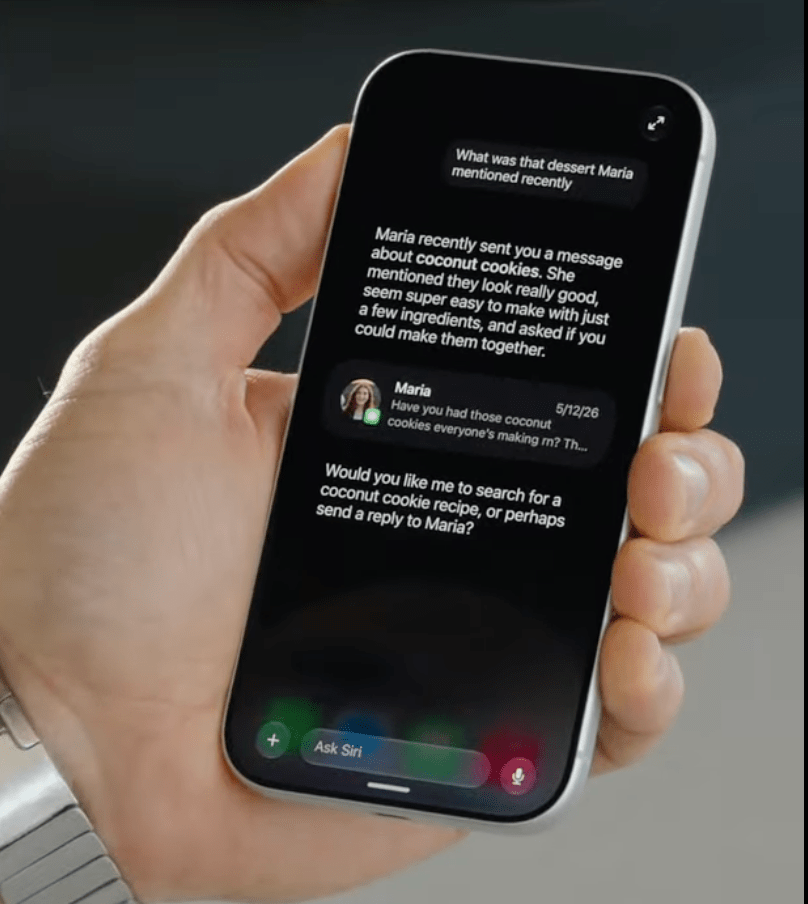
    Apple released a redesigned Siri with AI capabilities in the iOS 27 consumer beta in July. The assistant now understands personal context on your iPhone, answers general knowledge questions, holds natural conversations, and can complete tasks like finding photos, playing music, or getting directions—capabilities it has struggled with for years.

  2. Why it matters

    Siri's overhaul delivers on Apple's long-standing promise to make the assistant genuinely useful, powered by Apple's own Foundation Models trained with Google's Gemini technology. However, the arrival feels less momentous than it might have, since AI assistants have already advanced far beyond simple helpers—today they code, build software, complete multi-step reasoning tasks, and work alongside users on complex work.

  3. What to watch

    iOS 27 is expected to launch officially in September, when the general public gains access to the new Siri. The redesigned assistant will be available across iPhone, with options to adjust voice expressivity and pacing, type instead of speak, or use it via a dedicated app that can reference past conversations.

In Depth

Read the full story

After repeated delays, Apple finally deployed a redesigned, AI-powered Siri in the iOS 27 consumer beta in July. The updated assistant represents a fundamental shift in how Siri works. It can now engage in natural, multi-turn conversations with adjustable voice expressivity and pacing settings, support typing as an alternative to voice, and reference past conversations via a dedicated app for the first time.

The most consequential improvements center on context understanding. Siri can now search your personal data—photos, emails, contacts, texts, calendar events—to locate information even when you don't recall its exact location or storage method. For example, asking it to pull up your last saved receipt will work without specifying where the receipt was stored. The assistant can also parse information from photos you've taken, such as extracting a driver's license number from a photo of your license or recognizing a QR code you screenshotted. Beyond personal data, Siri can answer general knowledge questions, help you brainstorm ideas, suggest recipes based on ingredients in your fridge, tell you when your favorite band is performing, and complete practical tasks like launching apps, getting directions, playing music, editing photos, drafting emails, and even splitting restaurant bills via the Camera viewfinder.

A particular point of improvement is music playback. The old Siri frequently failed to play the correct song, podcast, or audiobook on the user's preferred app; the new version now handles this consistently and accurately. Apple achieved this leap by partnering with Google for access to Gemini AI models, which it then used to train and refine its own proprietary Apple Foundation Models. These models are engineered to run on Apple's own Silicon and Private Cloud Compute infrastructure, balancing capability with the company's privacy commitments.

Despite delivering a genuinely functional and capable assistant, the broader reception has been muted. The improvement reads as a long-overdue fix to a chronic problem rather than a transformative advance. The AI landscape has shifted dramatically in the years Apple spent iterating: AI tools now generate and refine code, autonomous agents complete complex multi-step workflows, and AI systems reason, remember, create media, and work alongside users in ways that transcend simple question-and-answer interaction. Being a competent chatbot no longer constitutes a breakthrough. The general public will gain access to the new Siri when iOS 27 launches officially in September.

Context & Analysis

Siri's struggle has been a defining friction point in Apple's ecosystem for over a decade. The new AI-powered version finally addresses the core complaint: a voice assistant that actually understands what you're asking and can reliably complete tasks. By leveraging Google's Gemini technology as a foundation, Apple was able to build models tailored to its own hardware and privacy infrastructure, sidestepping years of internal R&D delays. The partnership signals a pragmatic choice—rather than develop from scratch, Apple integrated proven AI capability and adapted it to its devices.

Yet timing matters enormously in technology. Siri's arrival in July 2024 lands in a landscape transformed by rapid AI progress. Conversational chatbots and personal assistants have become table stakes; the frontier has moved to AI agents that tackle multi-step reasoning, code generation, and autonomous task completion. Apple is solving a problem that once felt urgent—making Siri work at all—just as the industry's definition of "useful AI" has expanded significantly. The result is a correction rather than an innovation: Siri is now the assistant it should have been years ago, but that alone no longer qualifies as a leap forward.

FAQ

When will regular iPhone users be able to use the new Siri?
iOS 27 is expected to launch officially in September, at which point the general public will gain access to the new Siri. It is currently available in the consumer beta build.
How does Apple's new Siri work differently from the old one?
The new Siri understands your personal context and can find things on your iPhone like photos, emails, contacts, texts, and calendar appointments even when you're not sure where they are stored. It can answer general knowledge questions, hold natural back-and-forth conversations, understand things you've saved as photos (like a driver's license number), and consistently play the song or podcast you request—tasks the old Siri frequently failed at.
What technology powers the new Siri?
Apple partnered with Google to use Gemini AI models to train and refine its own proprietary Apple Foundation Models, which are designed to run on Apple's Silicon and Private Cloud Compute infrastructure.

Get the latest Large Language Models news every morning

AI-summarized, only the topics you pick — one digest a day via Email, Slack, or Discord.

Free · takes 30 seconds · unsubscribe anytime

Ask AI

Ask AI anything about this article. Q&As are published on this page for other readers too.

Related Articles

Next articleFormula 1 cuts data integration from 8 weeks to 40 minutes with AI agents on AWS

The AI news that matters, in one minute each morning.

Sign up free