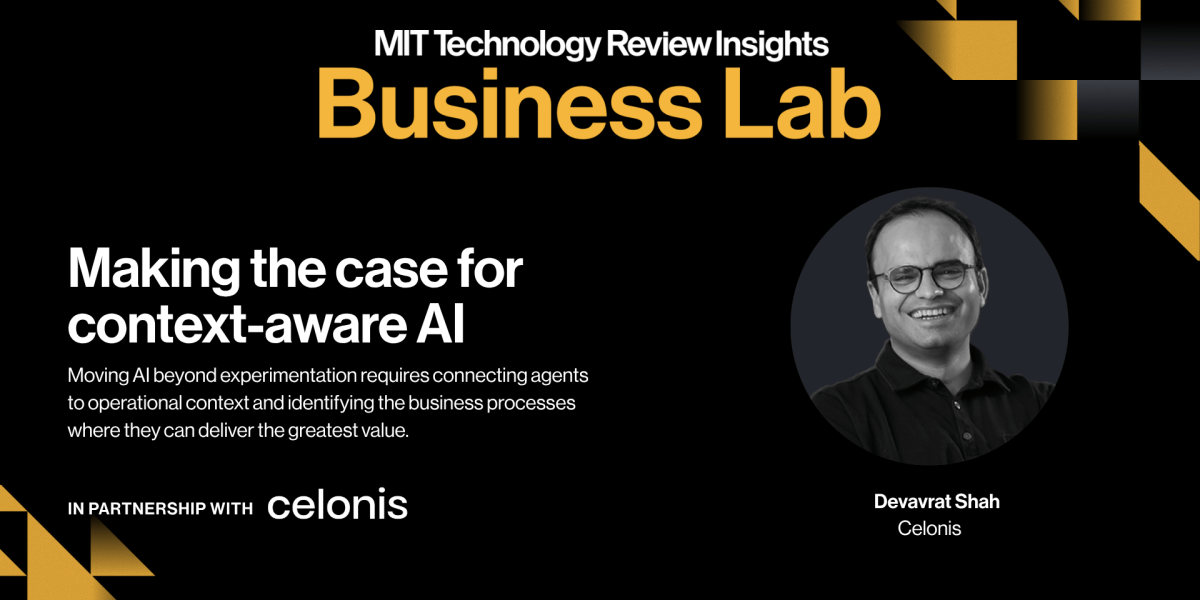
What happened
Devavrat Shah, chief scientist of enterprise AI at Celonis, said on MIT Technology Review's Business Lab podcast that AI agents lack operational context and are performing at a significant deficit, applying generalized principles to specialized scenarios and coming up short.
Why it matters
Without operational context, agents risk overlooking important constraints, making costly mistakes, or consuming excessive computing resources as they try to work out what they need to know, Shah said.
Summaries like this, in your inbox every morning.
Shah's comments come as enterprise AI moves from experimentation to everyday operations, a transition he describes as being at a crossroads after years of demos and pilots. His argument is that the technology's biggest impact will come in decision-making, where AI agents can support individual tasks within larger processes rather than replace whole decisions. He frames this as bringing “decision intelligence” to enterprises, an approach that depends on connecting AI to the processes and data companies already use.
Celonis's background is in process intelligence, helping organizations adhere to ideal processes and re-engineer them. Shah describes extending that to decision intelligence by having agents take on atomic steps that experts previously handled, with a context layer designed to abstract the systems below and guardrail the agents above. He notes that connecting to existing systems of record and workflow tools requires classical information security review before a vendor's software can be trusted inside an organization.
Looking ahead, Shah expects the shift to free people from repetitive manual work and coordination tasks so they can focus on strategic decisions, while cautioning that workforce education must keep pace. He points to enterprise-wide planning in finance, workforce management, marketing, and sales as areas where faster, better-informed decisions could matter most, suggesting annual planning cycles may no longer need to take a full year.
Pick your industry and the AI tools you use, and get news related to your work every day.
Free · 30 seconds with Google · unsubscribe anytimeWhat is AIToday? →
Ask AI anything about this article. The AI reads this article, earlier AIToday articles, and Wikipedia, and cites its sources. Q&As are published on this page for other readers too.
Action State Group Inc. launched open-source EvidenceBook, Terms Packs and Countersign so companies can cross-…

Egis Group and SiPearl formally signed a strategic CPU partnership at the Egis Group TechDay Taiwan-France cer…

Startups Electric Twin, Artificial Societies, GWI and Toluna are using data from real focus groups and surveys…

DeepSeek raised around $15 billion in one of China's biggest-ever financing rounds, after twice increasing its…
US stock futures and Asian markets fell on fears the AI boom is turning to bust, as an Australian data center…

Meta is creating a new class of nonvoting stock, first reported by Semafor, so Zuckerberg can issue shares for…