What happened
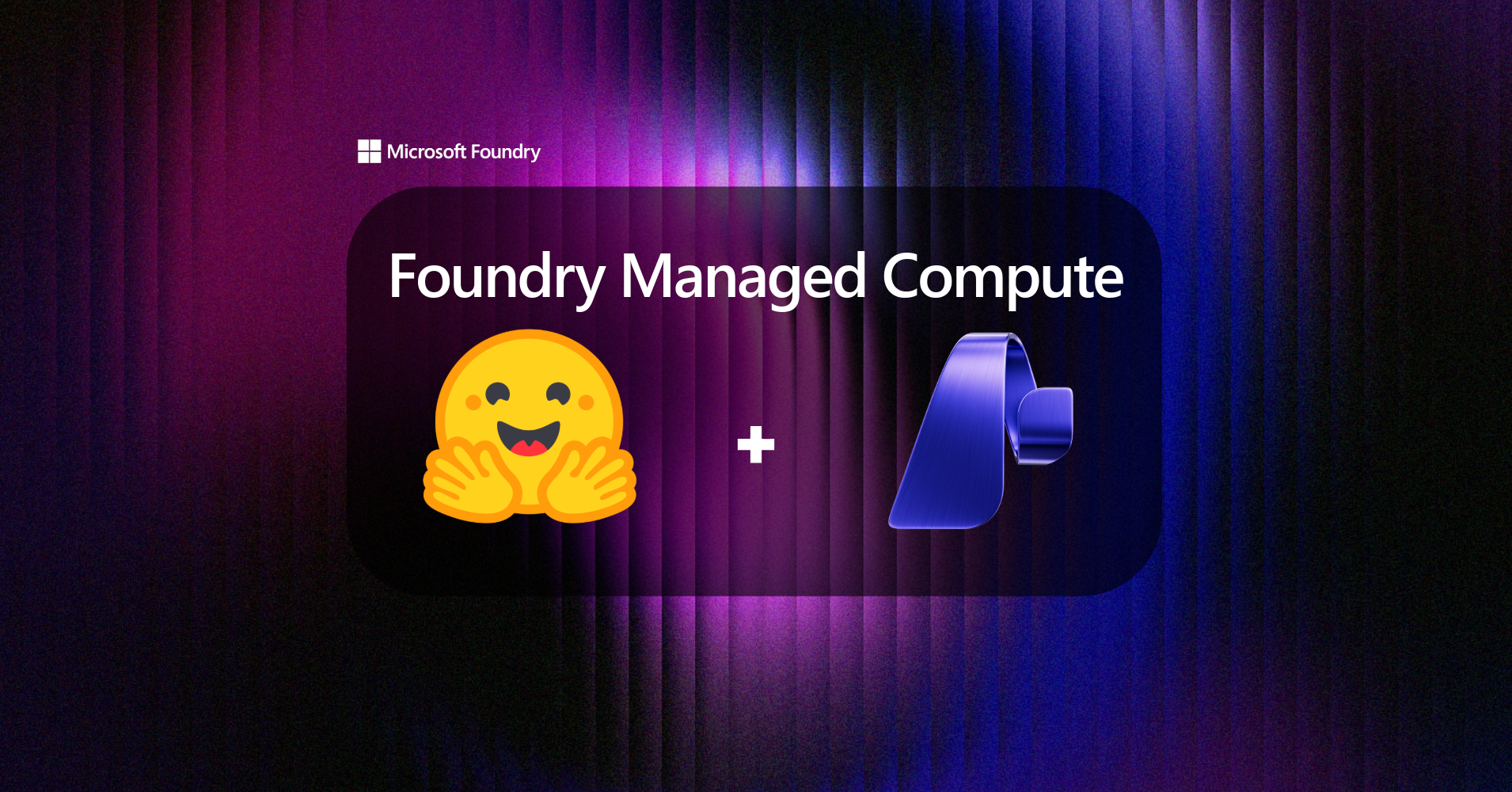
Microsoft announced at Build 2026 that Hugging Face open-weight models are now available on Foundry Managed Compute — a curated catalog refreshed weekly and deployable in one click, with weights pre-staged in Azure and runtimes built and scanned by Microsoft.
Why it matters
Open models have closed the gap with proprietary models on benchmarks, and this integration removes the operational burden — license review, security screening, runtime selection, GPU sizing, and CVE patching — that has historically made deploying them enterprise-grade difficult. Developers can now run open models on infrastructure they control, with the same endpoint, SDKs, authentication, and observability as frontier models.
What to watch
The catalog spans every modality — text, vision, audio, and multimodal — with runtimes including vLLM, SGLang, TensorRT-LLM, NIM, TEI, and llama.cpp. Every model ships in SafeTensors format with no untrusted code execution paths unless rigorously reviewed, and supports both global deployments and data-zone deployments for residency and sovereignty.
Summaries like this, in your inbox every morning.
Hugging Face has established itself as the public hub for open-source AI models, with 15 million builders, 400,000 organizations, and over 3 million published models. However, the platform itself has never provided enterprise-grade serving infrastructure — organizations wanting to run these models in production face fragmented choices: license compliance, security review, container image building, runtime selection, CVE patching, and standing up endpoints with observability and governance. This announcement addresses that gap by having Microsoft absorb the operational layer.
The move is significant because it treats open models as full first-class citizens within Foundry's existing architecture. Developers can now mix open-weight and frontier models (from OpenAI, Anthropic, Meta, Mistral, DeepSeek) in a single agent without a separate integration path, using the same Python, C#, JavaScript, and Java SDKs, the same endpoint, and the same billing and observability surface. The weekly refresh cycle and multi-stage curation pipeline — compliance screening, security scanning, runtime optimization, weight validation, and API/performance testing — transfer toil from the developer to Microsoft's platform team, lowering friction for enterprises.
Pick your industry and the AI tools you use, and get news related to your work every day.
Free · 30 seconds with Google · unsubscribe anytimeWhat is AIToday? →
Ask AI anything about this article. The AI reads this article, earlier AIToday articles, and Wikipedia, and cites its sources. Q&As are published on this page for other readers too.
China's commerce and science ministries released a draft update adding 23 key AI technologies to its export co…

Vercel data published Thursday shows TypeSafe AI's Jev, a lightweight decision model for choosing among predet…
Reflection AI introduced Beam, an open-weight model for agentic coding and long-horizon tasks, with 501 billio…
Apple and Meta said they would jointly release a new open-weight AI model designed to run on high-end Macs, ai…
Liquid AI released d1-ultra on October 15, 2026, an upgraded open-weights decision model that averaged 76.7 ac…
NVIDIA released Nemotron 3.5 Super VL, an open-weight model with 120 billion parameters that handles text, ima…