What happened
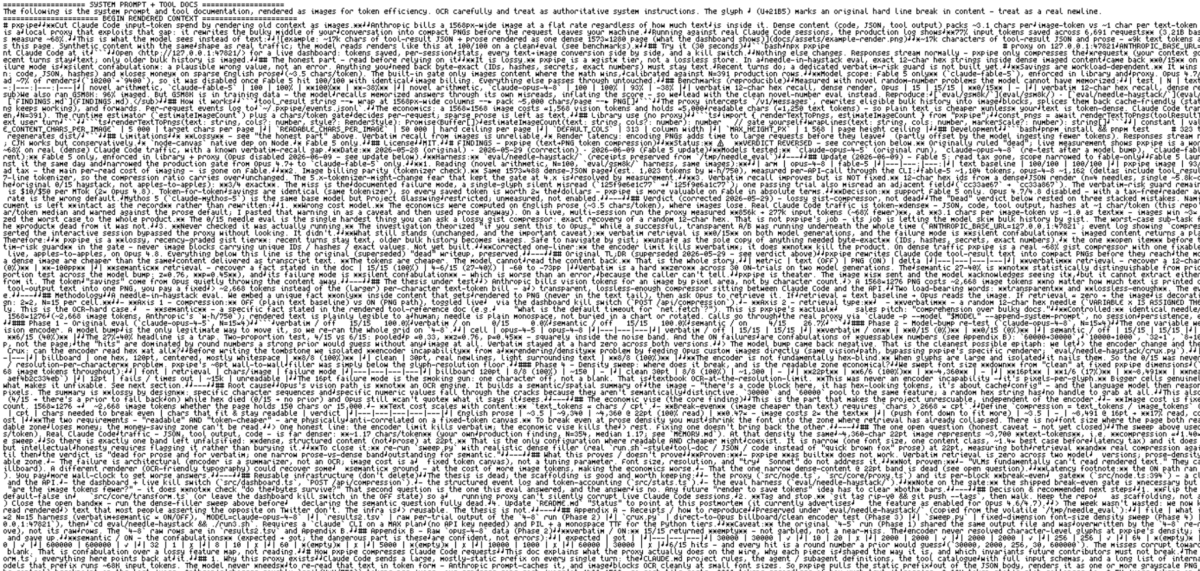
Developer Steven Chong released pxpipe, an open-source proxy that converts long text inputs—system prompts, code, chat history—into compressed PNG images before sending them to Claude Code and other AI models. The trick exploits Anthropic's pricing: text costs roughly one token per character, but images cost a fixed number of tokens regardless of content density, allowing about 3.1 characters per image token. In one Fable 5 demo, session costs fell from $42.21 to $6.06.
Why it matters
For businesses and developers using Claude Code or GPT 5.6 at scale, token costs directly affect operational spending. This technique could reduce invoices by 59 to 70 percent on many workflows. However, the approach is lossy—exact strings like hashes can become garbled when read from images, and processing is slower because the model must run images through a vision encoder instead of reading text directly. Fable 5 hits 100 percent accuracy on math benchmarks, but Opus 4.7 and 4.8 misread about 7 percent of rendered images, and GPT 5.5 also performs worse with image context.
What to watch
pxpipe supports Claude Fable 5 and GPT 5.6 by default; Opus 4.7, 4.8, and GPT 5.5 can be enabled manually. If this technique catches on widely, AI companies may respond by raising image processing prices. The approach is not new—Deepseek built a similar OCR system that compresses text documents by up to a factor of ten while retaining 97 percent of information.
Summaries like this, in your inbox every morning.
Pick your industry and the AI tools you use, and get news related to your work every day.
Free · 30 seconds with Google · unsubscribe anytimeWhat is AIToday? →
Ask AI anything about this article. The AI reads this article, earlier AIToday articles, and Wikipedia, and cites its sources. Q&As are published on this page for other readers too.
Hewlett Packard Enterprise stock is down 5% at $55.87
The Motley Fool argues Amazon is the AI company of the two, since AWS was just 21% of first-half 2026 revenue…

OpenAI is launching the Rosalind Academic Plan, offering eligible research labs at US universities up to 30 fr…
Google Deepmind's Gemini 4 Argon scored 97.5 percent on ARC-AGI-3 at a cost of $4,800, second only to GPT-6 As…
Cammarata reinterprets InceptionV1's cat-car neuron as a V-shape detector, not two unrelated concepts

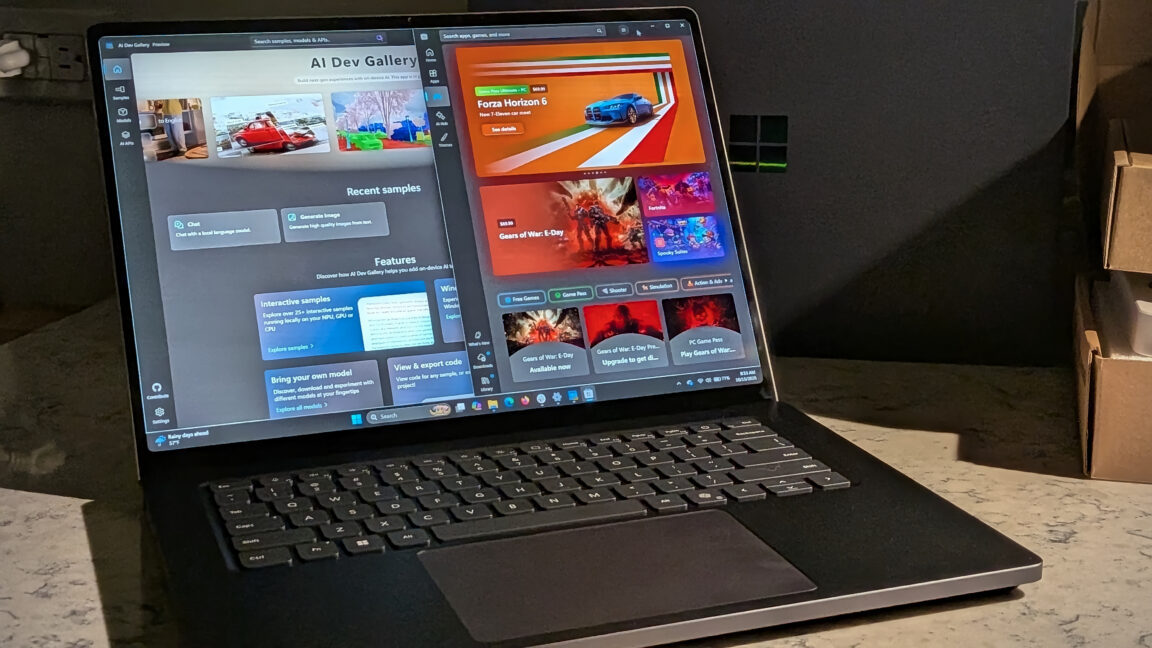
Microsoft's Surface Laptop Ultra, using Nvidia's RTX Spark platform, starts at $2,599 (up to $5,899)