What happened
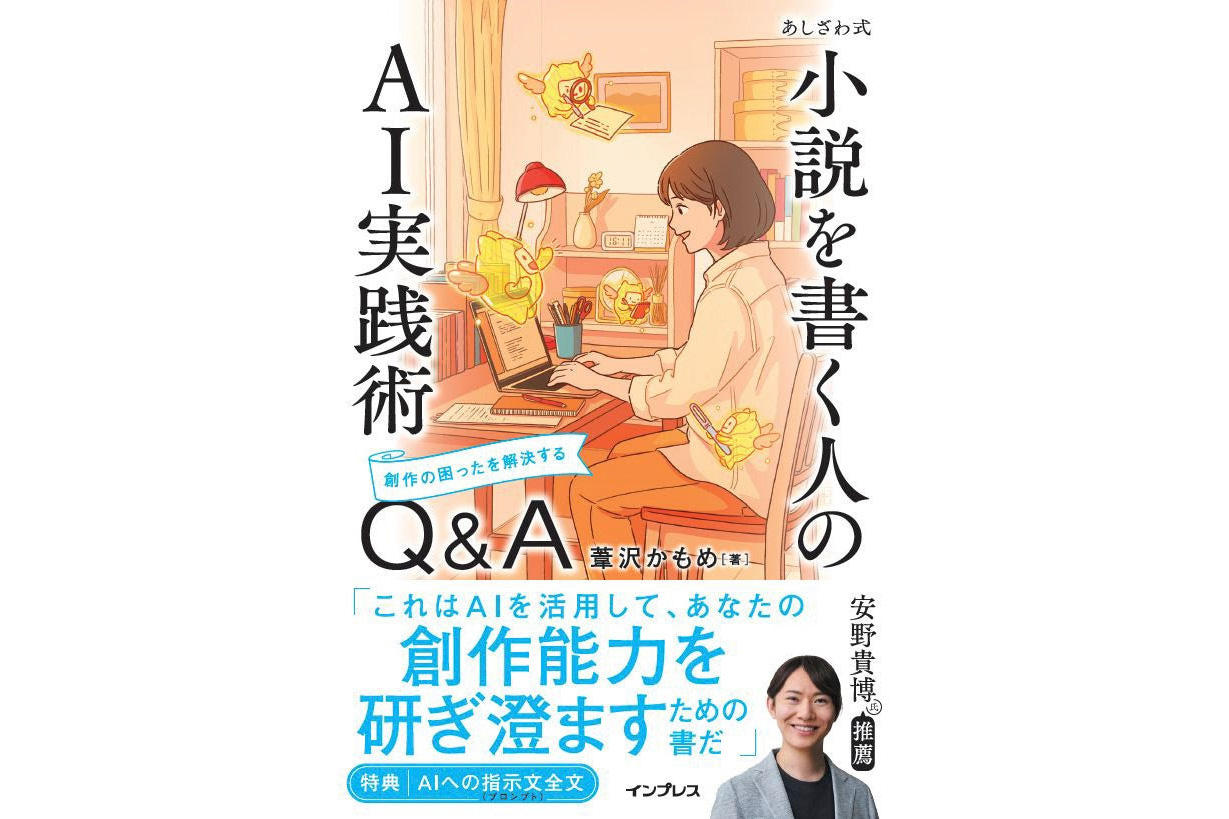
Impress released Kamome Ashizawa's book on October 7 for 1,980 yen. It covers using AI from story ideas through drafting, revising, and submitting, and includes prompts, AI answer examples, and a copyright column.
Why it matters
The book treats AI as a personal editor for novelists — evaluating drafts, polishing style, and designing foreshadowing — and offers step-by-step guides to building a custom AI tuned to a writer's own style.
What to watch
It also addresses copyright questions writers hesitate over, such as whether AI-written text can be submitted unchanged to a newcomer award. Whether that guidance holds depends on how prize rules and rights law are read.
WHO IT HITSWriters working on novels, short stories, and award submissions — especially those already using ChatGPT, Gemini, or Claude — get a hands-on reference for prompt and workflow choices, while award judges and publishers may face more AI-assisted entries.
Summaries like this, in your inbox every morning.
The book arrives as a practical follow-up to a 2024 title, 'AI Techniques for Novelists: Expanding Story Ideas Through Dialogue with AI,' written by Kenichi Yamakawa, Akihiko Imai, and Kamome Ashizawa. Where that earlier volume explored ideas, this one moves into execution — troubleshooting the points in a writing project where people get stuck, from outlining and character building to drafting, polishing, and sending work out.
Its structure mirrors that journey: chapters on whether AI helps at all, on generating ideas, on characters and worldbuilding, on breaking through writer's block, on refinement, on handling unsatisfying AI answers, and on getting more out of the tools, plus a column on copyright rules. Ashizawa is an SF author whose AI-assisted fiction took an excellence award at the 9th Nikkei 'Shinichi Hoshi Award' and a runner-up spot at the 2nd AI Art Grand Prix, so the guidance comes from working practice rather than theory.
The riskiest territory is what the copyright column addresses: questions like whether AI-produced text can go unchanged into a newcomer contest, or whether AI use can be kept quiet. How much weight to give that advice may depend on how individual prizes and rights holders interpret their own rules, which is likely to keep shifting. For now, the book's value for writers probably hinges on whether its downloadable prompts and multi-tool workflow actually shorten the distance between a stalled draft and a submittable one.
Pick your industry and the AI tools you use, and get news related to your work every day.
Free · 30 seconds with Google · unsubscribe anytimeWhat is AIToday? →
Ask AI anything about this article. The AI reads this article, earlier AIToday articles, and Wikipedia, and cites its sources. Q&As are published on this page for other readers too.
At Team ‘26 Europe, Atlassian unveiled Agentic Multiplayer Protocol, giving every AI agent an admin-assigned i…

Meta and enterprise AI startup Sierra are leading Walmart, Stripe, Shopify, Genesys, Instinct and Rocket in de…
Gartner forecasts that 70% of AI agents developed by vendors' forward-deployed engineers (FDE) will be abandon…
OpenAI published 372 mathematical results from an internal frontier model on GitHub, including improvements to…
HP Japan launched the HP ZBook Ultra G3a 16 inch on October 7, starting at 639,100 yen, built with AMD and run…

Anthropic merged its Project Glasswing and CVP programs into three access levels — Defense Access, Red Team Ac…