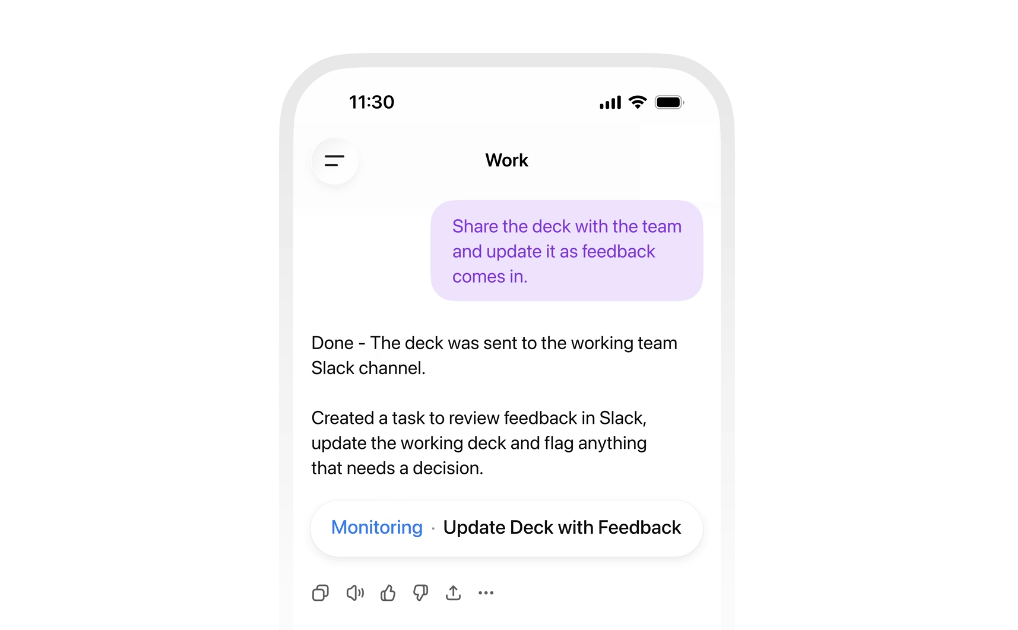
OpenAI launched ChatGPT Work, an agent tool that automates business workflows across connected apps and files, powered by its new GPT-5.6 model. GPT-5.6 delivers a 54% improvement in token efficiency for agentic coding tasks, reducing computational costs—a key metric as enterprises weigh AI spending against value. The tool is rolling out to Pro, Enterprise, and Edu subscribers, with support for plugins including Slack, Teams, Salesforce, and Google Workspace.
Summaries like this, in your inbox every morning.
Sign up free →What happened
OpenAI unveiled ChatGPT Work, an agentic tool that automates tasks across connected applications, files, and workflows. Powered by GPT-5.6, it can create spreadsheets, presentations, and dashboards from a single prompt, and ask for human approval before sensitive actions. The tool is rolling out to Pro, Enterprise, and Edu subscribers, with Pro and Business users gaining access in the coming days. GPT-5.6 itself is now broadly available in three variants: Sol (advanced reasoning and coding), Terra (enterprise), and Luna (high-volume, low-cost applications).
Why it matters
ChatGPT Work extends OpenAI's reach into enterprise automation, where competitors like Anthropic and SpaceX's Grok are also competing. GPT-5.6 shows a 54% improvement in token efficiency for agentic coding tasks compared to GPT-5.5, potentially lowering costs for automated software development—a critical use case for enterprises evaluating AI spend. The tool can break down complex goals into smaller tasks over extended timeframes, integrating with Slack, Teams, Gmail, Salesforce, and other business platforms.
What to watch
ChatGPT Work has already been tested by workers at Nvidia, Zapier, RingCentral, and Virgin Atlantic Airways during its beta phase. Enterprise controls allow organizations to preauthorize sensitive actions and set usage limits. GPT-5.6 underwent government review led by Treasury Secretary Scott Bessent, Commerce Secretary Howard Lutnick, and U.S. National Cyber Director Sean Cairncross before public release.
ChatGPT Work represents OpenAI's push to capture enterprise automation workflows as competition intensifies. The tool is not merely a language model interface but an autonomous agent that can decompose goals into subtasks, manage them over extended periods, and integrate with the full stack of workplace productivity tools—Slack, Teams, Salesforce, Google Workspace, and Microsoft 365. This breadth of integration is significant because it positions ChatGPT Work as a potential workflow backbone rather than a standalone chatbot.
The 54% improvement in token efficiency for GPT-5.6 addresses a concrete pain point: enterprise customers evaluating AI have shifted focus from capability to cost-per-task. By reducing tokens consumed per operation, OpenAI is directly lowering the cost of agentic coding, which has emerged as a high-value use case (software generation from natural language prompts). The arrival of competing models like Grok 4.5 with similar efficiency gains suggests that cost optimization and enterprise adoption have become the battlefield.
The government review by Treasury, Commerce, and Cyber officials before GPT-5.6's public release signals that frontier AI models now face regulatory scrutiny as a standard step. OpenAI's framing of this as "collaborative" and tied to safety claims underscores that broad access to powerful models now requires government confidence—a structural shift that may slow but also legitimize AI rollout in enterprise settings where regulatory risk is a barrier to adoption.
No comments yet. Be the first to share your thoughts!
Log in to join the discussion


Get curated AI news from 200+ sources delivered daily to your inbox. Free to use.
Get Started FreeFree · takes 30 seconds · unsubscribe anytime
1 minute a day. The AI essentials.
200+ sources · Email / LINE / Slack
