What happened
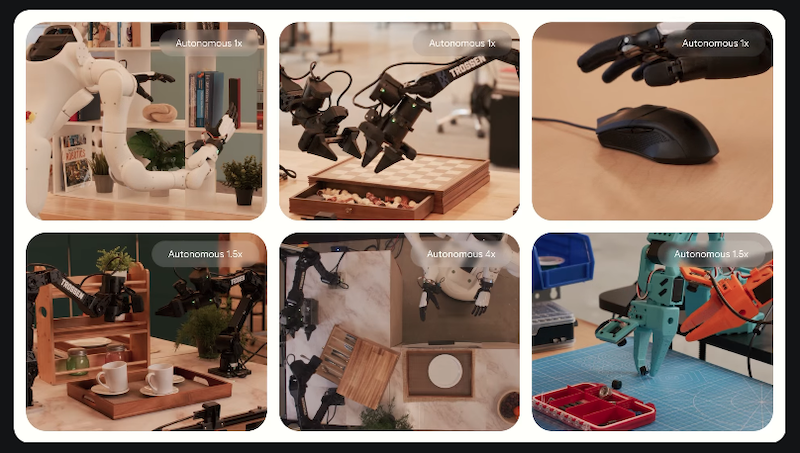
Google DeepMind launched Gemini Robotics 2, a suite of three AI models enabling humanoid robots to move beyond pre-programmed tasks. The system is demonstrated on Apptronik's Apollo 2 humanoid, which can now perform full-body autonomous movements—walking, crouching, bending, manipulating objects—while reasoning through complex tasks in real time. Gemini Robotics ER 2 also enables multiple robots to collaborate on workflows.
Why it matters
The platform adds whole-body control (extending beyond earlier upper-body focus) and can be adapted to new robot hardware in a matter of hours, meaning developers can deploy the system across different robot types faster. For industrial and logistics settings, the on-device model runs directly on robot hardware without cloud dependency, requiring fewer than 200 training examples over just a few hours to adapt to new dual-arm platforms. The release also includes ASIMOV-Agentic, a safety benchmark that evaluates whether robots can refuse unsafe actions and request human help when needed.
What to watch
Gemini Robotics ER 2 is now available through Google AI Studio and in private preview on the Gemini Enterprise Agent Platform; Gemini Robotics 2 and Gemini Robotics On-Device 2 are available to selected early-access partners. Apptronik's Robot Park facility, launched earlier this month, is collecting data to train next-generation versions of these models.
Summaries like this, in your inbox every morning.
Google DeepMind's release of Gemini Robotics 2 marks a shift from task-specific robotic control to whole-body autonomous reasoning. The announcement builds on an established partnership with Apptronik, which launched Robot Park earlier this month—a data collection facility designed to train next-generation AI models including this suite. The three-model architecture (a vision-language-action model, an embodied reasoning module, and an on-device optimized version) addresses different deployment scenarios: cloud-connected settings, multi-robot coordination, and edge-constrained industrial environments where connectivity is limited.
The capability improvements reported—whole-body movement coordination ("feet to fingertips"), dexterity with five-fingered hands for tasks like tying trash bags, and cross-platform adaptability in hours—signal that the barrier to deploying generalist robot control is dropping. For industrial deployments, the on-device model's ability to adapt with fewer than 200 training examples over a few hours suggests a meaningful reduction in setup friction. The inclusion of ASIMOV-Agentic, a safety benchmark for agentic reasoning, indicates Google DeepMind is embedding safety evaluation into the product rather than treating it as a downstream concern—a practical necessity for real-world robotics deployment.
Pick your industry and the AI tools you use, and get news related to your work every day.
Free · 30 seconds with Google · unsubscribe anytimeWhat is AIToday? →
Ask AI anything about this article. The AI reads this article, earlier AIToday articles, and Wikipedia, and cites its sources. Q&As are published on this page for other readers too.
Chunghwa Telecom president Rong-shy Lin said the shift from conversational AI to autonomous AI agents is resha…

Apple and Meta said they would jointly release a new open-weight AI model designed to run on high-end Macs, ai…

A writer and entrepreneur opened his daily to-do list and found 156 items, and concluded that an AI assistant…

A Zenn contributor sorted AI use into three modes — AI as an assistant, AI running alongside people, and AI th…

A non-engineer operator says one person ships four smartphone apps on Google Play, three on the App Store, wit…
The walkthrough points the CLI at a local mock via the ANTHROPIC_BASE_URL environment variable

