What happened
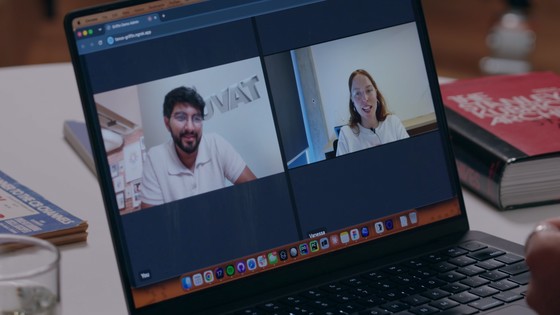
Tavus ran a study where 54 participants had a one-minute video call believing they were talking to another person; 26, about 48%, judged the AI-driven Griffin-Lite to be human, with 79% average confidence.
Why it matters
If roughly half of participants in a controlled study take an AI for a real person, that is a sign such systems could be misused to deceive people, which is why Tavus is restricting access.
What to watch
Whether Tavus's safety measures work will determine when Griffin becomes broadly available, and until then it stays a limited research preview for trusted testers.
WHO IT HITSTrust and safety teams evaluating synthetic media, and video-call platforms, may need to assess whether AI participants can pass as human in their products.
Summaries like this, in your inbox every morning.
Tavus built Griffin as a so-called Human Interaction Model. Unlike typical voice AI that waits for a user to finish before recognizing, generating a reply, and synthesizing speech, Griffin continuously reads video and audio and can nod, murmur, or interrupt in under a second. It generates not just a face but arms, fingers, body motion, chair, shadow, and background from one reference image, at 720p in 320-millisecond chunks, with an average 0.43-second delay from received audio to on-screen video on NVIDIA H100 hardware. Tavus says that is about half the delay of the next-fastest streaming video generation method it compared.
On NVIDIA's VideoFDB benchmark, Griffin-Lite scored 3.83 out of 5 on Generation, close to the 3.92 for human reference data and above Gemini 2.5 + Anam at 2.80. On Perception it scored 3.73 versus 4.20 for humans and 3.44 for MiniCPM-o 4.5; Tavus says NVIDIA ran that evaluation independently in September 2026. In the conversation study, participants rated Griffin-Lite 5.4 for naturalness, 5.6 for trustworthiness, 5.8 for wanting to talk again, and 5.5 for feeling listened to, while natural conversational flow scored lowest at 4.9.
The gap between the 4.9 flow score and the 48% human judgment is the tension Tavus is sitting on. Whether Griffin moves beyond a limited research preview is likely to hinge on how well the company can build visible signs that a caller is an AI without degrading the very naturalness that produced these results.
Pick your industry and the AI tools you use, and get news related to your work every day.
Free · 30 seconds with Google · unsubscribe anytimeWhat is AIToday? →
Ask AI anything about this article. The AI reads this article, earlier AIToday articles, and Wikipedia, and cites its sources. Q&As are published on this page for other readers too.
OpenAI released its Jev-style Decisions API, previously announced at last week's DevDay, and Simon Willison us…

The engineer wired Claude Code headless into a pipeline that turns backlog items into merged code, logging 243…

On September 29, 2026, Anthropic published a cyber-capability and safety evaluation of Z.ai's GLM-5.3, reporti…
OpenAI says it will automatically watermark ChatGPT text in the European Union and offer the feature elsewhere…
Lucas Baker, Head of LLM R&D at Jump Trading, said GPT-6 Astra lets agents run multi-day quant research workfl…

Fujitsu announced four AI agents for retail store operations and management decisions, covering sales structur…