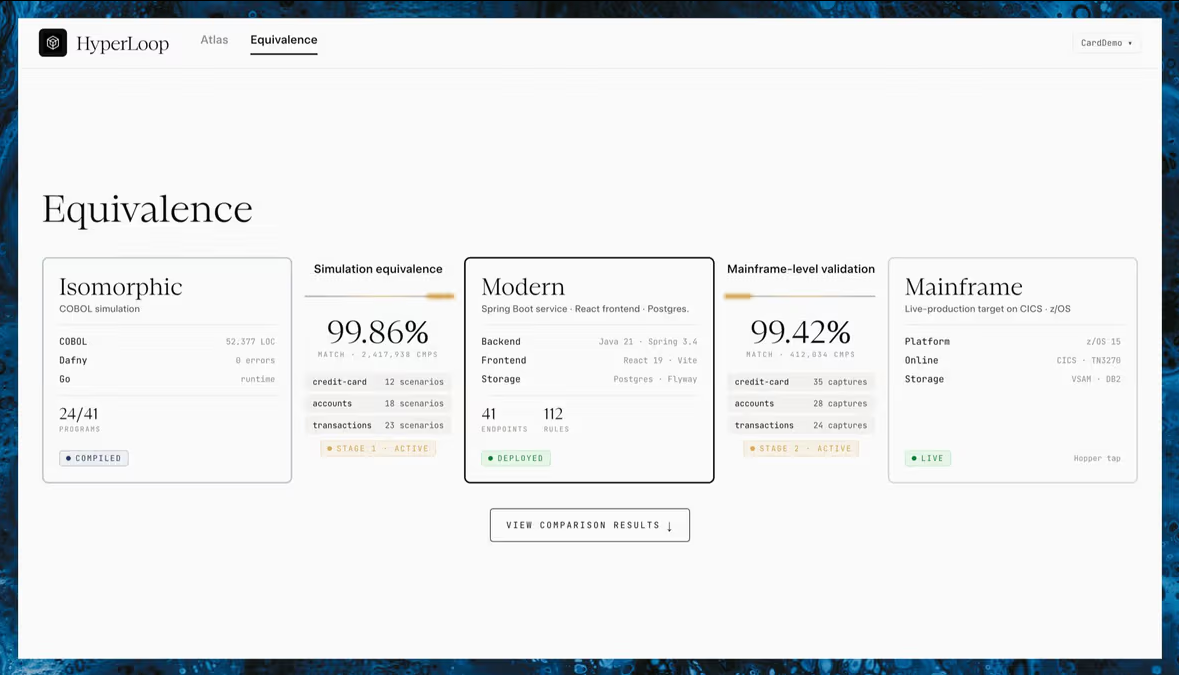
What happened
Hypercubic, founded by former Apple engineers Sai Gurrapu and Aayush Narik, raised $5.3 million in seed funding led by CIV with participation from Y Combinator, Afore Capital, Pioneer Fund, Multimodal Investors, and angels including Opendoor CEO Kaz Nejatian. The startup uses AI agents to map, document, and rewrite legacy COBOL applications.
Why it matters
COBOL—first written in 1959 and still supporting more than 95% of the world's swipe transactions and automated teller machines—is embedded in critical systems at banks and governments, yet 90% of current COBOL engineers are expected to retire within the next five to 10 years. Manual modernization takes years and carries massive risk; Hypercubic's agents can complete the job in just a couple of months, potentially solving a pressing crisis for financial institutions and industrial companies.
What to watch
Hypercubic is already working with one of the largest banks in Latin America and a leading Caribbean retailer serving more than 50 million customers annually. The funding will be used to expand AI agent capabilities and serve more enterprise customers.
Summaries like this, in your inbox every morning.
The COBOL crisis is real and growing urgent. Estimates indicate 200 billion-plus lines of COBOL code remain in production globally, primarily at banks, governments, and large industrial firms where downtime is catastrophic. The language's original developers have long since retired, and the second generation—the engineers who learned COBOL decades ago—are now aging out themselves; 90% are projected to leave the workforce within five to 10 years. Organizations know modernization is necessary but have systematically delayed it because manual rewrites are expensive, time-consuming (taking years per application), and carry extreme risk: a single undocumented change in a monolithic COBOL system can bring down critical services such as bank ledgers or government payment systems, with debugging potentially taking days.
Hypercubic's approach sidesteps this paralysis by automating the most labor-intensive and risky parts of the modernization process. Rather than hand-translating syntax, the startup's AI agents first map the entire codebase and recover the business logic buried within it—logic that was never formally documented when the code was originally written. From that recovered logic, the agents generate documentation and then produce equivalent modern code (in languages such as Java) that preserves the original system's behavior. By compressing a multi-year project into a couple of months and reducing manual risk, the startup addresses a genuine pain point for its target customers. The fact that it is already working with one of Latin America's largest banks and a major Caribbean retailer—each with millions of customers at stake—suggests the value proposition is compelling to risk-averse enterprises.
Pick your industry and the AI tools you use, and get news related to your work every day.
Free · 30 seconds with Google · unsubscribe anytimeWhat is AIToday? →
Ask AI anything about this article. The AI reads this article, earlier AIToday articles, and Wikipedia, and cites its sources. Q&As are published on this page for other readers too.
NEURA Robotics introduced Neuron AI, a multimodal foundation model combining 3D vision, touch, audio, robot st…
Google released Gemini 4 Argon globally for coding, knowledge work, enterprise workflows and cyber defense, wi…

Google started rolling out Gemini 4 Argon worldwide via AI Studio and the Gemini API, and to Google AI Ultra u…

Anthropic said its Japan staff grew from 3 to over 50 in a year, customer adoption rose 10-fold, and Claude us…

On October 12, 2026, Character.ai announced it began bankruptcy proceedings to sell certain assets to a Walt D…

Snowflake said Gemini 4 Argon is now in Public Preview natively within Snowflake Cortex AI, available at launc…