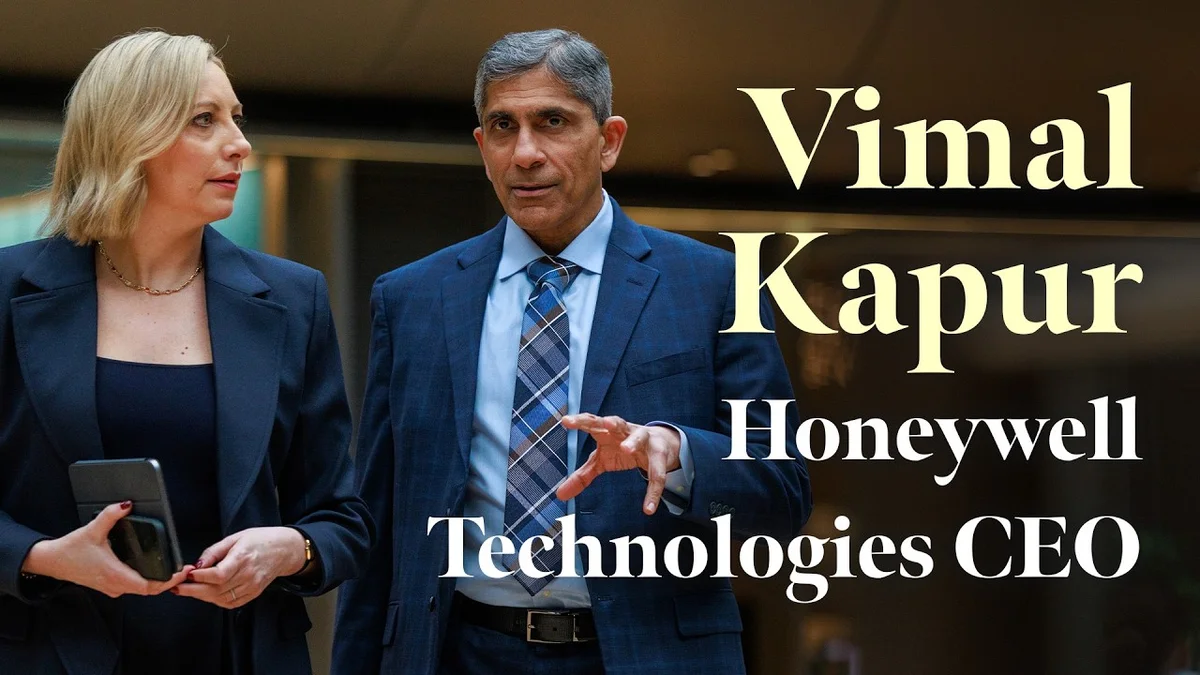
Honeywell's new CEO Vimal Kapur explained the strategic reasoning behind breaking up Honeywell International, arguing that the conglomerate structure was too complex for future growth driven by top-line expansion. He highlighted AI as a fast-growing capability within the company, with the most immediate payoff in software development and testing productivity, but argued that the real transformation will require reimagining workflows around AI agents rather than deploying AI as a standalone tool.
Summaries like this, in your inbox every morning.
Sign up free →What happened
Vimal Kapur, Chair and CEO of the newly formed Honeywell Technologies, discussed the strategic breakup of Honeywell International in a podcast interview, citing the need for focused companies as the conglomerate structure became too complex for future growth. He also highlighted AI adoption across the company, particularly in productivity gains in software development and testing.
Why it matters
Kapur framed the split as essential for top-line growth, noting that earnings growth in the next 50 years will require simpler organizational structures—a shift driven partly by emerging opportunities in AI and aerospace. For industrial companies, his comments suggest that conglomerate models may face pressure to disaggregate as sectors diverge in their technology needs and growth trajectories.
What to watch
Kapur emphasized that true AI transformation will come not from isolated productivity tools, but from integrating AI agents into workflows—a shift that requires rethinking how work itself is structured. He also stressed the importance of clear strategic conviction when dealing with activist investors like Elliott Investment Management, which had pushed for the breakup.
Vimal Kapur, who has led Honeywell through one of industrial manufacturing's most significant restructurings, reflected on his career and the company's transformation in a Bloomberg podcast interview. Kapur began his career with Honeywell in India in the late 1980s, describing a startup environment with fluid roles and accelerated learning. He emphasized that there is no single path to the C-suite, noting that his own journey was rooted in customer-facing and business roles rather than traditional corporate functions.
At the heart of the conversation was Honeywell's decision to break itself up into distinct companies. Kapur explained that while the conglomerate structure had succeeded historically, it had become too complex to support future growth. He stated plainly: "It was clear to me that our next 50 years, the earnings growth will come from top line growth, and top line growth is hard to accomplish if you are a complex structure with addressing multiple segments." The split was driven partly by the emergence of AI opportunities and growth in aerospace, both of which could be better served by focused organizations. This restructuring coincided with the arrival of activist investor Elliott Investment Management, though Kapur framed the investor's involvement as collaborative, with strategic goals largely aligned.
On artificial intelligence, Kapur outlined a vision that distinguishes between incremental productivity gains and true transformation. Currently, he sees AI as a fast adopter within Honeywell, with the most significant near-term impact in software development and testing productivity. However, he believes the real breakthrough will come from integrating AI agents into workflows—a shift that fundamentally reimagines how work is structured. "Transformational will occur if we redraw our work right, in which we can use agents as part of our workflow," he explained. This framing suggests that industrial companies cannot simply layer AI onto existing processes; they must rethink those processes from the ground up.
When asked about navigating activist investors, Kapur offered advice grounded in conviction and clarity. He described his interactions with Elliott as productive and noted that his strategy was to maintain clear conviction and communicate it with passion. "If you have a conviction on your strategy, that's what you need to really think about and worry about. If that's clear, then it's less about what they believe in. It's more about what you believe in," he said. Kapur also acknowledged the challenges of leading a U.S.-based company amid political unpredictability, noting that while businesses thrive on predictability, reality demands constant adaptation—and CEOs must focus on foundational elements like serving shareholders and customers rather than worrying about external factors beyond their control.
The breakup of Honeywell International represents a broader trend of large conglomerates reconsidering their multi-segment model as growth dynamics shift. Kapur's framing—that future earnings will depend on top-line growth rather than operational leverage across diverse segments—signals a view that scale and complexity are becoming liabilities in a faster-moving industrial landscape. The timing coincides with both the arrival of activist investor Elliott Investment Management and the emergence of AI as a transformative technology, though Kapur frames the split as driven by structural clarity rather than pressure alone.
Kapur's nuanced stance on AI is instructive for industrial companies. While he acknowledges immediate productivity gains in software development and testing, he positions AI agents integrated into workflows as the true inflection point—suggesting that companies must fundamentally redesign processes, not merely insert AI tools into existing ones. This distinction reflects a mature view of technology adoption: incremental automation is valuable but discontinuous; transformational value requires organizational rethinking. His emphasis on strategic conviction when engaging with activists also points to a posture of clarity and conviction as a defense against external pressure—implying that CEOs who lack a coherent strategy are more vulnerable to activist intervention.
AI-summarized, only the topics you pick — one digest a day via Email, Slack, or Discord.
Free · takes 30 seconds · unsubscribe anytime
No comments yet. Be the first to share your thoughts!
Log in to join the discussion

Get curated AI news from 200+ sources delivered daily to your inbox. Free to use.
Get Started FreeFree · takes 30 seconds · unsubscribe anytime
1 minute a day. The AI essentials.
200+ sources · Email / LINE / Slack
