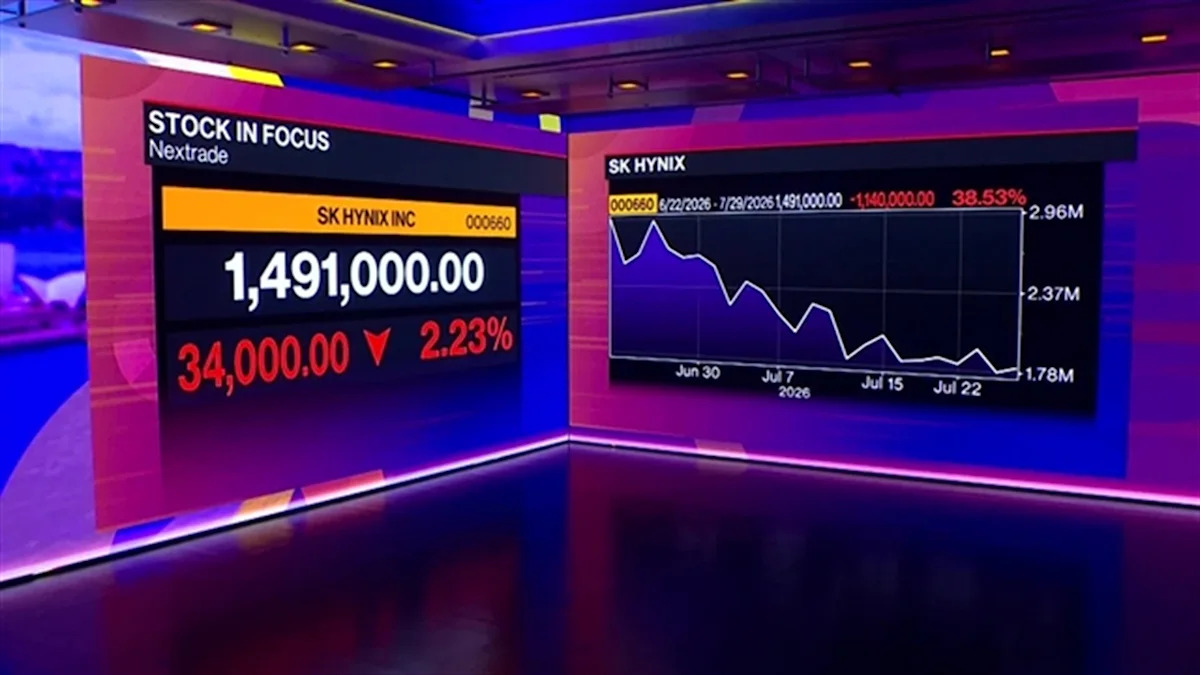
What happened
SK Hynix reported operating profit of 60.5 trillion won ($42 billion) in the June quarter, falling short of the analyst average estimate of 64.2 trillion won. Revenue came to 79.3 trillion won, versus the average estimate of 83.9 trillion won. The company won multiyear contracts with around 10 customers.
Why it matters
SK Hynix is the dominant supplier of high-bandwidth memory for Nvidia's chips, so its earnings directly reflect the strength of AI infrastructure spending. The miss signals investor concerns that the AI boom driving semiconductor valuations may be slowing, and that soaring chip costs could trigger broader economic slowdown and push manufacturers to cut production of PCs and smartphones. The company has shed more than $500 billion of value since June as these doubts grew.
What to watch
SK Hynix's CEO stated that severe memory chip shortages would likely persist beyond 2030, but investors are focused on whether margins and guidance can justify the company's recent stock performance. Brokerages have trimmed second-quarter profit estimates citing moderated growth in average selling prices of chips.
Summaries like this, in your inbox every morning.
SK Hynix's earnings miss arrives at a critical moment for semiconductor valuations. The company has become the de facto bellwether for AI infrastructure spending because it supplies the high-bandwidth memory that powers Nvidia's data-center chips—the workhorse of the AI boom. When SK Hynix posts weaker-than-expected results, it signals not just a single company's performance but a potential slowdown in the entire AI capital cycle that has driven semiconductor stocks to historic highs.
The miss was narrow in percentage terms—operating profit came in about 6% below consensus—but the market's reaction was severe. Investors appear concerned that rising chip costs will eventually force cloud providers and other data-center operators to throttle spending, or that the cost pressure will ripple into consumer electronics, dampening demand for PCs and smartphones. Brokerages have already begun trimming their profit estimates for SK Hynix based on moderating growth in chip average selling prices, suggesting the easy margin expansion phase may be ending. Yet the company's own management pushes back on slowdown fears: CEO Kwak Noh-Jung told Bloomberg that memory shortages would persist beyond 2030, and the company won multiyear contracts with around 10 customers in the quarter, pointing to sustained long-term demand.
Pick your industry and the AI tools you use, and get news related to your work every day.
Free · 30 seconds with Google · unsubscribe anytimeWhat is AIToday? →
Ask AI anything about this article. The AI reads this article, earlier AIToday articles, and Wikipedia, and cites its sources. Q&As are published on this page for other readers too.
Chunghwa Telecom president Rong-shy Lin said the shift from conversational AI to autonomous AI agents is resha…
CoreWeave fell 5% in premarket trading Friday and was on track to finish the week down 15%, after rebounding f…
Apple and Meta said they would jointly release a new open-weight AI model designed to run on high-end Macs, ai…

Investors put $38.5 billion into Asian startups in Q3, per Crunchbase data

A longtime Anthropic investor told Fortune he expects shares priced around $1.8 trillion, below the company's…

In Q2, billionaires or their funds sold six 'Magnificent Seven' AI stocks