Zaatar has launched an AI-powered SEO automation tool that runs audits and generates fixes 24/7, shipping technical improvements and article drafts as pull requests to your GitHub repository for approval. The product handles indexation, on-page optimization, schema markup, page speed, backlink outreach, author credentials, and AI search formatting—work that agencies charge $1,500+ per month for—at a flat rate starting at $79 per month, with the AI fully included and no need to supply your own API key or subscription.
Summaries like this, in your inbox every morning.
Sign up free →What happened
Zaatar is launching an AI product that runs SEO automation on your website 24/7, identifies issues (missing H1 tags, slow page load times, broken backlinks), and ships fixes as pull requests to your GitHub repository for you to approve. The system works across eight SEO verticals—indexation, on-page optimization, schema, performance, authority, E-E-A-T (expertise, experience, authoritativeness, trustworthiness), AI search formatting, and code quality—using a fleet of specialist agents that handle 95% of the work while you make the 5% strategic decisions.
Why it matters
SEO agencies typically charge $1,500+ per month for similar weekly audits and fixes; Zaatar bundles the AI at no extra cost within its subscription, starting at $79 per month for small sites. Because fixes land as pull requests rather than direct site changes, you retain full control over what ships—nothing publishes without your approval. For teams managing technical SEO, this shifts the burden from manual auditing and implementation to human review only, potentially freeing engineering and marketing time.
What to watch
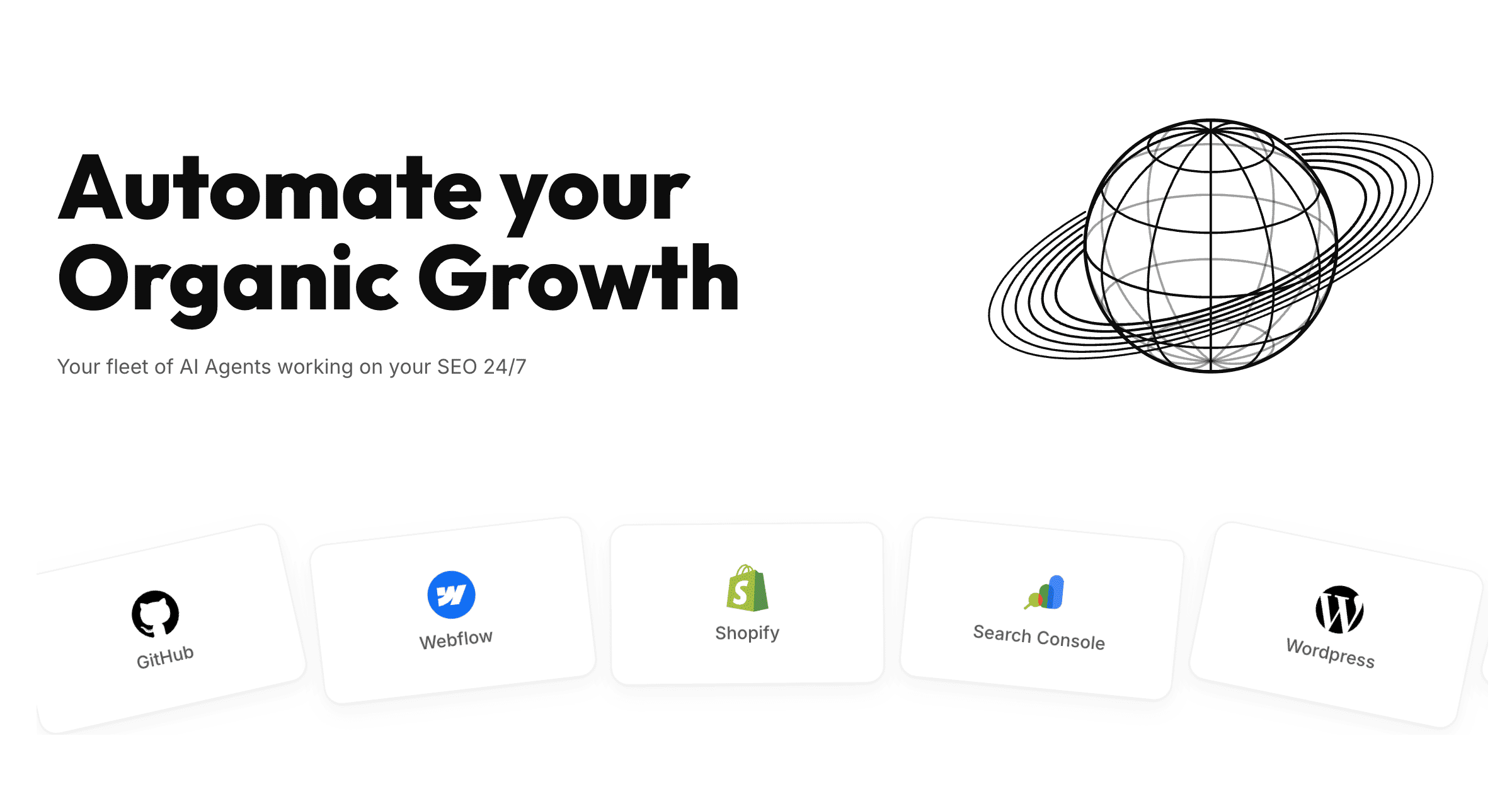
During the beta, Zaatar requires a GitHub repository and Google Search Console connection; CMS integrations (Webflow, WordPress, Shopify) are coming soon. Technical fixes (Core Web Vitals, schema, internal links) typically appear in pull requests within the first week and move rankings 2–4 weeks after Google recrawls; content ranking compounds slower, with pillar content expected to rank after 2–3 months of consistent shipping. Pricing scales with page count (up to 25,000 pages monitored on the $249/month plan) and language support (up to 8 languages).
Zaatar is a new SEO automation platform designed to run optimization work on your website 24/7 without you needing to learn new tools or supply your own API keys. The product operates as a fleet of specialist agents organized into eight SEO verticals: indexation (14 agents monitoring coverage and fixing canonicals), on-page optimization (22 agents rewriting titles, drafting meta descriptions, adding missing H1 tags), schema (4 agents patching FAQ and breadcrumb markup), performance (3 agents monitoring Core Web Vitals and optimizing page load metrics like LCP and INP), authority (16 agents handling backlink outreach and brand mention tracking), E-E-A-T (14 agents auditing trust signals and generating author bios), AI search (12 agents formatting content for AI engines and updating llms.txt), and code quality (9 agents fixing JavaScript hydration errors and validating configuration). These agents work continuously, auditing your site every week and queuing up fixes.
The key architectural choice is that agents prepare work but do not publish it. Technical fixes (Core Web Vitals, schema, internal links, meta tags) arrive as pull requests to your GitHub repository; content drafts land in your queue for review; outreach pitches are drafted for you to send. Nothing changes your live site without your approval. For technical fixes, the timeline is fast: pull requests typically appear within the first week, and rankings often move 2–4 weeks after Google recrawls. Content compounds slower; pillar content usually takes 2–3 months of consistent publishing before ranking traction appears. Setup is minimal: connect your Google Search Console and GitHub repository, and Zaatar begins its initial audit.
Pricing scales with site size and language coverage. The entry plan is $79 per month, supporting up to 500 pages, one language, 4 articles per month, 100 keywords tracked, and 3 competitors monitored. The mid-tier ($149 per month) supports up to 5,000 pages, up to 3 languages, 12 articles per month, 500 keywords, and 10 competitors. The top tier ($249 per month) covers up to 25,000 pages, up to 8 languages, 30 articles per month, 2,000 keywords, and 20 competitors. All plans include the full AI capability—no separate API charges or subscription overlays—and support one additional website at 15% discount for each new site added after the first.
Zaatar addresses a common concern by citing evidence that Google does not penalize AI-written content per se. The company points to Google's own guidance that it rewards high-quality content regardless of authorship, Ahrefs' analysis of roughly 600,000 pages showing effectively zero correlation (0.011) between AI-writing prevalence and ranking position (and noting that 86.5% of top-ranking pages already use AI to some degree), and the fact that OpenAI's own AI-text detector shut down in 2023 for accuracy too low to be reliable (catching AI writing only 26% of the time). The product's quality gate explicitly filters out signs of AI-slop: em dashes, filler words like "delve" and "leverage," and empty openers like "Furthermore" hard-cap the quality score and block drafts from moving forward. During the beta, Zaatar is onboarding three design-partner companies before opening to the broader public. GitHub is currently required (because fixes ship as pull requests to code), though CMS support (Webflow, WordPress, Shopify) is planned for the future.
Zaatar positions itself as an alternative to both traditional SEO agencies and generic SEO tools by automating the entire audit-and-fix workflow while keeping humans in the approval loop. The product addresses a specific friction point: SEO agencies sell weekly audits and strategic recommendations, but implementation often falls to in-house teams or requires paying the agency to do it. Zaatar collapses that gap by having agents not only identify problems but prepare fixes—shipped as code pull requests for Git-based sites or as ready-to-apply artifacts for CMS platforms. The 95/5 split (agents handle routine work, humans make strategic calls) reflects a pragmatic acknowledgment that SEO still requires judgment: keyword strategy, content topic selection, and competitive positioning cannot be fully automated.
The pricing model—$79 to $249 per month, with AI fully included—undercuts the stated $1,500+ monthly cost of traditional SEO agency work, though the comparison conflates different service levels. The product's strength lies in technical SEO (page speed, schema, canonicals, indexation), where fixes are deterministic and automated patches are less risky. Content generation is present but positioned as the slower and more human-dependent piece: agents draft articles from SEO briefs, but a quality gate filters for AI writing artifacts before landing in the editor for final review.
The beta phase is narrow—three design-partner companies during launch, with GitHub-only support and CMS integration delayed—suggesting Zaatar is validating the core model before expanding. The daily ranking tracking and competitor monitoring add a feedback layer that pure tools lack, positioning the product as ongoing optimization rather than one-time audit.
AI-summarized, only the topics you pick — one digest a day via Email, Slack, or Discord.
Free · takes 30 seconds · unsubscribe anytime
No discussion yet for this article
Get curated AI news from 200+ sources delivered daily to your inbox. Free to use.
Get Started FreeFree · takes 30 seconds · unsubscribe anytime

