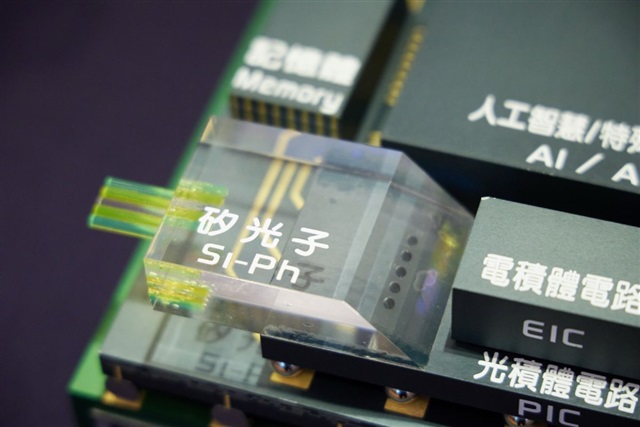
VisEra, an optical components supplier affiliated with semiconductor maker TSMC, is scaling its products to support AI data centers' need for faster data connections.
The company's MicroLens products for 800G transceivers are already in mass production, and it is developing silicon photonics technology to handle even higher capacities at 1.6T, positioning it as a key supplier for the infrastructure demands of large-scale AI systems.
What happened
VisEra, a TSMC-affiliated optical components supplier, is expanding into AI optical interconnects and silicon photonics. The company's MicroLens products for 800G pluggable transceivers are already in mass production, and it is advancing next-generation PIC thin-film processes to support higher capacity.
Why it matters
As AI data centers demand faster, higher-capacity interconnects to move massive amounts of data between processors, suppliers like VisEra that can scale optical components to handle 1.6T silicon photonics become critical infrastructure partners. TSMC's backing gives VisEra both manufacturing credibility and access to advanced semiconductor processes.
What to watch
VisEra's ability to move its next-generation PIC thin-film processes from development into production, and whether its silicon photonics solutions gain adoption among hyperscalers (large cloud providers) building out AI infrastructure.
VisEra, an optical components supplier owned by TSMC, is making a strategic push into the AI infrastructure market by scaling its silicon photonics and optical interconnect capabilities. The company's MicroLens products, designed for 800G pluggable transceivers (optical modules that transmit data at 800 gigabits per second), have already reached mass production, indicating that the technology is proven and being deployed in customer systems. This puts VisEra in a position to serve data center operators who are racing to expand their AI infrastructure. Beyond the current 800G product, VisEra is developing next-generation PIC (photonic integrated circuit) thin-film processes that will enable silicon photonics operating at 1.6T (1.6 terabits per second) — a significant jump in capacity. These advances matter because AI training and inference workloads generate enormous volumes of data that must move between processors, GPUs, and memory systems within data centers; optical interconnects that can handle higher speeds and densities than traditional copper connections help ease that bottleneck. As a TSMC affiliate, VisEra benefits from access to TSMC's advanced manufacturing processes and the credibility that comes with TSMC backing, giving it a competitive advantage in serving hyperscalers that are building out their AI infrastructure.
VisEra's expansion into AI optical interconnects reflects a broader market shift driven by the infrastructure demands of large-scale AI systems. As hyperscalers deploy more AI workloads, the need to move data quickly and efficiently between processors becomes a bottleneck; optical interconnects operating at higher speeds (800G today, moving toward 1.6T silicon photonics) offer a path to address this constraint. VisEra's position as a TSMC affiliate is strategically significant: it provides both manufacturing credibility and access to TSMC's advanced semiconductor processes, which are essential for developing next-generation photonic components. The fact that the company's 800G MicroLens products are already in mass production suggests market validation and revenue momentum, while the push toward 1.6T silicon photonics indicates that VisEra is positioning itself for the next generation of AI infrastructure buildout.
AI-summarized, only the topics you pick — one digest a day via Email, Slack, or Discord.
Free · takes 30 seconds · unsubscribe anytime
Ask AI anything about this article. Q&As are published on this page for other readers too.
QumulusAI announced a GPU-as-a-Service agreement with DRW, a global trading firm, to supply a dedicated NVIDIA…

OpenAI introduced Premium Seats for ChatGPT Business, priced at $125 per user per month ($100 with annual bill…

Anthropic pledged to embed machine-readable watermarks in Claude-generated text and digitally signed provenanc…

OpenAI announced that its unreleased model Astra had produced solutions to 10 long-standing mathematics proble…

Anthropic confirmed it will add watermarks to text generated by Claude and other models to comply with the EU…

Tech companies are raising unprecedented sums for AI infrastructure—$194 billion so far in 2026 by just four f…
The AI news that matters, in one minute each morning.
Sign up free