What happened
At Y Combinator's AI Startup School, Andrej Karpathy said software has changed twice in 70 years: Software 1.0 (humans write code), Software 2.0 (data trains neural networks), and Software 3.0 (natural language programs an LLM).
Why it matters
If programming has already shifted this way twice in a short span, the barrier to building software falls and the value of hand-written code declines — though the talk frames this as a historical reading, not a prediction.
What to watch
Karpathy's warning hinges on execution: a Waymo demo that looked perfect in 2013 is still not finished 12 years later, and he admits letting an AI agent run free produced a 1,000-line diff nobody could read.
WHO IT HITSProduct managers and startup founders deciding how much autonomy to hand an AI agent, and engineers whose hand-written code is being replaced, face Karpathy's argument that augmentation tools beat full automation.
Summaries like this, in your inbox every morning.
Karpathy's talk, delivered at Y Combinator's AI Startup School, is built around a historical arc rather than a product announcement. He argues that software's method of creation has flipped twice in a short period: from humans writing code, to data training neural networks whose weights act as code, to natural language serving as the programming interface for an LLM. He points to Tesla's self-driving work as firsthand evidence, describing how handwritten C++ code was progressively replaced by neural networks.
A second thread concerns where this technology spreads. Karpathy notes that LLMs reached ordinary users before militaries and large companies, an inversion of the usual adoption path, and uses the metaphor that if an LLM goes down, the planet gets dumber — treating it as infrastructure like electricity or water.
The stakes, on his account, sit at the boundary between demo and production. He recalls a Waymo demo in 2013 that looked perfect yet remains unfinished 12 years later, and describes his own experience letting an agent run free until a 1,000-line diff became unreadable. His prescription — build Iron Man's suit, not his robot — suggests the near-term gains may go to teams that keep a human in the loop rather than chase full automation.
Pick your industry and the AI tools you use, and get news related to your work every day.
Free · 30 seconds with Google · unsubscribe anytimeWhat is AIToday? →
Ask AI anything about this article. The AI reads this article, earlier AIToday articles, and Wikipedia, and cites its sources. Q&As are published on this page for other readers too.
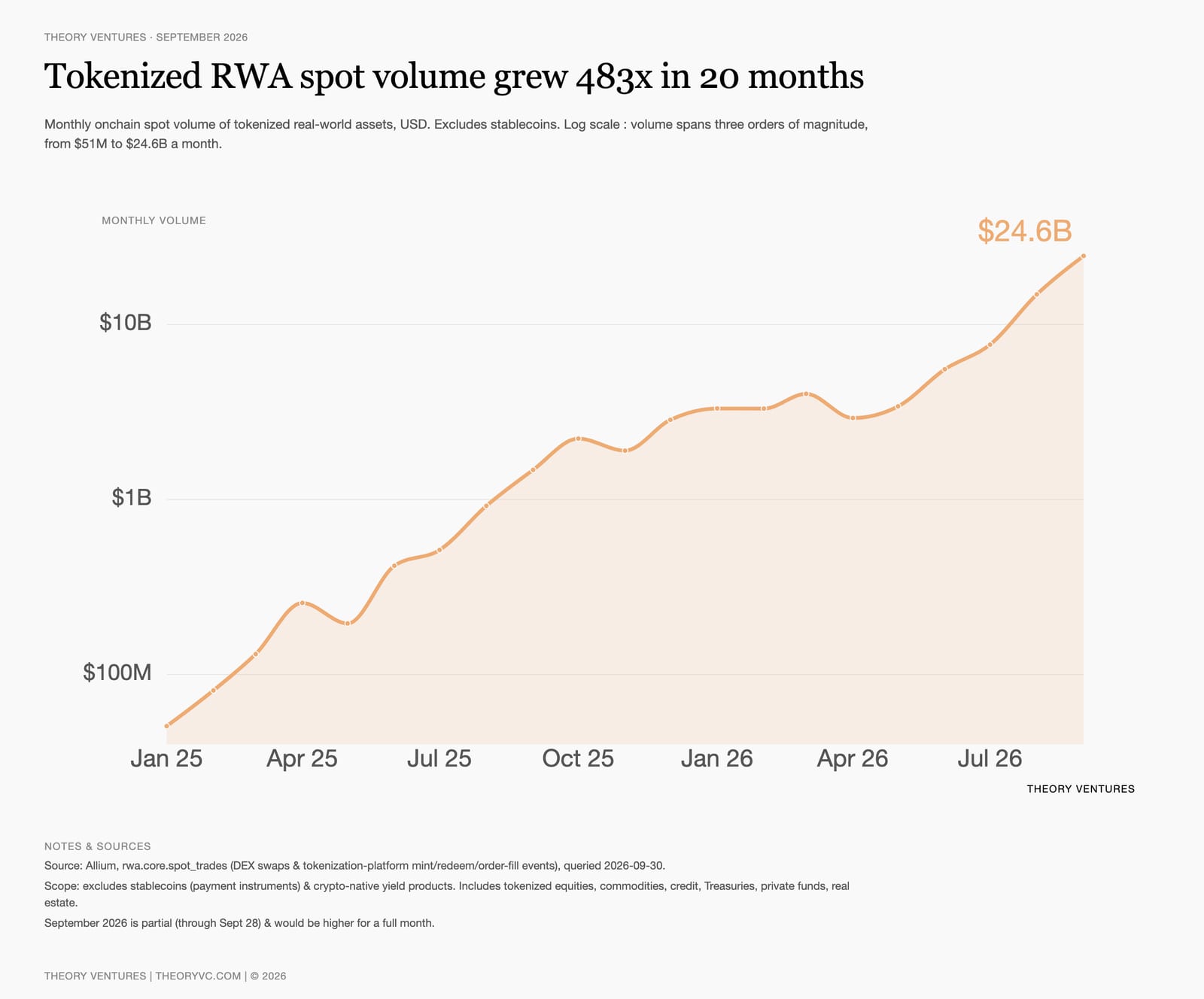
Tokenized real-world assets (RWAs) — stocks and commodities like oil and copper traded on blockchains — are co…
After OpenAI staff raised concerns on Slack, president Greg Brockman abandoned the second half of his $50 mill…
GovAI research fellows Alan Chan and Sam Manning said at a Sept
OpenAI announced "dots" at its September 29 DevDay — always-on agents with their own cloud computer and browse…
Anthropic beta-launched Claude Slides and Claude Docs, letting users build slides and documents directly in Cl…
Intel jumped as much as 14% intraday to $123.82 and gained over 11% after Meta's Muse AI agent boosted expecta…