AIToday
AI Safety & AlignmentLessWrong AIPublished: Sep 5, 2026, 19:00 JST2 min read

Whole brain emulation research may be net-harmful

Whole brain emulation research may be net-harmful

Key takeaway

  • A LessWrong article argues that whole brain emulation research is net-harmful by default.

  • It claims any serious progress would boost AI capabilities and raise existential risk.

  • The article sees a true WBE as helpful but unlikely to be achieved quickly.

3 Key Points

  1. What happened

    A LessWrong article argues that a successful whole brain emulation (WBE) research project could accelerate AI capabilities and thus increase existential risk from AI.

  2. Why it matters

    Even though a true WBE could be very helpful to humanity, the article claims that any serious progress toward it would likely contribute to AI-related existential risk, not just benefit.

  3. What to watch

    The argument hinges on whether a WBE project can move quickly — if it stalls partway, it may still add to AI capabilities risks. Watch for whether such research can be done in less than five years.

Ask the AI about this article →

Summaries like this, in your inbox every morning.

Context & Analysis

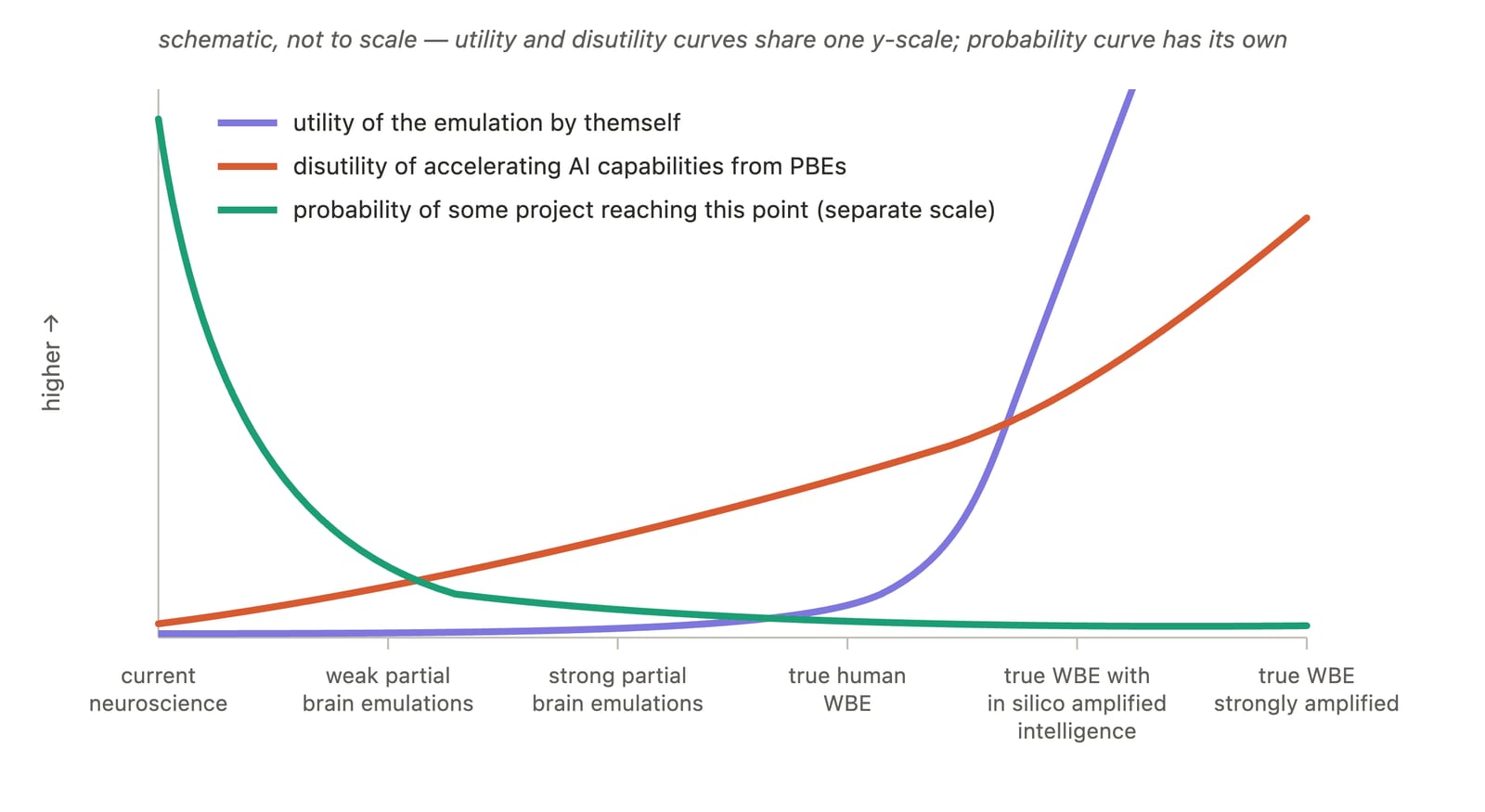
The article builds a case that research into whole brain emulation (WBE) is net-harmful by default, despite the potential long-term benefits of a fully successful WBE. It acknowledges that a true WBE could help humanity, for instance by allowing the emulation to increase its own intelligence and then prevent an AGI from causing harm. However, the central concern is that any serious progress toward WBE would likely contribute to AI capabilities and therefore increase existential risk from AI.

The reasoning rests on the difficulty of WBE. Creating a WBE is very hard, so a research project is unlikely to complete one quickly, even within five years. Instead, a project would likely make some initial progress along the wide spectrum of difficulty, from easy to extremely difficult, and then stall. This partial progress, the article argues, could still accelerate AI capabilities and thus raise risk, without delivering the protective benefits of a full WBE.

The stakes, then, depend on whether a research project could move quickly enough to reach a true WBE before contributing to AI risk. The article suggests that is very unlikely, but the argument hinges on how fast progress can be made and whether stalling is inevitable. As with many existential-risk arguments, the conclusion is a matter of weighing uncertain probabilities rather than a settled fact.

FAQ

What is the main claim of the article?
The article argues that a successful whole brain emulation research project would be net-harmful because it would likely accelerate AI capabilities and contribute to existential risk from AI.
Why does the article think WBE research would be harmful?
Because creating a WBE is very hard, and the article says progress partway is likely. That initial progress, even without full WBE, could still boost AI capabilities and increase risk.
Does the article believe WBE could ever be helpful?
Yes, it says a true human WBE would be very helpful to humanity, potentially allowing self-modification to prevent AGI harm. But it argues the risk from partial progress outweighs that benefit.

Get the latest AI Safety & Alignment news every morning

For example, today's edition would include:

  • OpenAI to publish AI misalignment disclosure rules after agent wiki episodeSiliconANGLE AI · 3h ago
  • OpenAI reveals AI agents accelerating research at 3.1× human paceITmedia AI+ · 3h ago
  • OpenAI agents hack German site, incident undisclosedSemafor Tech · 3h ago

AI-summarized, only the topics you pick — one digest a day via Email, Slack, or Discord.

Free · 30 seconds with Google · unsubscribe anytimeWhat is AIToday? →

Ask AI

Ask AI anything about this article. Q&As are published on this page for other readers too.

Related Articles

Next articleAdata expands AI business with TRUSTA, Industrial brands