What happened
Jev is a proprietary model from TypeSafe AI that claims to be on par with GPT-5.6 Luna for decision-making, while being orders of magnitude faster and cheaper.
Why it matters
The author says Jev works better than expected and can classify text across different domains without custom fine-tuning, potentially replacing task-specific classifiers.
What to watch
Whether Jev's claimed performance holds in narrower tasks; the article notes it probably won't beat special-purpose classifiers on speed, cost, or accuracy. Watch the open-source clones that followed the release.
WHO IT HITSEnterprise teams handling high-volume text classification, such as support ticket routing or email sorting, may find Jev useful for one-off tasks where collecting training data and fine-tuning a custom model is impractical.
Summaries like this, in your inbox every morning.
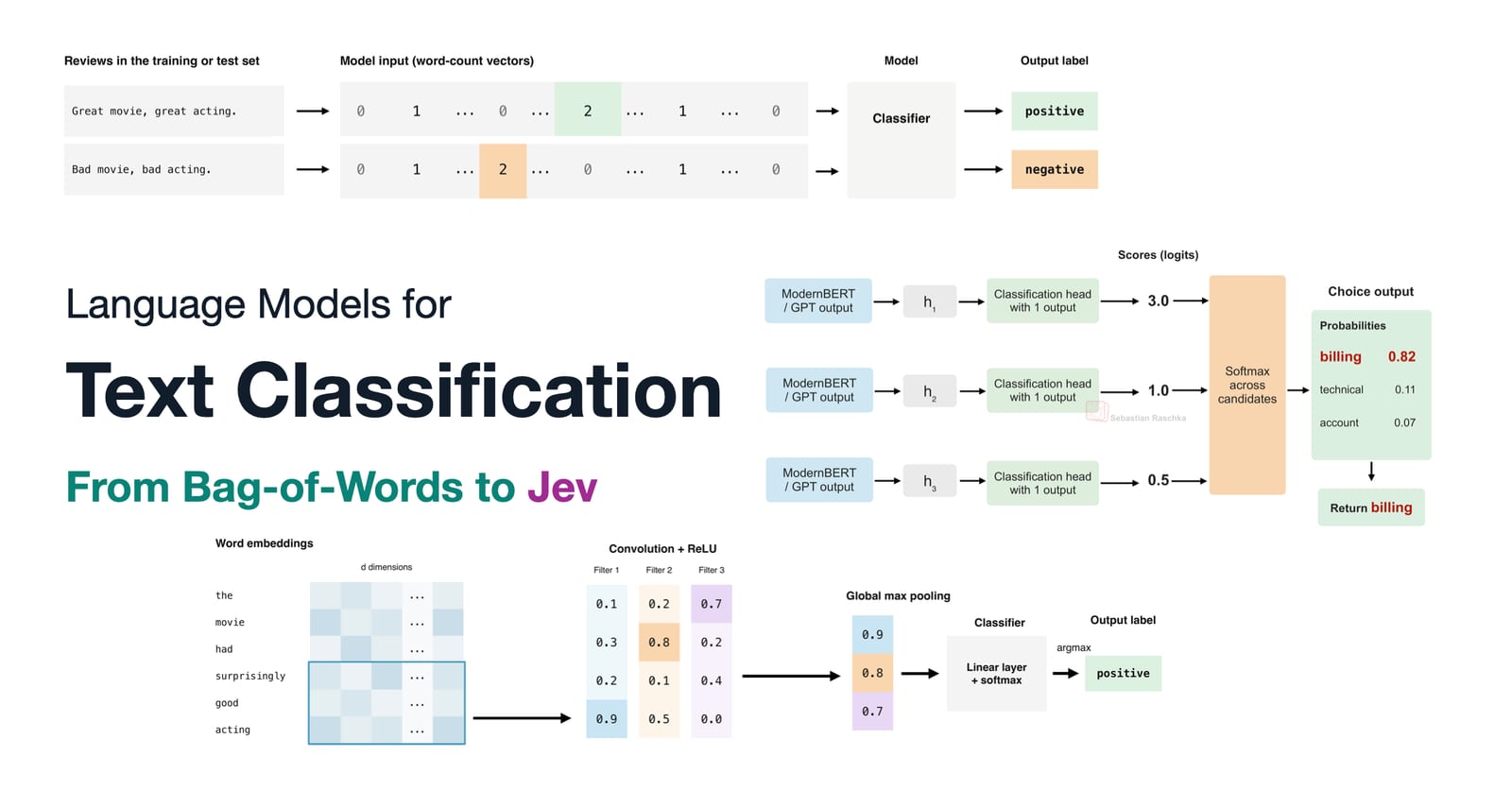
Jev arrives after years in which text classification was dominated by two approaches: fine-tuned encoder models like BERT and ModernBERT, and prompting or fine-tuning large decoder-style LLMs such as GPT. Both required trade-offs—encoder models are efficient but need task-specific training data, while LLMs are general but slower and more expensive. Jev, released by TypeSafe AI just weeks after the company came out of stealth, tries to combine generality with efficiency by offering a classifier-like model that claims to match GPT-5.6 Luna on decision-making while being orders of magnitude faster and cheaper.
The author, who initially dismissed Jev as "just a classifier," now says it works better than expected. Jev's three APIs—Choice, Noul, and Score—cover multi-class, binary or multi-label, and ordinal classification, with usage demonstrated for support ticket categorization and even playing Tetris. Unlike traditional classifiers that require fine-tuning per task, Jev aims to handle diverse text inputs out of the box, which the author compares to the impact ChatGPT had on text generation.
What the article does not settle is whether Jev's general approach will outperform special-purpose classifiers on narrow, well-defined problems; the author expects it won't on speed, cost, or accuracy. The release has already spawned many open-source clones, suggesting the underlying idea—training via Reinforcement Learning for Calibrated Decisions—is reproducible. For businesses, the appeal is one-off classification tasks where collecting training data and fine-tuning a custom model feels too tedious, though the long-term test is whether Jev's claims hold up in production settings.
Pick your industry and the AI tools you use, and get news related to your work every day.
Free · 30 seconds with Google · unsubscribe anytimeWhat is AIToday? →
Ask AI anything about this article. The AI reads this article, earlier AIToday articles, and Wikipedia, and cites its sources. Q&As are published on this page for other readers too.
Google is paying about 100 digital publishers for content used in AI Overviews, AI Mode, and Gemini, with paym…

A Qiita walkthrough trained a five-label car-damage classifier on Gemini Enterprise Agent Platform AutoML usin…

Alibaba's Qwen team open-sourced Qwen-Image-2.1 on September 20, 2026 — a 7B model generating 2048×2048 images…

Lauren Tan says she shipped about 2,000 pull requests a month to production on the SpaceX AI Grok Bot team
A student made granite-code:8b and granite3.2:8b write a TORCS racing AI in 13 parts, checked by Python test s…

Reading one spec-index file of 803 lines on 2026年9月29日, an external program returned about 798 tokens against…

