What happened
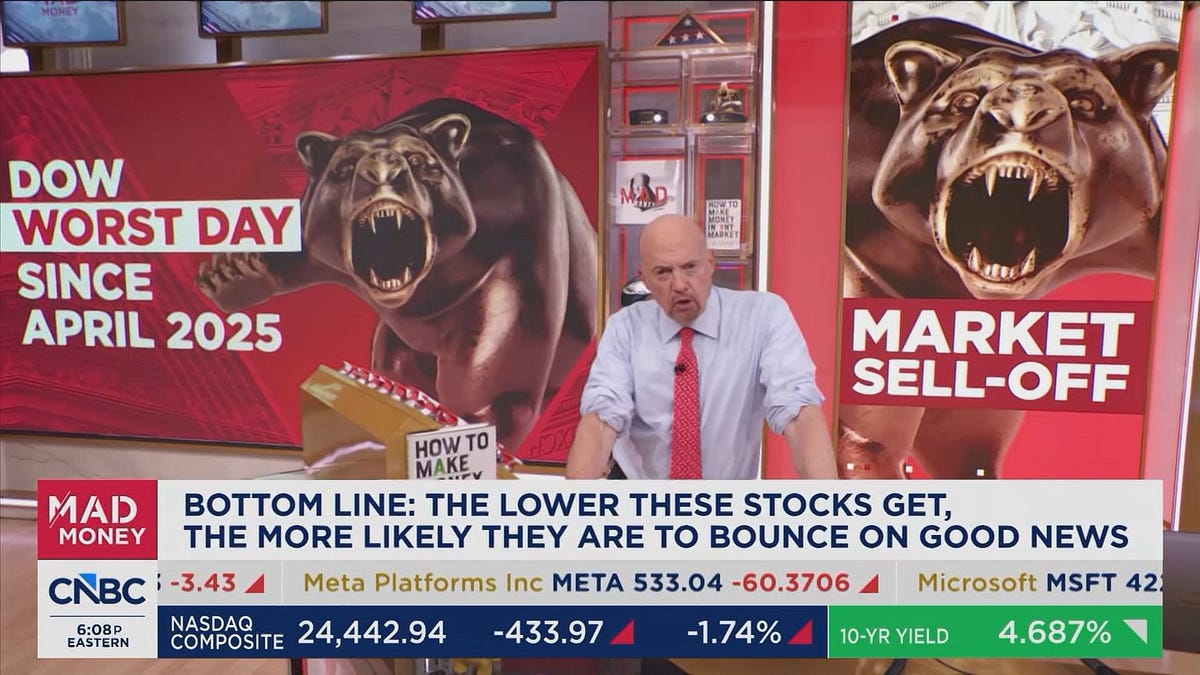
An investor argues that the AI capital cycle has overextended beyond what economics can support, with hyperscalers and Nvidia now carrying roughly $1.8 trillion of off-balance-sheet commitments (including about $982 billion in purchase obligations and $822 billion in leases not yet commenced), while long-term borrowing costs have surged—Japan's 10-year JGB reached 2.93% (its highest since 1996) and the U.S. 30-year Treasury hit 5.27% (not seen since 2007).
Why it matters
The author contends that AI's financing structure has become self-reinforcing: companies raise capital at high valuations to buy compute, which generates revenue for semiconductor suppliers and data center operators, supporting higher valuations that enable more financing. This circular flow masks whether the underlying demand for AI infrastructure can actually justify the trillions being deployed. If this cycle breaks—say, if AI customers disappoint and cut compute purchases—semiconductor earnings would fall at the exact moment investors compress valuations, potentially triggering cascading losses across the ecosystem.
What to watch
The author predicts the AI boom may begin to unravel around the end of 2026 and beginning of 2027, citing five key reasons including rising household debt (American households carried roughly $18.8 trillion of debt as of the end of June 2026, up about $400 billion from a year earlier) and elevated delinquencies (4.7% of all outstanding household debt was in some stage of delinquency as of Q2 2026). Goldman Sachs has predicted hyperscaler AI capex could reach as much as $1.4 trillion in 2027.
Summaries like this, in your inbox every morning.
The author frames the AI boom not as a technology problem but as a capital cycle problem. While acknowledging that AI is genuinely transformative, the piece argues that investors have extrapolated AI's eventual dominance backward into today's valuations and financed a decade or more of buildout in advance—a pattern the author notes has recurred with railroads, fiber optic cable, and the internet itself. In each case, the technology was revolutionary but investments far outpaced sustainable returns, destroying shareholder wealth despite long-term economic benefit. The specific danger with AI, the author contends, is the structural circularity: Nvidia and other suppliers are now financing their own customers, meaning revenue growth depends on capital availability rather than underlying demand. This creates reflexive dynamics where minor disappointments cascade—if AI customers spend less because financing tightens, compute orders fall, semiconductor earnings decline, and the multiple investors pay for those earnings compresses simultaneously, amplifying losses. The timing compounds the risk: the AI boom is reaching its most aggressive phase precisely when households are carrying record debt loads (American households held roughly $18.8 trillion as of the end of June 2026, with credit card and auto loan balances near all-time highs), as asset prices that have propped up household balance sheets face renewed pressure from higher rates, and as bond markets globally are signaling that risk is underpriced. The author's analogy—a poker table where the same chips circulate to create the illusion of wealth—suggests that even without fraud or irrationality, the system becomes fragile once the flow stops. Goldman Sachs estimates hyperscaler AI capex could reach $1.4 trillion in 2027, while Morgan Stanley calculates roughly $1.8 trillion in existing commitments, but these forecasts rest on the financing conditions remaining supportive, a assumption the author doubts will hold through the end of 2026.
Pick your industry and the AI tools you use, and get news related to your work every day.
Free · 30 seconds with Google · unsubscribe anytimeWhat is AIToday? →
Ask AI anything about this article. The AI reads this article, earlier AIToday articles, and Wikipedia, and cites its sources. Q&As are published on this page for other readers too.
Holtek Semiconductor unveiled its 2026 product roadmap on October 15, focusing on four core areas: smart prote…

Supermicro Computer appointed Mark Long as chief financial officer, bringing an experienced technology finance…
TSMC reported about NT$763.1b in Q3 net profit and confirmed that demand for advanced processors is running ah…

Nvidia-backed CoreWeave steadied Thursday after a sharp slump, as investors worried about the debt financing b…
Weathernews said on October 15 it implemented its own AI weather-forecasting model, AI-Nowcast, in its Weather…

TOPPAN Holdings and Keio University ran a quantum-computer and generative-AI proof-of-concept from February 1…