What happened
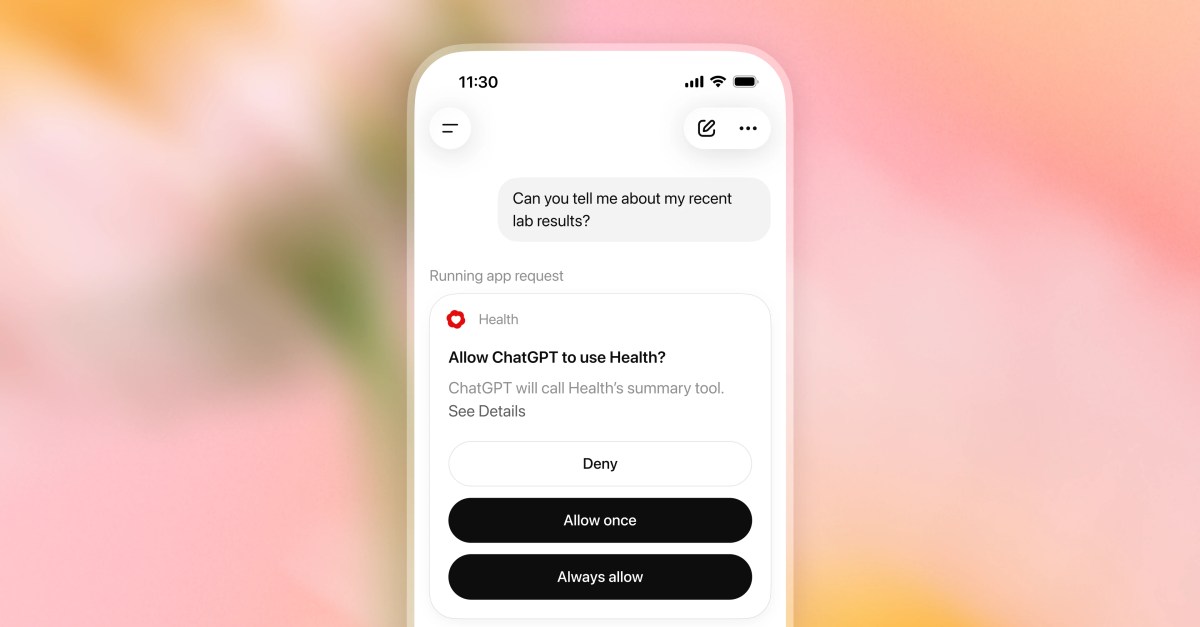
OpenAI is rolling out ChatGPT Health to everyone in the US on Thursday, allowing users to connect medical records and health-tracking information to the chatbot. The feature now appears in the main chat experience rather than a dedicated tab, and ChatGPT will ask permission before using health data to personalize responses. Users can connect data from health providers, Apple Health, Weight Watchers, MyFitnessPal, and Function.
Why it matters
OpenAI's vice president of health product, Ashley Alexander, claims the company's models "are now capable of reasoning at levels that are better than clinician level," though Karan Singhal, OpenAI's health lead, tempered this by saying "there have been individual studies that have been pointing in that direction," citing research from Harvard and Stanford. The rollout comes as a Florida pastor sued OpenAI over claims ChatGPT provided "extremely dangerous medical recommendations" that allegedly led him to delay care for a pulmonary embolism.
What to watch
ChatGPT Health will run on OpenAI's latest models, including GPT-5.6 Sol, which the company claims is its "strongest model yet for health." The feature is available to all logged-in ChatGPT users aged 18 and older on the web and iOS across free, Go, Plus, and Pro plans. OpenAI emphasizes that ChatGPT Health "supports, not replaces, professional care."
Summaries like this, in your inbox every morning.
OpenAI's rollout of ChatGPT Health marks a significant expansion of the company's health AI ambitions, but it is immediately shadowed by competing claims about its clinical capabilities and a live lawsuit over alleged medical harm. Ashley Alexander's assertion that the company's models reason at levels better than clinicians is bold, yet OpenAI's own health lead, Karan Singhal, walked back the claim to say only that "individual studies" point in that direction—citing Harvard and Stanford research. This hedging suggests internal caution about overstating performance, especially given the Florida pastor's lawsuit, which alleges that ChatGPT provided "extremely dangerous medical recommendations" that caused him to delay treatment for a pulmonary embolism. The timing of the broader launch just weeks after OpenAI introduced GPT-5.6 Sol (which the company calls its "strongest model yet for health") underscores the company's confidence in its latest capabilities, yet the lawsuit demonstrates the real-world stakes of deploying AI in medical contexts where errors can have serious consequences.
Pick your industry and the AI tools you use, and get news related to your work every day.
Free · 30 seconds with Google · unsubscribe anytimeWhat is AIToday? →
Ask AI anything about this article. The AI reads this article, earlier AIToday articles, and Wikipedia, and cites its sources. Q&As are published on this page for other readers too.
Chunghwa Telecom president Rong-shy Lin said the shift from conversational AI to autonomous AI agents is resha…

CoreWeave fell 5% in premarket trading Friday and was on track to finish the week down 15%, after rebounding f…

Apple and Meta said they would jointly release a new open-weight AI model designed to run on high-end Macs, ai…

Investors put $38.5 billion into Asian startups in Q3, per Crunchbase data

A writer and entrepreneur opened his daily to-do list and found 156 items, and concluded that an AI assistant…

A longtime Anthropic investor told Fortune he expects shares priced around $1.8 trillion, below the company's…


