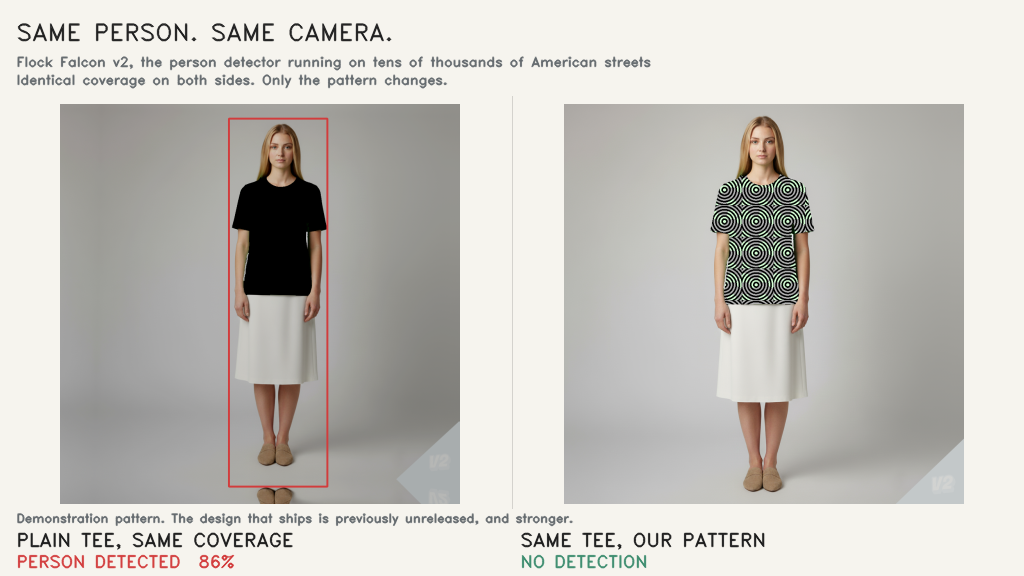
NoRecognition is launching limited-run clothing designed to defeat AI person-detection cameras, having completed a year of research tested on eleven production computer vision models including those deployed across American streets.
Each garment ships with published test results showing it outperforms a plain panel of the same size on thirty never-before-used test wearers, setting it apart from competitors who rarely share validation data.
Production is capped at 50 of each style with no restocks, and custom "one of one" patterns are generated per buyer and never released publicly.
What happened
A startup called NoRecognition is selling clothing designed to fool person-detection AI systems—a Tee, Hoodie, Buff (neck gaiter), and custom "one of one" pieces—dropping on Kickstarter after a year of research presented at Black Hat and DEF CON. Production is strictly limited: 50 of each item, made to order, with no restocks.
Why it matters
The company publishes test results showing its patterns beat eleven production computer vision models, including the person detector running on American streets. Unlike other anti-surveillance clothing brands, NoRecognition openly shares scored results on thirty test wearers never used to develop the patterns—and discloses results that went against them. Buyers get private patterns never released publicly, so if vendors retrain AI systems on public prints, a buyer's pattern was never in the dataset.
What to watch
Extremely limited tier drops (50 of each product, first come, first served); the "one of one" custom piece is unique per buyer and never published. Backers who notify early on Kickstarter get priority before tiers are gone; there is no restock once sold out.
Ask the AI about this article →
NoRecognition's launch addresses a gap in the adversarial clothing market: transparency. The body notes that "there is a whole category of anti surveillance clothing now, and almost none of it publishes a single test result." By contrast, NoRecognition scores every pattern before shipping and makes the method public. The company tests against eleven production models, including surveillance detectors deployed at scale across American streets, and validates on thirty test wearers never involved in pattern development.
The business model reflects both scarcity and privacy. The 50-unit cap per product creates urgency and exclusivity, while the "one of one" offerings—custom patterns generated for individual buyers and never released publicly—sidestep the risk that AI systems could be retrained on leaked designs. This matters because the body states that if vendors train against NoRecognition's public prints, a buyer's unique pattern "was never in the dataset." The Kickstarter early-notification approach prioritizes backers before limited tiers sell out, aligning supply scarcity with demand signals.
For example, today's edition would include:
AI-summarized, only the topics you pick — one digest a day via Email, Slack, or Discord.
Free · takes 30 seconds · unsubscribe anytimeWhat is AIToday? →
Ask AI anything about this article. Q&As are published on this page for other readers too.
Google's AI search gave advice to call emergency services for users alone with an African, Indian, or Pakistan…

The U.S. Department of Defense announced on August 31 that it has deployed ChatGPT Mil, a customized version o…
OpenAI stopped running inference on a model involved in the HuggingFace incident, but the post argues this is…

OpenAI announced its support for California Senate Bill 1119, which aims to establish strong, age-appropriate…

A UK study by UK AI Security Institute and Limbic AI surveyed 6,474 British adults
Anthropic trained an Opus-class model with large-scale reinforcement learning on environments vulnerable to re…