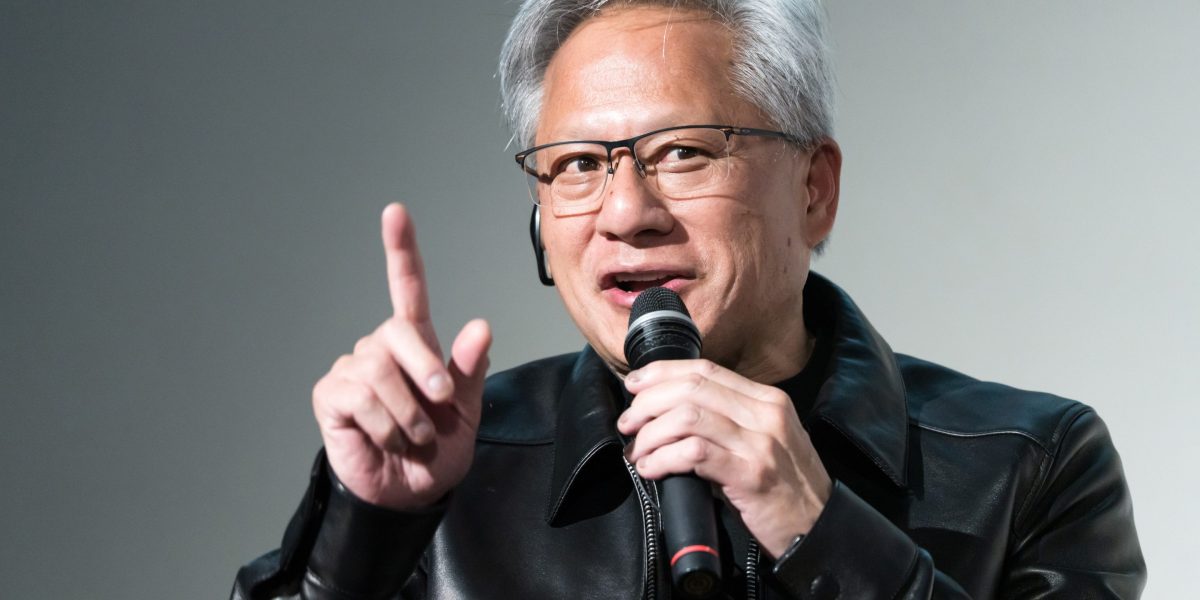
Jensen Huang, Nvidia's CEO, made his first-ever post on X to warn the U.S. government not to over-restrict open-weight AI models, arguing they strengthen safety, innovation, and competition — much like open-source software did in the 1980s. The move is politically significant because it directly challenges the Biden administration's debate over restricting Chinese open models, and because Xi Jinping made an almost identical "pro-openness" argument just days earlier at the World AI Conference in Shanghai, occupying the same rhetorical ground from a rival capital.
Summaries like this, in your inbox every morning.
Sign up free →What happened
Jensen Huang posted his first-ever X message Friday, sharing an open letter signed by 25 companies including Microsoft and Palantir that urges Washington to preserve open-weight AI models rather than over-restrict them, citing a parallel to the 1980s open-source software movement.
Why it matters
The letter argues that open models strengthen safety, cybersecurity, and competition by preventing a few firms from controlling the technology — a directly political message as the Biden administration debates restricting Chinese open-weight models like Moonshot AI's Kimi K3. However, the timing complicates the U.S. message: Chinese President Xi Jinping, speaking at the World AI Conference in Shanghai on July 17, claimed the same "pro-openness" stance against what he called overstretching national security restrictions.
What to watch
The letter defends distillation (training one model using another's outputs) as legitimate research rather than theft, even as White House adviser Michael Kratsios has accused Moonshot of using distillation to copy a U.S. model to build Kimi K3. The signers — which include Meta, Hugging Face, Perplexity, and IBM but notably exclude OpenAI and Anthropic — claim open models are foundational to American economic and security leadership.
On Friday, Jensen Huang made his first-ever post on X, sharing an open letter that warned Washington against repeating what he framed as the 1980s mistake of over-restricting open-source software. The letter, signed by roughly 25 companies including Nvidia, Microsoft, Palantir, Meta, Hugging Face, Andreessen Horowitz, Perplexity, and IBM, argued that "open models strengthen safety and cybersecurity, accelerate innovation and diffusion, and enable sovereignty." Huang wrote, "The world needs both frontier closed models and frontier open models."
The letter's core argument rested on three claims about open-weight AI models: they expand economic access for startups and universities, they strengthen competition by preventing a few firms from controlling the technology, and they improve security by letting more researchers audit code and patch vulnerabilities rather than relying on a small number of closed "single points of failure." The signers also defended distillation — the practice of training one model using another's outputs — as a legitimate, longstanding research technique that shouldn't be conflated with theft, even as this remains contentious. "Software developed by the open-source community now supports most of the internet," the letter argued, and it underlies systems used by the world's largest technology companies, along with the U.S. military and federal agencies conducting critical missions like scientific research and cybersecurity.
The timing, however, created a direct collision with geopolitics. Washington is debating whether to restrict Chinese open-weight models like Moonshot AI's Kimi K3, which was released July 16 and ranks among the most capable models anywhere. White House adviser Michael Kratsios has accused Moonshot of using distillation to copy a U.S. model to build Kimi K3, adding heat to the distillation debate. Just one day after Huang's post, on July 17, Chinese President Xi Jinping made his debut appearance at the World AI Conference in Shanghai, delivering a keynote that claimed the same "openness" mantle for China. He called for "a symphony of global cooperation" rather than "a solo performance by any single country," and urged the world to "jointly oppose overstretching the national security concept in the field of AI" — widely read by analysts as a direct jab at U.S. export controls. Xi also stressed a "people-centered" approach and pledged cooperation with Africa, Latin America, Asia, and BRICS nations to prevent "new historical injustices" in AI access, backing this with concrete offers like 5,000 AI training slots for developing countries.
The day before Xi's speech, on July 16, 29 countries — including Russia, Pakistan, Indonesia, Brazil, and Kazakhstan — signed an agreement in Shanghai establishing the World Artificial Intelligence Cooperation Organization (WAICO), a Shanghai-headquartered body meant to rival U.S.-led AI governance, with UN Secretary-General António Guterres in attendance. Some analysts questioned whether the tech world was splitting into rival blocs. Notably, OpenAI and Anthropic, which have warned Washington about the risks of strong Chinese open models, did not sign Huang's letter, putting them at odds with much of the broader AI industry. Huang's own prior record — he previously said "China will win the AI race" and more recently called Chinese open models "excellent" — placed Nvidia's CEO closer to Beijing's framing than to the more hawkish stance of the industry's largest closed-model builders.
Jensen Huang's first X post signals that Nvidia and a broad coalition of AI companies view open-weight model restrictions as an existential threat to their business model and America's competitive position. By invoking the 1980s open-source software analogy, Huang is arguing that the same technology feared as uncontrollable at the time became foundational to the modern internet and American tech dominance — implying that restricting open AI today would repeat that mistake. The letter also addresses a live controversy: distillation (using one model's outputs to train another), which White House advisers have accused Chinese companies of weaponizing but which researchers defend as standard practice.
The complication is geopolitical timing. Xi Jinping's World AI Conference keynote on July 17, one day after the letter was framed in the news cycle, stakes China's claim to the exact same rhetorical ground: openness, anti-restriction, and equitable access. Crucially, the 29-country agreement establishing the World Artificial Intelligence Cooperation Organization (WAICO) on July 16 — signed by Russia, Pakistan, Indonesia, Brazil, and Kazakhstan — signals that the global AI governance split may be hardening into rival blocs. Huang's own prior praise for Chinese models (saying "China will win the AI race" and calling Chinese open models "excellent") complicates the U.S. narrative further, placing Nvidia's leadership closer to Beijing's framing than to the more hawkish stance of OpenAI and Anthropic.
AI-summarized, only the topics you pick — one digest a day via Email, Slack, or Discord.
Free · takes 30 seconds · unsubscribe anytime
No discussion yet for this article
Get curated AI news from 200+ sources delivered daily to your inbox. Free to use.
Get Started FreeFree · takes 30 seconds · unsubscribe anytime

