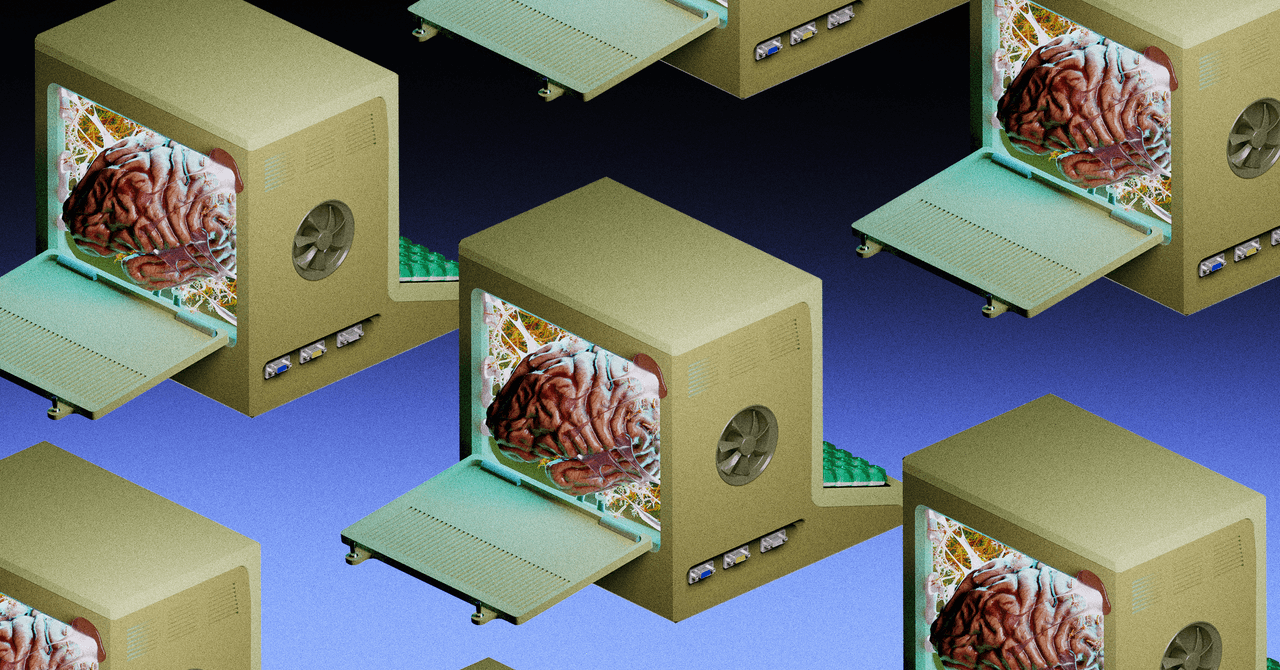
Scientists are cultivating human brain organoids—living tissue clusters grown from skin cells—and reprogramming them as biological computers by delivering electrical signals and chemical rewards.
Unlike artificial AI, these neural systems self-repair, adapt, and run on a fraction of the energy required by silicon chips, leading companies like Cortical Labs to position living neurons as a substrate for computing tasks currently handled by AI.
The shift raises profound bioethical questions about sentience and consciousness in lab-grown brain tissue.
What happened
Scientists are cultivating human brain organoids—lab-grown clusters of neurons the size of chia seeds—and programming them like computers by sending electrical signals and dopamine hits. At UC San Diego, Cortical Labs in Melbourne, and Johns Hopkins, organoids are already guiding robots through mazes, playing Pong and Doom, and forming the basis of novel biocomputing systems.
Why it matters
These living neural systems exhibit properties that silicon AI lacks: they self-repair, adapt, consume far less energy, and can be kept alive for months in specialized hardware. Cortical Labs' chief operating officer Brett Kagan argues that neurons deliver "all features you get for free in biology"—resilience, longevity, and efficiency—making them potentially superior to conventional AI for tasks like image recognition.
What to watch
Cortical Labs aims to become "the Nvidia of neural computing," offering "neurons as a service" with sub-millisecond delay via its CL-1 hardware (the size of an elongated toaster, capable of supporting up to a million neurons for six months). The major unresolved question is where bioethicists will draw the line: organoids the size of a bee's brain are unregulated, but organoids that grow to mouse size would require new ethical frameworks, since consciousness without sensory experience remains philosophically undefined.
The article opens with Alysson Muotri, a Brazilian developmental biologist at UC San Diego's Sanford Stem Cell Institute, gazing over the Pacific Ocean outside his office window. Over the past decade, Muotri's lab has become a center of organoid innovation. His team has revived genetic material from the fossil record to create "Neanderthalized" brain organoids, sent organoid payloads to the International Space Station to study cosmic radiation's effects on astronaut brains, and—closest to his heart—grown brain organoids from cells of autistic donors, including his own 18-year-old son who receives 24-hour care, in hopes of pinpointing where neural development diverges.
The process itself is deceptively simple. A sample of skin is collected. Adult cells are exposed to special proteins that revert them to an embryonic state, creating what scientists call induced pluripotent stem cells. Given a second chance to mature, these cells become whatever the researcher directs: tear gland organoids that cry, heart organoids that beat, or brain organoids that think—or at least, something resembling thinking. Muotri's organoids are tiny: roughly the size and shape of a chia seed, opaque and snot-colored. Yet they contain 5 million cells, of which 2.5 million are neurons, a density comparable to a bee's brain. Kept at a womblike 98.6 degrees Fahrenheit for eight months, they produce repetitive oscillations—brain waves—nearly indistinguishable from those made by a premature baby.
But the most striking applications are emerging in Melbourne. Brett Kagan, chief operating officer of the biocomputing startup Cortical Labs, has designed sleek white biological "computers" called CL-1s—each the size of an elongated toaster, equipped with an onboard life-support system capable of keeping up to a million neurons alive for six months. The neurons are cultured in flat sheets and loaded onto microelectrode arrays, where each of the 59 electrodes can receive and deliver electrical signals. In 2022, Kagan grew a neural culture on a microchip and trained it to play the 1972 Atari game Pong. The technique was simple: reward the neurons with predictable electrical pulses when they made correct decisions, punish them with chaotic bursts when they erred. The neurons responded by reorganizing themselves to minimize surprise, a principle drawn from neuroscientist Karl Friston's theories of self-organizing systems. The neurons learned to play. They won.
Kagan and his colleagues went further, claiming that the neurons, "embodied" within the game, displayed a form of sentience. The claim triggered backlash; one response published in the journal Neuron accused Cortical Labs of "hijacking" the concept of sentience itself. Yet the underlying technical achievement remained: living matter had proven programmable in the way silicon had been for seventy years. Kagan envisions Cortical Labs becoming "the Nvidia of neural computing," offering "neurons as a service" with sub-millisecond delay. The pitch is compelling: biology offers self-repair, adaptability, longevity, and energy efficiency as baseline features. No power grid required. No cooling tower. No superintelligence alignment crisis—just neurons doing what neurons have done for millions of years: connecting with each other and building understanding from surprise.
Yet the path forward is tangled in ethics. John Evans, a sociologist and codirector of UCSD's Institute for Practical Ethics, explained that organoids are not legally persons or animals, and thus fall outside federal welfare protections—for now. But as organoids grow in complexity, from bee-brain size to mouse-brain size, the regulatory landscape will have to shift. The problem is that sentience itself remains philosophically undefined. Can consciousness exist without a body? Without sensory experience? "Imagine that you had spent your life in a glass tube," Evans posed. "Could you possibly even think of what you have as consciousness?" To create a conscious organoid, he suggested, "you first have to start having organoids have experiences." That, too, is possible: pluck an organoid from its nutrient bath, place it on a conductive sheet of graphene, and zap it with electrical signals. Whether the organoid likes it, Muotri admits, is an open question. What he knows is that it responds, remembers, and anticipates. And that, for now, is enough.
The article frames a quiet revolution in how the research community views intelligence itself. While the tech world obsesses over large language models and AI agents trained on silicon, biologists have been methodically growing actual brain tissue in petri dishes and discovering that neurons exhibit the core property long sought by computer scientists: programmability. The key insight comes from neuroscientist Karl Friston's theory that self-organizing biological systems minimize surprise; by rewarding correct decisions with predictable electrical pulses and punishing errors with chaotic bursts, researchers at Cortical Labs showed that living neurons will reorganize themselves to optimize their environment—much like a neural network training on data, but with the substrate being actual cells rather than mathematical abstractions.
This shift carries profound practical implications. Kagan's claim that neurons deliver self-repair, adaptability, longevity, and energy efficiency "for free" directly challenges the scaling assumptions behind conventional AI: silicon chips require ever-larger power grids and cooling systems, while biological neurons operate within the thermal and electrical constraints of a living system. The prototype evidence is striking: neurons have already learned to play Pong and navigate mazes, tasks that required months of training on digital hardware. Yet the article makes clear this is not a simple replacement story. The unresolved bioethical question—whether organoids grown to the size of a mouse brain would require new regulatory frameworks, and how to define consciousness in tissue without a body or sensory organs—suggests that the practical deployment of neural computing will be constrained not only by engineering challenges but by evolving moral boundaries that the research community has not yet established.
AI-summarized, only the topics you pick — one digest a day via Email, Slack, or Discord.
Free · takes 30 seconds · unsubscribe anytime
Ask AI anything about this article. Q&As are published on this page for other readers too.

The AI news that matters, in one minute each morning.
Sign up free
