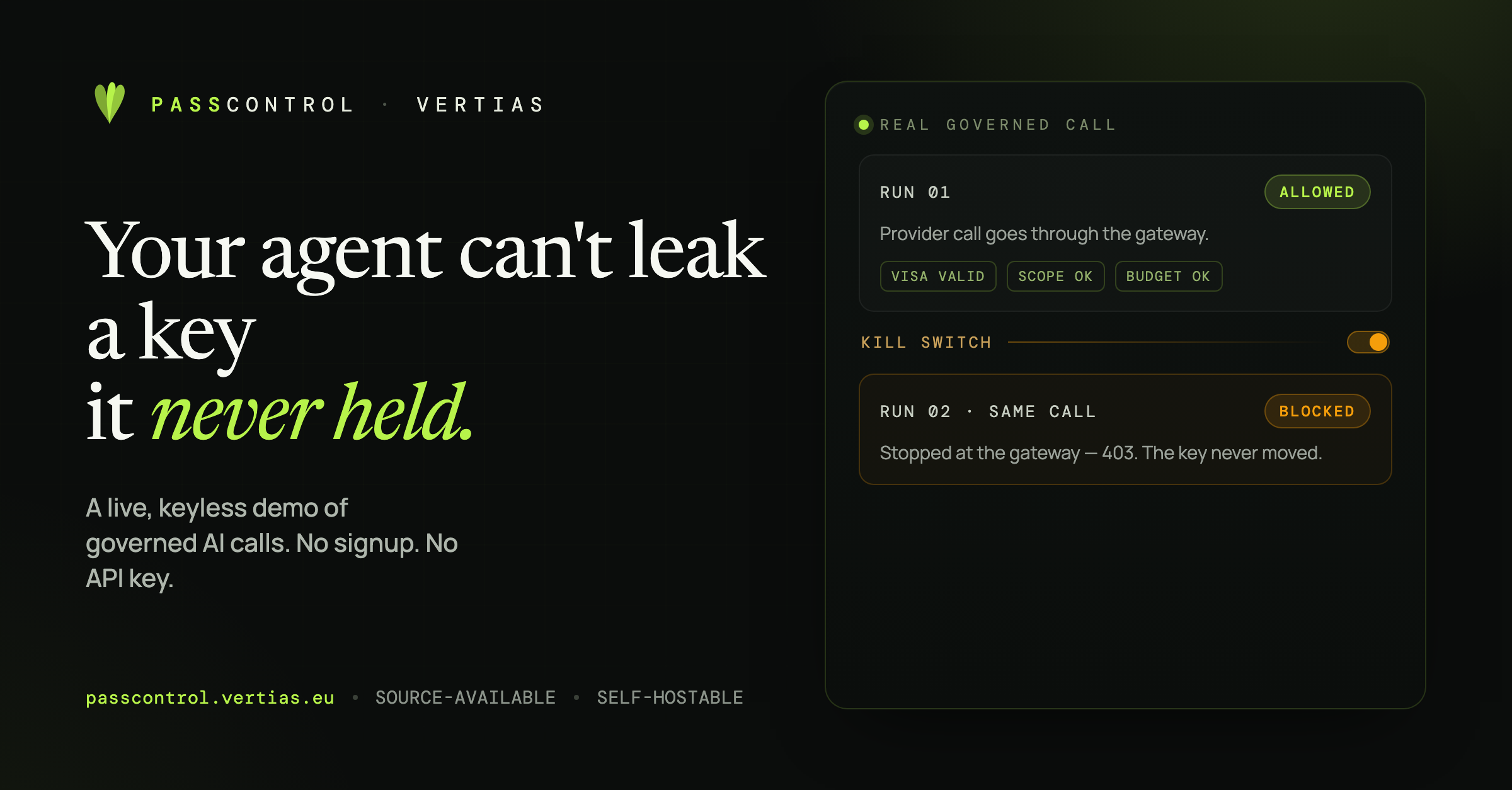
What happened
PassControl, a source-available credential gateway, lets AI agents call OpenAI, Anthropic, and other providers without ever holding the real API key. Instead, each agent gets a cryptographic Ed25519 identity and a short-lived work-visa token; the gateway verifies the request, checks budget and scope, then injects the real key in-flight and proxies the call.
Why it matters
Keeping real API keys out of agent runtimes shrinks the blast radius if an agent is compromised or logs its environment. Teams can now revoke a single agent's access at the gateway instantly without rotating every provider key or restarting processes. Budget limits are enforced per agent before the provider call, so spend overruns can be prevented rather than just audited.
What to watch
PassControl is early (v0.4.x), solo-built, and not yet independently audited—the authors recommend testing against non-critical keys first. It is source-available under the Business Source License 1.1 (not OSI open source) and supports OpenAI, Anthropic, Groq, Mistral, Together, and DeepSeek. A sidecar auto-refreshes the work-visa token, so multi-hour sessions do not time out even with 5-minute token lifespans.
Summaries like this, in your inbox every morning.
PassControl addresses a practical security gap in AI agent deployment: most teams today embed real API keys (like OpenAI's `sk-proj-...` secrets) directly in agent code or environment variables, accepting the risk that an agent crash, compromise, or log leak exposes those credentials. The core insight is cryptographic separation—each agent gets a non-secret identity (an Ed25519 keypair) instead of the secret that pays for API calls. The agent signs a challenge locally using only its private key (never sent on the wire), the gateway validates that signature, checks the agent's scope and budget against a policy, and only then retrieves the real provider key from a secure vault and injects it into the proxied request.
This design achieves three concrete gains. First, revocation becomes instant and targeted: a team can kill access for one agent at the gateway without rotating keys across every provider or restarting agent processes. Second, budget enforcement becomes preventive rather than reactive: PassControl reserves token and cost limits atomically before the provider call, so overspend can be blocked rather than discovered after the fact. Third, audit trails are centralized at a single policy boundary—every governed call is logged with provider, model, status, tokens, cost, latency, and agent identity, giving operators one view of all agent activity.
The trade-off is that PassControl is early (v0.4.x), built solo, and not yet independently audited. The authors explicitly recommend testing against non-critical keys first and note that careful code is not the same as audited code. The source is available under the Business Source License 1.1 (not OSI open source), so users can inspect the credential path and self-host, but it is not freely modifiable open source. The authors also plan paid hosting and an accountability layer later.
Pick your industry and the AI tools you use, and get news related to your work every day.
Free · 30 seconds with Google · unsubscribe anytimeWhat is AIToday? →
Ask AI anything about this article. The AI reads this article, earlier AIToday articles, and Wikipedia, and cites its sources. Q&As are published on this page for other readers too.
Chunghwa Telecom president Rong-shy Lin said the shift from conversational AI to autonomous AI agents is resha…

Apple and Meta said they would jointly release a new open-weight AI model designed to run on high-end Macs, ai…

A writer and entrepreneur opened his daily to-do list and found 156 items, and concluded that an AI assistant…

A Zenn contributor sorted AI use into three modes — AI as an assistant, AI running alongside people, and AI th…

The walkthrough points the CLI at a local mock via the ANTHROPIC_BASE_URL environment variable
A non-engineer operator says one person ships four smartphone apps on Google Play, three on the App Store, wit…

