What happened
Atmospheric CO2 reached 432 ppm in May 2026 and is accumulating roughly three times faster than in the 1960s; South Korea's fertility rate stands at 0.80 births per woman (2025), far below the 2.1 replacement level, with Seoul at 0.63; and major infrastructure projects like Saudi Arabia's NEOM face massive cost overruns ($8.8 trillion projection vs. original plans), forcing construction suspension after only 2.4 of 170 kilometers completed.
Why it matters
These three separate systems — the atmosphere, human reproduction, and state power — are straining simultaneously on different timescales and for different reasons, but all converge on the same problem: a shrinking, aging workforce must fund and build climate-resilient infrastructure while institutional capacity is concentrated unevenly across states and firms, leaving smaller or resource-poor economies facing harder constraints.
What to watch
Whether large institutions can actually finance and control the infrastructure required to manage climate and resource scarcity, or whether even unlimited capital (as NEOM's $8 billion write-down suggests) hits structural limits that make decentralized adaptation the default path.
Summaries like this, in your inbox every morning.
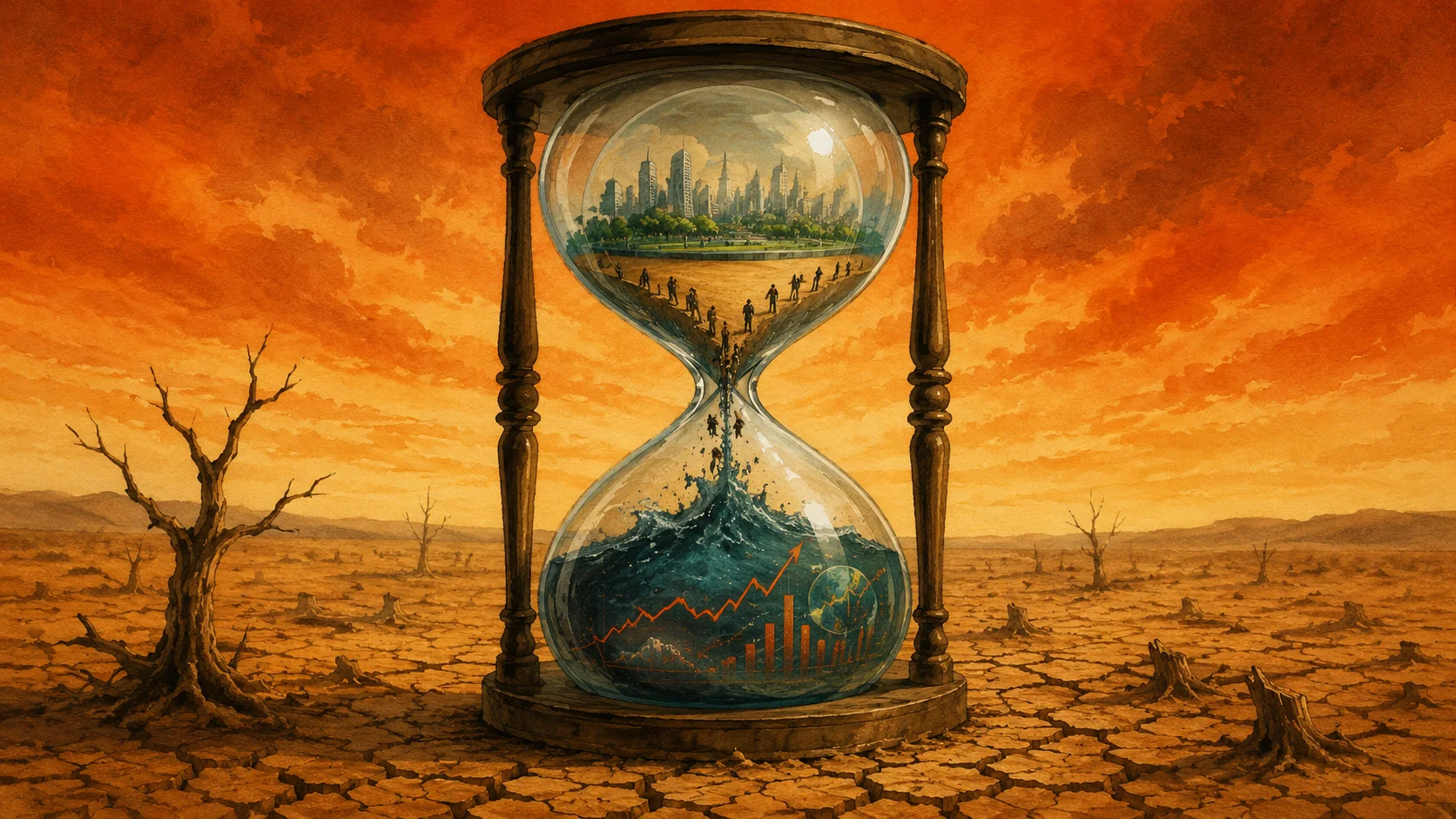
The article frames a fundamentally novel problem: not a single dramatic crisis with a clear date and villain, but three independent systemic pressures converging on shared resource and infrastructure constraints. Each pressure originates from entirely separate causes — atmospheric physics, demographic and gender dynamics, competitive capital allocation — yet all require massive institutional coordination and financing to manage. The key insight is timing mismatch. Biological and evolutionary adaptation unfold across thousands of generations; atmospheric CO2 has shifted in roughly one human lifetime. Labor markets and pension systems built to handle one shock at a time now face multiple overlapping demands: climate infrastructure requires capital and coordination, but the workforce funding it is simultaneously shrinking, aging, and exhausted by domestic cultural conflict (as evidenced by South Korea's political polarization along gender lines). This isn't a story of coordinated human response; Google Cloud grew 63% while Meta's comparable numbers fell, showing competitive market sorting rather than unified strategy. The article's most concrete example — NEOM's stalled foundations — demonstrates that even unlimited capital hits structural limits. What emerges is not doom but exhaustion arriving earlier than expected, with institutional absorption happening "more slowly, and more unevenly, than either the optimists or the doomers expect."
For example, today's edition would include:
AI-summarized, only the topics you pick: one digest a day via Email, LINE, or Slack.
Free · 30 seconds with Google · unsubscribe anytimeWhat is AIToday? →
Ask AI anything about this article. The AI reads this article, earlier AIToday articles, and Wikipedia, and cites its sources. Q&As are published on this page for other readers too.

