What happened
Taiwan is on track for its first double-digit GDP growth since 2010 driven by AI hardware exports; Japan, Malaysia, Singapore and China all reported over 20% export growth in July, while South Korea's exports surged more than 60%. Chipmaker ChangXin Memory Technologies and robot manufacturer Unitree shares surged more than 450% on their first trading days in late July and August.
Why it matters
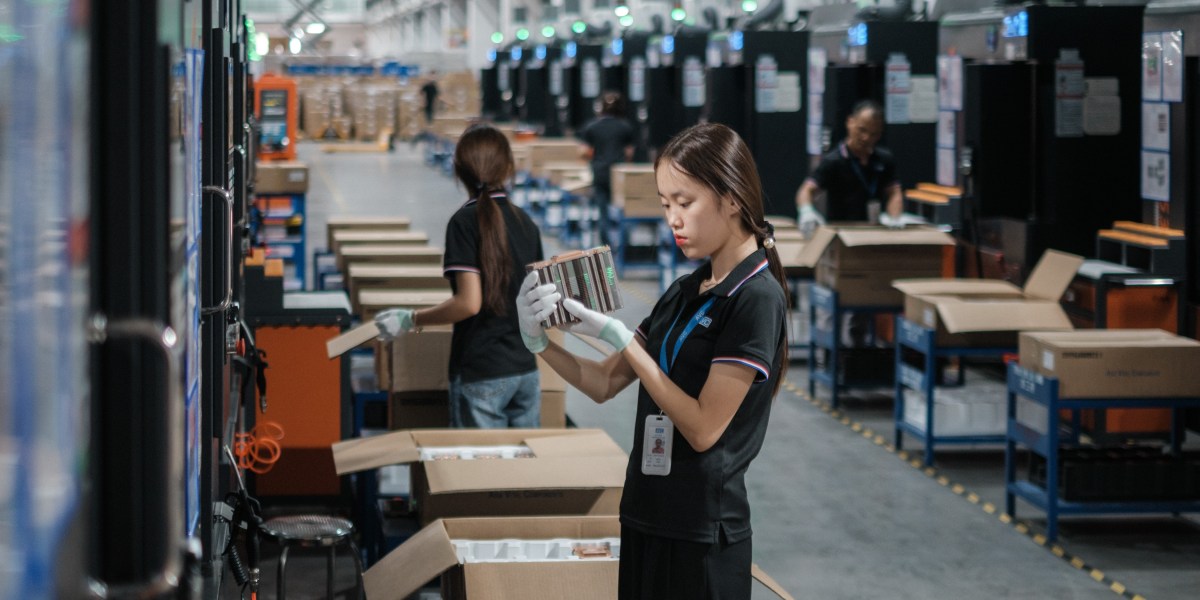
Southeast Asia's growth comes from providing supporting semiconductors and data center power—commodities with no sustained competitive advantage, according to Danny Quah of Singapore's Lee Kuan Yew School of Public Policy. The region risks being trapped at the bottom of the AI value chain because its competitive edge (cheap, low-skilled labor) could erode as populations age and skilled workers leave, while grid reliability and water shortages limit data center expansion.
What to watch
The U.S. and China are pushing countries to choose between competing AI frameworks—Pax Silica (U.S.-led) and WAICO (China's World Artificial Intelligence Cooperation Organization)—a geopolitical split that threatens Southeast Asia's traditional multi-source investment model. Singapore lifted its 2024 growth forecast to 4.5–5.5% on August 11, citing AI-related sectors, while Malaysia and Thailand are investing in data centers and cloud computing.
Summaries like this, in your inbox every morning.
Asia's AI boom is real but geographically uneven. Taiwan, South Korea, Japan and Singapore—economies with established semiconductor and technical talent—are capturing the gains through hardware exports and equity market rallies (Japan's Nikkei 225 and South Korea's KOSPI are up roughly 25% and almost 60% year-to-date, respectively). Southeast Asian economies initially appeared to benefit: Singapore lifted its 2024 growth forecast to 4.5–5.5% on August 11, citing AI-related sectors, while Malaysia, Thailand and Vietnam attracted investments in chip assembly, data centers and cloud computing.
However, experts see a structural trap. As economist Danny Quah explains, Southeast Asia's role is confined to commodifiable supporting tasks—chip assembly, testing, packaging, and providing power for data centers—rather than designing or leading frontier AI development. This arrangement leaves the region vulnerable to low margins, wage competition from robots, and the natural erosion of its comparative advantage as labor costs rise and populations age (Malaysia is projected to become an "aged nation" by 2048, when 14% of citizens will be 65 and above). Brain drain—particularly Malaysia's long-standing outflow of skilled talent to Singapore and the West—further constrains the region's ability to climb the value chain. Grid congestion and water shortages also limit data center expansion, meaning Southeast Asia cannot easily scale its AI infrastructure without solving underlying energy and expertise gaps.
The geopolitical dimension deepens the risk. A Reuters report revealed that the U.S. is pushing countries to choose between the U.S.-led Pax Silica framework and China's WAICO (World Artificial Intelligence Cooperation Organization). This divide threatens Southeast Asia's decades-long strategy of economic openness and strategic hedging across multiple powers. Smaller economies with limited bargaining power may face pressure to align with one superpower, constraining their access to technology, investment and markets from the other. The ASEAN Digital Economy Framework Agreement (DEFA), set to be signed in November, offers a possible regional counterweight by unifying digital trade rules across Southeast Asia—but its effectiveness depends on whether members can maintain economic interoperability while navigating the U.S.–China split.
Pick your industry and the AI tools you use, and get news related to your work every day.
Free · 30 seconds with Google · unsubscribe anytimeWhat is AIToday? →
Ask AI anything about this article. The AI reads this article, earlier AIToday articles, and Wikipedia, and cites its sources. Q&As are published on this page for other readers too.

