What happened
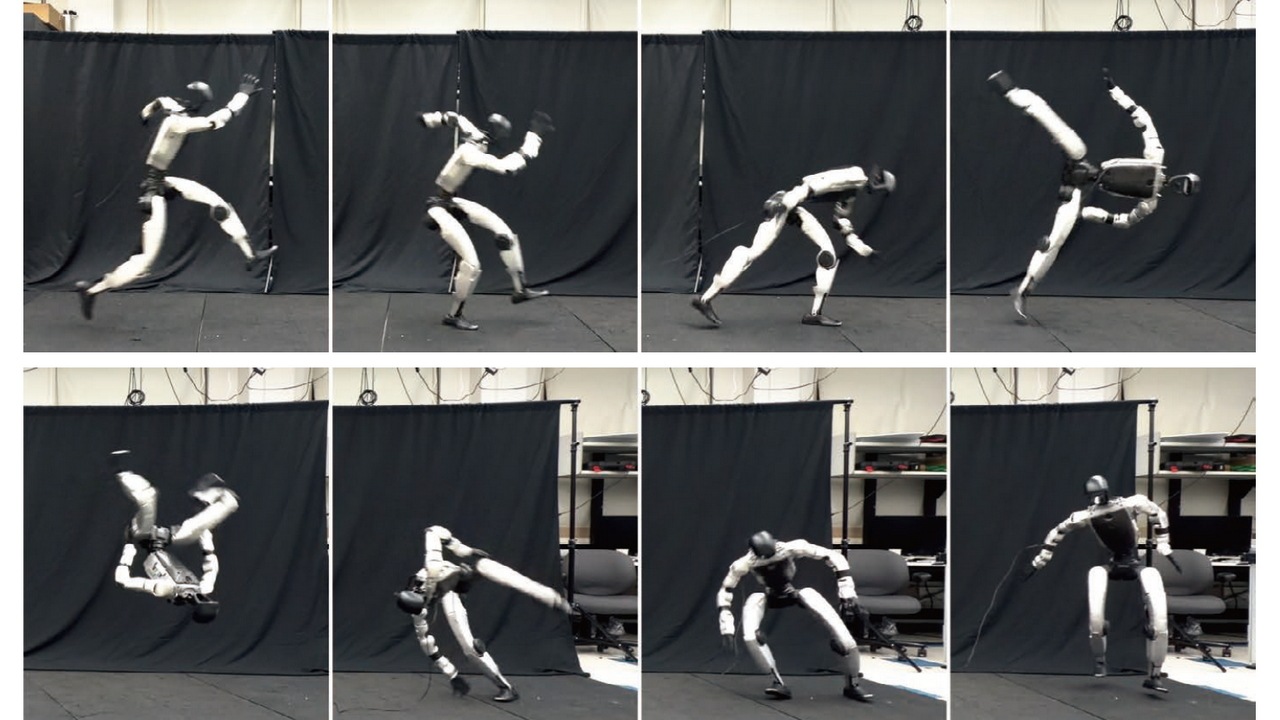
Pieter Abbeel's group at University of California Berkeley published SuperMimic, which replaces the physics simulator in sim-to-real with a neural world model, speeding reinforcement learning by up to several hundred to nearly 1,000 times.
Why it matters
This means robot learning can be completed entirely in computer simulation without any trial and error on a real machine, and it also succeeds at difficult motions that conventional physics simulators struggled with.
WHO IT HITSRobotics research teams working on sim-to-real for humanoid locomotion and full-body control could cut simulation time dramatically, and they may gain access to motions that physics-simulator-based training could not achieve.
Summaries like this, every morning.
The result comes from a group led by Pieter Abbeel, a professor at the University of California, Berkeley who is also affiliated with Amazon's Frontier AI & Robotics (FAR) organization. Abbeel is a well-known figure in robot machine learning; about a decade ago he paused his university teaching to work full-time as a researcher at OpenAI when that company was still doing robot reinforcement learning. He is also the mentor of Chelsea Finn, a co-founder of Physical Intelligence, and a former research collaborator of Sergey Levine.
The work sits in the classical lineage of world models in robot learning rather than the recent video-generation wave. WAM (world action model) and VAM (video action model) approaches, such as NVIDIA's DreamZero covered in the April 2026 issue of this magazine, are built mainly on diffusion-based video generation and are being applied to manipulation tasks. Abbeel's method instead directly predicts the state quantities of the robot and its environment as parameters.
The body notes that sim-to-real is currently used extensively for humanoid walking (locomotion) and full-body motion control such as dance. If the speed and success-rate gains hold, this could represent a significant step for that area, though the findings are presented as a university research result rather than a deployed product.
Pick your industry and the AI tools you use, and get news related to your work every day.
Free · 30 seconds with Google · unsubscribe anytimeWhat is AIToday? →
Ask AI anything about this article. The AI reads this article, earlier AIToday articles, and Wikipedia, and cites its sources. Q&As are published on this page for other readers too.
Meta released Muse Ember, its smallest and most efficient AI model, available from April 9 as muse-ember-1.0 o…
NVIDIA introduced GR00T 2, an open world action model trained on 100,000 hours of egocentric data
On Paramount Skydance's earnings call, CEO David Ellison said AI could be the 'biggest creative unlock in mode…

AT&T is rebuilding its network for the AI and autonomous era, Fierce Network reported

IBM plans to bring Anthropic's Claude Mythos cyber reasoning into IBM Concert Protect, combining AI code scann…
Apple's CEO is pressing the company's software chief to pursue a more ambitious AI strategy, Bloomberg.com rep…