What happened
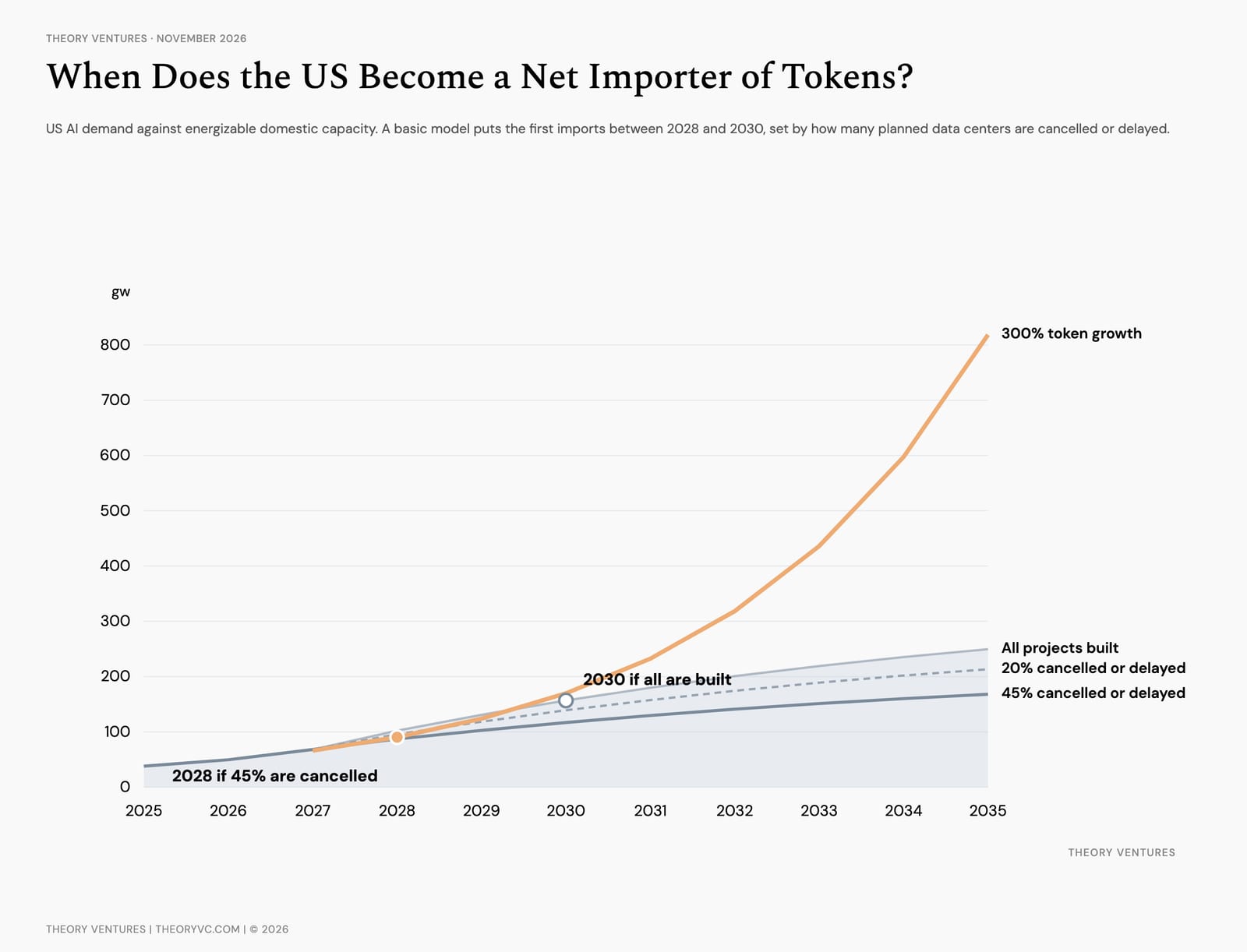
Tom Tunguz's model estimates the US will consume more tokens than it produces between 2028 and 2030. If 45% of planned projects fail to connect, imports start by 2028; even if every proposed facility gets built on time, the gap still opens by 2030.
Why it matters
The US becoming a net importer would mirror its position as a net importer of rare earth metals, meaning domestic AI capacity would no longer keep pace with demand. The timing hinges on how many planned facilities materialize, with even the best-case scenario showing a gap by 2030.
Summaries like this, every morning.
The prediction rests on a simple physical constraint: power required equals tokens demanded divided by tokens per watt. Current systems, with new data centers coming online, can handle 2.5x annual token growth, but above that rate, efficiency gains from chips and models can no longer offset domestic demand growth. This is why the timing of the US becoming a net importer is framed as a range—2028 to 2030—depending on how many planned facilities actually get built and connected.
What the physical models leave out is price. They assume the cost of compute stays constant, but in reality when supply chokes, prices spike. So far, demand has proven remarkably price-inelastic: short-term GPU rental prices surged from $5 to more than $13 per hour over the past two quarters, Anthropic signed billions in burst compute at premium rates, and overall demand barely blinked. Buyers simply paid the toll.
The open question is at what price demand would finally slow—whether it is model labs burning capital to pre-train the next frontier, enterprises financing vibe-coding teams that burn hundreds of millions of tokens a week, or consumers asked to pay $40 a month for an autonomous agent subscription. Throttling demand through scarcity pricing denies the basic market reality that at a lower cost of production, demand would be orders of magnitude higher. Without domestic power and facilities to satisfy that demand, tokens will simply be produced elsewhere and imported, making the US a net importer just like it is a net importer of rare earth metals.
Pick your industry and the AI tools you use, and get news related to your work every day.
Free · 30 seconds with Google · unsubscribe anytimeWhat is AIToday? →
Ask AI anything about this article. The AI reads this article, earlier AIToday articles, and Wikipedia, and cites its sources. Q&As are published on this page for other readers too.

