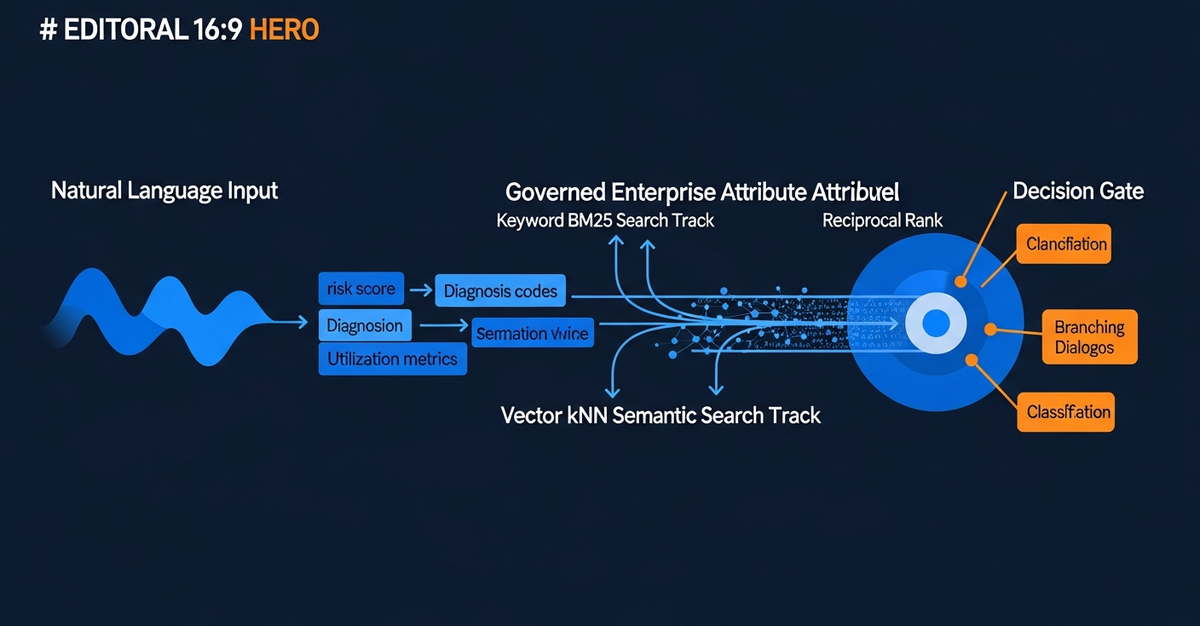
A reference architecture called Attribute Knowledge RAG has been described as a method to prevent LLMs from inventing nonexistent data fields in regulated enterprise systems like banks and healthcare organizations.
Unlike standard RAG, which retrieves document chunks and allows the LLM to generate field names freely, AK-RAG indexes individual governed attributes and restricts the LLM to phrase extraction and clarification, ensuring only attributes that exist in the catalog can appear in the output and governance policies are enforced automatically.
What happened
A reference architecture called Attribute Knowledge RAG (AK-RAG) has been documented as a solution to prevent large language models from inventing nonexistent data fields in regulated enterprise systems. Instead of embedding full documents, AK-RAG indexes an organization's attribute catalog as individual knowledge objects, with the LLM performing phrase extraction and clarification rather than free-form field generation.
Why it matters
In regulated sectors—banking, healthcare, compliance—standard RAG systems can produce confident-sounding responses that reference fields, thresholds, or identifiers that do not actually exist in the data model, creating governance failures and misleading outputs. AK-RAG fixes this at the retrieval unit level by ensuring that only attribute IDs that exist in the indexed catalog can appear in final output, eliminating the risk of field invention.
What to watch
The architecture uses a six-step query pipeline in which the LLM participates in only two steps (phrase extraction and clarification dialog generation), with deterministic governance checks—including PHI classification, HIPAA category validation, consent requirements, and minimum cell size enforcement—blocking any attribute that violates policy before the final governed DSL is emitted.
Ask the AI about this article →
The core problem AK-RAG addresses is a structural mismatch in standard RAG systems deployed in regulated enterprises. When an LLM retrieves document chunks and generates free-form text, it can reference fields, thresholds, and identifiers that exist nowhere in the actual data model. In consumer applications this is a nuisance; in credit underwriting, cohort identification for healthcare payers, or AML compliance query layers, it becomes a governance failure. Prompt-level mitigations—instructions to use only provided fields, few-shot examples, output validation—help at the margins but do not address the root cause: the retrieval unit itself is wrong.
AK-RAG solves this by making the attribute catalog, not the document corpus, the knowledge layer. The ingestion pipeline normalizes enterprise attribute metadata from Excel, CSV, or APIs, splits synonyms, parses ranges and thresholds, and transforms each attribute into a single NDJSON document. Each document is embedded and indexed with both lexical (BM25) and vector (kNN) retrieval, then fused via reciprocal rank fusion. The query pipeline is deterministic except for two LLM-driven steps: phrase extraction and clarification dialog. Three other steps—hybrid retrieval, decision policy (exact, near, ambiguous, or no match thresholds), and governance checks—are rule-based. The final output contains only attribute_id values that exist in the catalog, plus provenance metadata, making field invention structurally impossible.
For organizations in regulated industries—healthcare systems, financial institutions, compliance teams—this pattern can reduce the risk of governance violations and misleading outputs in downstream systems that depend on accurate attribute selection. The approach is agnostic to the embedding provider (sentence-transformers for development, OpenAI, Gemini, or Bedrock in production) and search backend (BM25 + vector + RRF fusion), making it adaptable to different infrastructure and scale requirements.
For example, today's edition would include:
AI-summarized, only the topics you pick — one digest a day via Email, Slack, or Discord.
Free · takes 30 seconds · unsubscribe anytimeWhat is AIToday? →
Ask AI anything about this article. Q&As are published on this page for other readers too.
CBTS Technology Solutions LLC launched Forge Agents, a platform that turns a plain-language job description in…

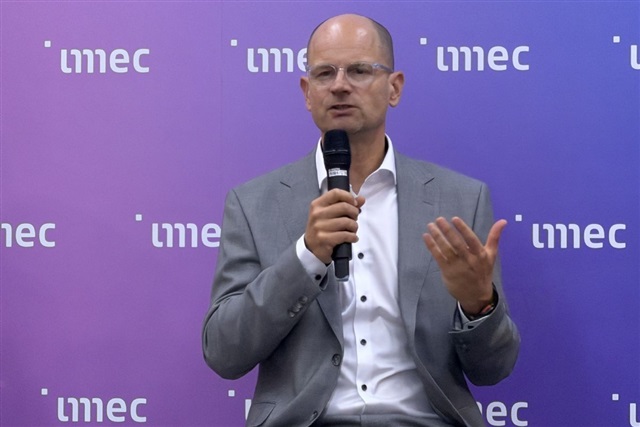
Imec CEO Patrick Vandenameele said at SEMICON Taiwan 2026 that the Belgian research center is broadening its c…
Alphabet's AI Overviews now reach over 2.5 billion monthly users through Google Search, and its ad business ge…
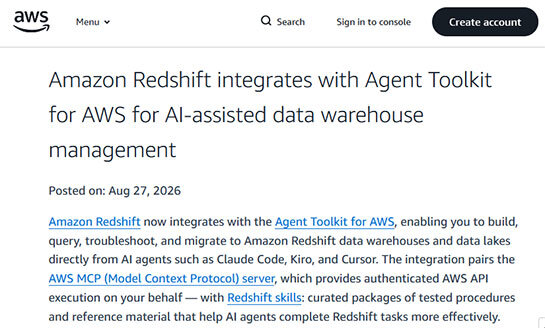
Amazon Web Services (AWS) has integrated its fully managed data warehouse service, Amazon Redshift, with Agent…
Visual Studio Code 1.135 now includes an experimental 'Rubber Duck' feature that lets developers request a sec…
Sonos announced a new app update with generative AI features, a new soundbar called the Beam Ultra, and its se…