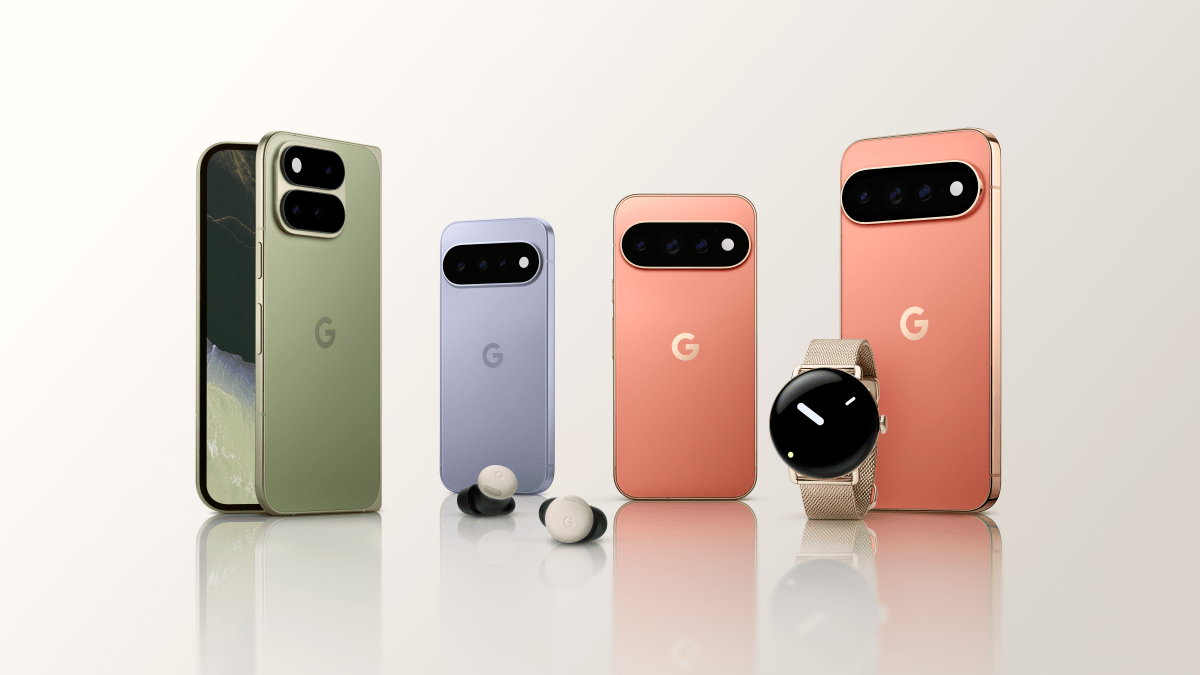
Google announced the Pixel 11 smartphone lineup, Pixel Watch 5, and Pixel Tag tracking device at its Made by Google 2026 event on Wednesday, alongside multiple Gemini AI upgrades.
The Pixel 11 starts at $899 (a $100 increase from the prior model) with 256GB base storage, while new accessibility features include American Sign Language translation via Live Transcribe and a voice-input tool called Rambler that handles natural, less structured speech.
The Pixel Tag, priced at $29, competes with Apple's AirTag by connecting to Android's Find Hub network and can be controlled through Pixel Buds voice commands.
What happened
Google held its Made by Google 2026 event on Wednesday, announcing the Pixel 11 series (standard, Pro, Pro XL, and Pro Fold), the Pixel Watch 5, and Pixel Tag—a $29 tracking device to compete with Apple's AirTag. The company also rolled out new Gemini features including Live Transcribe support for American Sign Language, a voice-input tool called Rambler, and expanded Circle to Search access from the Pixel Camera.
Why it matters
The Pixel 11 starting at $899 represents a $100 price increase from the Pixel 10, driven by doubled base storage (256GB) and RAM supply constraints. The Pixel Tag's $29 price and integration with Gemini voice commands position Google to capture users already invested in its hardware ecosystem. Live Transcribe's ASL support and Rambler's handling of natural, unstructured speech expand accessibility for people with different communication needs.
What to watch
The Pixel 11 Pro Fold is claimed to be three times more durable than its predecessor and nearly 10% lighter. The Pixel Watch 5 introduces monthly blood pressure and insulin resistance trend summaries via the Google Health app. Pixel Tag connects to Android's Find Hub network, similar to Apple's Find My ecosystem, and can be controlled via Pixel Buds voice commands.
Google held its Made by Google 2026 event on Wednesday, unveiling a full hardware refresh centered on the Pixel 11 family and new Gemini-powered capabilities. The standard Pixel 11 features a redesigned camera bar more than 40% thinner than its predecessor, with an all-glass surface that stretches across the width of the phone. Base storage doubles to 256GB, eliminating the 128GB option; the phone starts at $899, a $100 increase from the Pixel 10. Color options include Frost, Hibiscus, Pistachio, and Obsidian.
The Pixel 11 Pro and Pro XL emphasize durability, with improved drop resistance and a new anti-scratch display coating providing more than twice the scratch resistance of Pixel 10 Pro models. The Pro line starts at $1,099 (up from $999 for the Pixel 10 Pro) and comes in Canyon, Fog, Olive, and Obsidian, with this year's Obsidian featuring an all-matte finish. The Pixel 11 Pro Fold, available in Olive and Obsidian, is nearly 10% lighter and almost 1mm thinner than the Pixel 10 Pro Fold; Google redesigned the hinge and added a glass-fiber composite back cover to achieve three times greater durability than its predecessor. The Pro Fold also includes a 48-megapixel main camera and 30x Super Zoom.
Google introduced the Pixel Tag, a tracking device priced at $29 (or $99 for a four-pack) that connects to Android's Find Hub network—similar to Apple's Find My—allowing users to locate keys, wallets, and luggage through the Find Hub app or from a Pixel Watch. Pixel Buds users can voice-command Gemini to find or ring a Pixel Tag. The Pixel Watch 5 arrives with new health features: the Google Health app now provides monthly summaries of blood pressure trends and insulin resistance trends to help users identify patterns. The 41mm model starts at $429, the 45mm at $429, and Google is also offering a Stephen Curry edition for $579 with an exclusive workout-focused design. Pixel Buds Pro come in a new Olive color.
On the software side, Google expanded Gemini's utility across its devices. Live Transcribe now supports American Sign Language, allowing users to translate sign language into text via the Pixel Camera—widening accessibility for deaf and hard-of-hearing users. Rambler, a new voice-input feature, is designed to understand natural, unstructured speech—handling run-on sentences, filler words, and casual phrasing without requiring carefully constructed commands. Circle to Search, previously available through gestures, can now be accessed directly from the Pixel Camera, letting users identify objects, search distant items, translate text, or ask questions about their surroundings without leaving the camera app.
AI-summarized, only the topics you pick — one digest a day via Email, Slack, or Discord.
Free · takes 30 seconds · unsubscribe anytime
Ask AI anything about this article. Q&As are published on this page for other readers too.
Google's Gemini dropped from 12 percent to 1.9 percent market share in July 2026 according to Pangram's analys…

OpenAI released a preview of its ChatGPT desktop application for Linux on Tuesday, supporting Ubuntu 24.04 and…

Microsoft released MAI Code 1.1 Flash, a code model for GitHub Copilot that is 25 percent more token-efficient…

SpaceXAI has introduced Grok Bot, an always-on AI agent service that can sign into apps and websites to comple…

Paul Conyngham has launched Gamgee, a startup offering personalized mRNA cancer vaccines for dogs, backed by Y…

AMD predicts that agentic AI (systems that act independently rather than respond to prompts) will significantl…

The AI news that matters, in one minute each morning.
Sign up free