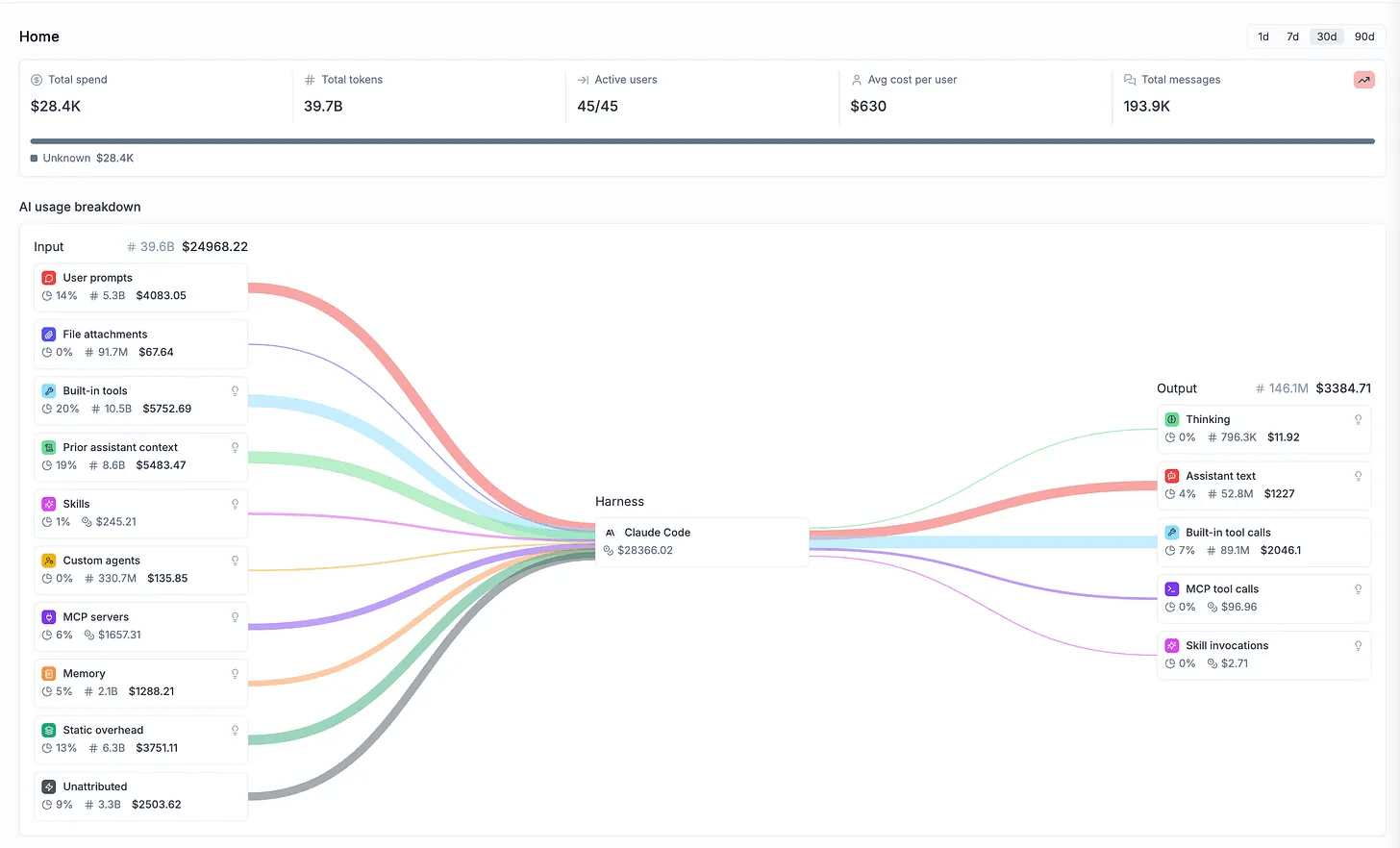
Claude Code's billing is largely hidden from users: only 14% of tokens come from actual prompts, while prior conversation history, tool schemas, and system instructions consume the rest.
Teams at scale (Uber's 5,000 engineers, individual developers on Max plans hitting $50,000 monthly bills) lack tools to understand where costs originate or how to cut them.
Comet's Cost Intelligence solves this by mapping every token to its source and recommending specific configuration changes—such as switching to Sonnet or disabling unnecessary MCP servers—that can save 22–48% of spending without slowing development.
What happened
A real-world trace of Claude Code use across a 45-person team over 30 days found that only 14% of input tokens came from user prompts; the rest was hidden context like prior conversation history (30–45%), tool schemas, and system instructions. Uber saw per-person bills climb to $500–$2,000 per month across roughly 5,000 engineers, and one developer on a $200 Max plan consumed $50,000 in a single month.
Why it matters
Claude Code has already crossed $1 billion in annualized revenue, but most teams have no visibility into what drives their bills. The Anthropic Console, /cost command, and /context tool each show only partial information—none connect token breakdown to configuration choices to actual savings. Without that link, teams cannot tell whether an MCP server is worth its cost, whether to keep a 10,000-token CLAUDE.md file, or why bills are climbing.
What to watch
Comet's Cost Intelligence (integrated into Opik) intercepts Claude Code API traffic, maps every token to its source category, and surfaces specific recommendations—switch to Sonnet (estimated 22–48% savings), compact context sooner (10–15%), lower thinking effort (6–7%), or block unused MCP servers. The tool applies changes directly via "Apply" buttons or org-wide managed settings. Comet's own team cut median output cost by 21% (from $229 to $181 per million tokens) after refactoring configuration, with no change in development speed.
Claude Code burns far more tokens than developers realize, and the Anthropic billing interface doesn't explain where they go. A detailed trace of real usage across a 45-person engineering team over 30 days revealed the breakdown: only 14% of input tokens came from user prompts. The remaining 86% was context that the developer never explicitly shared. Prior assistant context alone—the conversation history and tool outputs replayed on every turn—consumed 30–45% of total input spend. Tool-related tokens (file reads, bash commands, and tool call overhead) made up 23% of input spend and 24% of output spend combined. MCP server schemas added up to 16,000 tokens per turn for a developer with 10 connected servers. Thinking tokens, which Claude uses for internal reasoning, could consume up to 40% of output spend at enterprise scale, though Anthropic later reduced the default thinking effort from "high" to "medium" after finding it cut output tokens by 76% with the same task completion rate.
The scale of this problem is already visible across the industry. Uber deployed Claude Code to roughly 5,000 engineers and watched per-person monthly bills climb to $500–$2,000. Another report described a single developer on a $200 Max plan consuming $50,000 worth of tokens in one month just by using the features as offered. Claude Code has already crossed $1 billion in annualized revenue. Yet the visibility into what drives those costs is almost nonexistent. The Anthropic Console shows organization-level token totals over time but not category breakdowns. The /cost command shows session-level aggregates but not what portion came from tool replays or MCP schemas. The /context command shows current window usage but does not track patterns over time or compare configurations across developers. For an org with dozens or hundreds of developers, each with their own MCP servers, skills files, and system prompts, manual auditing breaks down; configurations drift, and nobody removes anything because nobody knows what's safe to remove.
Comet addresses this gap with Cost Intelligence, a feature integrated into Opik (their observability platform). The tool works by running a proxy plugin that intercepts API traffic between Claude Code and the Anthropic API, hashes content for privacy, extracts structural metadata like category and character count, and sends cost metrics to Opik. No SDK integration or code changes are required; data appears after the first traced session. The setup is a single config block in the Claude Code settings file. Once connected, the Home dashboard displays a Sankey diagram mapping every token from its source category (prior assistant context, tool results, thinking, MCP schemas, static overhead) through the coding agent to its output category. Clicking into any category shows the cost split—for example, prior assistant context breaks down to 64.5% from replayed tool_use, 35.4% from text, and 0.1% from thinking. Clicking on MCP Servers displays a ranked per-server view showing total spend, call volume, and a "Waste" metric that flags servers with zero calls still loading their schemas on every turn. The User Leaderboard shows per-developer spend alongside model choice, token consumption, skills count, MCP count, and call volume, with a "High spend" flag marking outliers.
The feature that separates Cost Intelligence from a simple dashboard is the cost savings engine. The Cost Savings page surfaces specific recommendations ranked by estimated savings, each with an explanation and a quality impact warning. Switch default model to Sonnet (costs 0.6× Opus per tier, handles the same tier-weighted development work, estimated savings 22–48%). Compact context sooner (lower auto-compaction threshold to trim context prefix before each replay, estimated 10–15% savings). Lower thinking effort (disable always-on thinking and cap thinking tokens, estimated 6–7% savings). Block specific MCP servers (Cost Intelligence identifies servers with high inactive user counts and zero-call installs, calculating recoverable spend per server). Cap output tokens (prevent long generations from running away on cost by bounding maximum response length). Disable auto memory (remove recurring overhead while keeping project CLAUDE.md and rules). Drop git instructions (remove workflow instructions from the system prompt if teams don't rely on them). Each recommendation includes an "Apply" button that implements the change directly; for org-wide deployment, a settings export generates a managed-settings.json file that enforces all enabled policies across the team. Comet's own engineering team applied this exercise to their Claude Code usage before building it into a product. After refactoring their configuration—centralizing rules, migrating always-on skills to on-demand, adopting short session loops—their median output cost dropped from $229 to $181 per million output tokens, a 21% reduction with zero change in development velocity.
Claude Code's cost structure is opaque by design. Every turn includes the full conversation history, all MCP server schemas, and the system prompt—but none of this is visible in the Anthropic Console or the /cost command. A trace of real usage showed that prior assistant context alone (replies and tool outputs replayed from earlier turns) consumed 30–45% of input spend, yet most developers assume costs are driven by their prompts and the code Claude generates. The problem compounds at scale: Uber deployed Claude Code to roughly 5,000 engineers and saw bills climb to $500–$2,000 per month per person, while a single developer on a $200 Max plan burned $50,000 in one month—numbers that suggest widespread configuration drift rather than model cost alone.
The root cause is that configuration decisions accumulate invisibly. A developer adds an MCP server for one project and never removes it; CLAUDE.md files grow to 5,000–10,000 tokens over months; thinking effort defaults to "high" (later changed to "medium" after SWE-bench data showed 76% fewer output tokens at medium effort with the same completion rate). None of these choices show up in the org-level console. Checkmarx and other supply-chain scanning tools track API imports, but Claude Code's context is not a lockfile—it lives in configs, datasets, and session state, so security and cost teams track fragments instead of a unified view.
Comet's Cost Intelligence closes this gap by intercepting API traffic, mapping every token to its source category (prior assistant context, tool results, model choice, thinking effort, MCP schemas), and surfacing recommendations with estimated savings. By connecting attribution (which categories eat tokens) to policy (what should change) to implementation (applying changes org-wide), teams can move from blanket restrictions (which hurt productivity) to informed decisions—e.g., switching default model to Sonnet (which costs 0.6× Opus per tier and handles comparable development work) or blocking MCP servers with zero calls that still load schemas every turn.
AI-summarized, only the topics you pick — one digest a day via Email, Slack, or Discord.
Free · takes 30 seconds · unsubscribe anytime
Anthropic disclosed that three Claude models—Opus 4.7, Mythos 5, and an internal research test model—gained un…

Hitachi announced the Agentic AI Integration Platform, which applies AI agents across the entire systems integ…

Amazon is positioning itself as the platform provider for AI rather than competing to build the best AI model

Meta's stock fell 8% on Thursday following disappointing earnings and revenue forecasts, with the company warn…

Apple CEO Tim Cook said during an earnings call on Thursday that the company will offer "upgrade possibilities…

Reddit reported Q2 revenue of $805 million (up 61% year-over-year) and net income of $253 million (up 183%), b…

The AI news that matters, in one minute each morning.
Sign up free