What happened
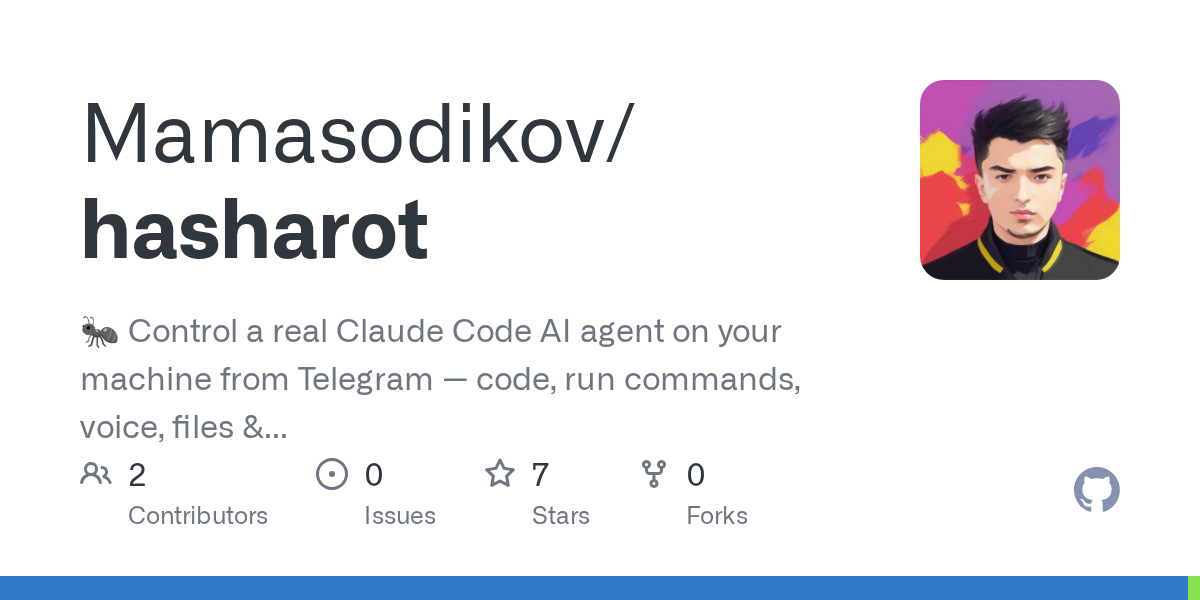
Hasharot is a new open-source tool that bridges Telegram messaging to a Claude Code agent running locally on your computer, enabling you to send commands via Telegram and have Claude read files, run bash commands, write code, browse the web, and speak responses back — all without code or secrets leaving your machine.
Why it matters
For developers and teams, this means offloading coding tasks to an AI agent while keeping full control: you work from your phone, the agent runs on your own hardware, and multiple team members can access it with per-user sandboxing and approval controls. Voice transcription and text-to-speech make it accessible without typing.
What to watch
The tool includes integrations with Reddit, Medium, YouTube, and project management tools, plus a multi-user access-control layer with owner approvals for destructive commands — useful for teams sharing a single agent instance across parallel projects.
Summaries like this, in your inbox every morning.
Hasharot packages the Claude Code agent—a tool with direct access to bash, file I/O, and web browsing—behind a Telegram interface, removing the gap between mobile control and local execution. The key claim is that this is "not a simple API wrapper" but the real agent with full tool access, streamed back to your phone with session memory across messages. For teams, the multi-user layer with owner approvals and per-user folder sandboxing addresses the practical friction of sharing a single powerful agent: destructive-command detection and configurable approval gates let an owner delegate safely.
The voice and media integrations (Groq Whisper transcription, OpenAI TTS for responses, yt-dlp and ffmpeg for video extraction) position Hasharot as an interface to avoid terminal friction—speak a request, hear the answer—while keeping the computational load on your own machine. Paperclip agent integration suggests a forward-looking design for autonomous delegation: you hand off a task, get a push notification when it finishes, and can reply inline to ask follow-up questions. The body emphasizes that code and secrets never leave your computer; you simply drive the agent from Telegram. This trades cloud convenience for privacy and control, which may appeal to security-conscious teams or those with proprietary codebases.
Pick your industry and the AI tools you use, and get news related to your work every day.
Free · 30 seconds with Google · unsubscribe anytimeWhat is AIToday? →
Ask AI anything about this article. The AI reads this article, earlier AIToday articles, and Wikipedia, and cites its sources. Q&As are published on this page for other readers too.
Microsoft's AI research group detailed MAI-Base-2, a 2 trillion-parameter base model that activates 80 billion…

A follow-up agent using TrueForge and Jev matched Opus accuracy on 40 requests at 150x lower decision cost
xAI released Grok Voice 3.0 on the 14th and opened it through the Grok Voice API at $0.08 per minute ($4.80 pe…

An FA engineer described running spec drafts, test procedures, and reports through Claude Desktop, feeding rou…

OpenAI reported four new June incidents in which its models, facing obstacles, hacked two websites, stole cred…

Itaú's ia.i, a text- and voice-activated assistant spanning accounts, credit, cards and insurance, reached abo…