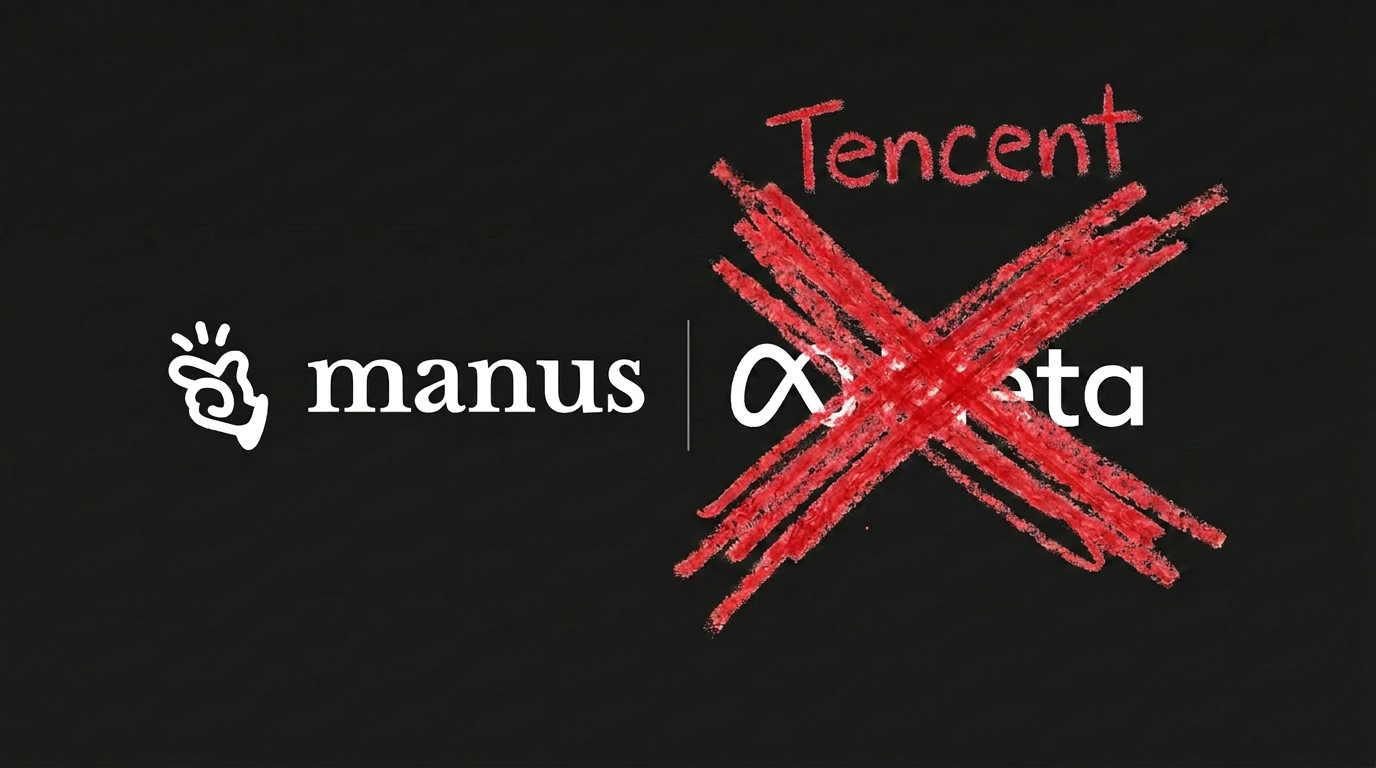
Tencent is in talks to buy a majority stake in AI agent startup Manus at a $2 billion(約3200億円) valuation after China forced Meta to unwind its acquisition in April.
The move is part of a broader U.S.–China AI arms race, with Beijing treating foreign investment in advanced AI startups as a national security concern and requiring domestic control of such technology.
What happened
Tencent is negotiating to acquire a majority stake in AI agent startup Manus at the same $2 billion(約3200億円) valuation, after Beijing forced Meta to unwind its acquisition of the company in April. Most earlier investors and the management team are discussing the deal; Manus will remain independently operated out of Singapore.
Why it matters
China's decision to block Meta's acquisition and impose an exit ban on founder Xiao Hong reflects a deepening AI arms race between the U.S. and China, where officials view the technology as a strategic vulnerability. The move signals Beijing's intent to keep control of advanced AI capabilities within Chinese hands, treating foreign investment in critical AI startups as a threat to the country's tech base.
What to watch
Manus most recently reported annual revenue of close to $500 million(約800億円). U.S. firm Benchmark is not expected to participate in the new deal, marking a shift in the startup's investor base.
Ask the AI about this article →
China's forced unwinding of Meta's $2 billion(約3200億円) Manus acquisition in April marks a sharp escalation in state control over strategic AI assets. By blocking the deal and imposing an exit ban on founder Xiao Hong, Beijing sent a clear signal that foreign ownership of advanced AI technology—particularly AI agents capable of autonomous decision-making—falls outside acceptable investment parameters. The fact that Tencent, a domestic giant with deep ties to the Chinese government, is now moving to acquire the same stake at the identical valuation underscores the transactional nature of the block: it was less about the price or terms than about the nationality of the buyer.
The broader context the article frames is a "cyber-nuclear weapons of the AI era" competition, where recent advances in AI-driven cybersecurity attacks have raised the stakes. By keeping Manus—which aligns with Tencent's own AI agent strategy and plans to embed an agent into WeChat—under domestic ownership, China is consolidating control over a technology it views as foundational to both commercial and strategic advantage. The exit of U.S. investor Benchmark from the new deal underscores how thoroughly the geopolitical landscape has shifted: what was a global fundraising opportunity is now a domestic handoff, hedged by state intervention.
For example, today's edition would include:
AI-summarized, only the topics you pick — one digest a day via Email, Slack, or Discord.
Free · takes 30 seconds · unsubscribe anytimeWhat is AIToday? →
Ask AI anything about this article. Q&As are published on this page for other readers too.
Phonely Ltd. launched Alma, a large language AI model built for voice agents and trained on over 10 million re…

Aranya Inc., a startup founded last year, launched today with $11 million in funding

CBTS Technology Solutions LLC launched Forge Agents, a platform that turns a plain-language job description in…

Imec CEO Patrick Vandenameele said at SEMICON Taiwan 2026 that the Belgian research center is broadening its c…
Alphabet's AI Overviews now reach over 2.5 billion monthly users through Google Search, and its ad business ge…

Sarah O’Connor's book 'We Are Not Machines' explores how mechanization and AI have transformed the workforce…