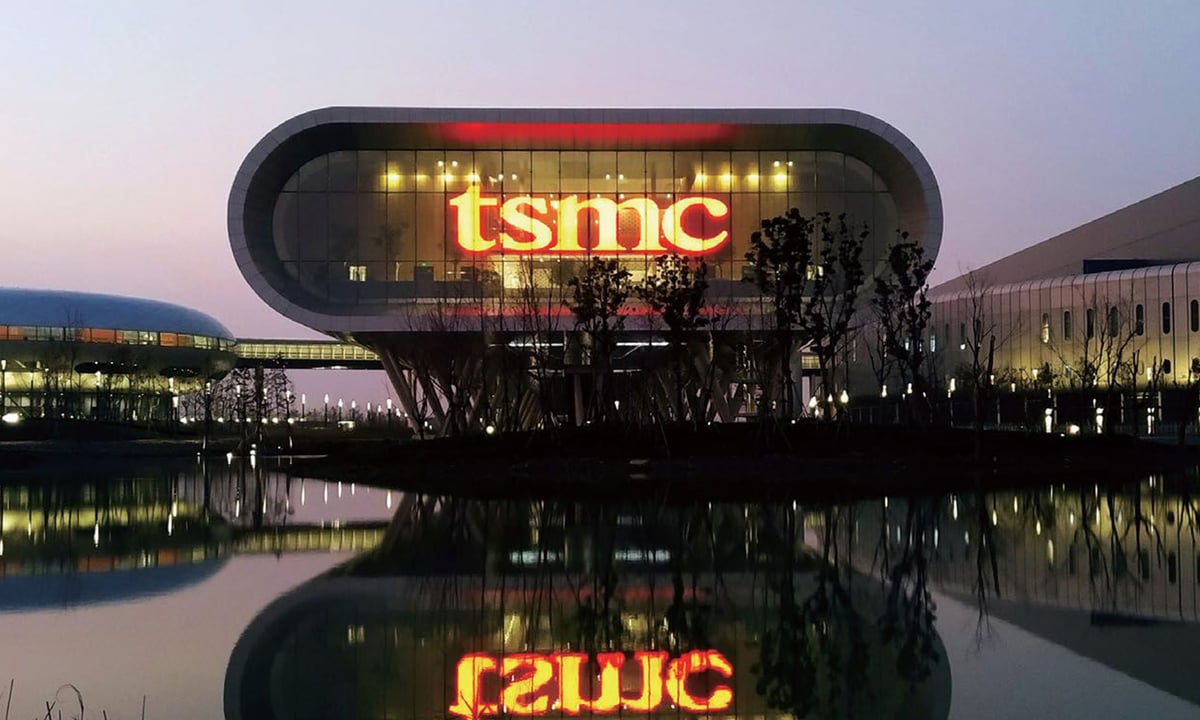
Taiwan Semiconductor Manufacturing stock has gained 32% year to date by capitalizing on its position as the world's largest chip foundry, controlling 73% of the manufacturing market. The company serves virtually all major AI chip designers—from Nvidia to Broadcom to Alphabet—and benefits from competing chip architectures and diversified demand beyond AI, making it less vulnerable to shifts in individual technology trends or customer preferences.
Summaries like this, in your inbox every morning.
Sign up free →What happened
Taiwan Semiconductor Manufacturing (TSMC) stock is up 32% year to date, outperforming the S&P 500 and rival AI chipmakers like Nvidia and Broadcom. According to Counterpoint Research, TSMC controls 73% of the chip manufacturing market, a share that has increased over recent years. The company announced plans to invest another $100 billion(約16兆円) in its Arizona foundry, bringing its total to $265 billion(約42兆円), with CEO C.C. Wei stating it plans to open four more facilities there in addition to fabs at other U.S. locations.
Why it matters
TSMC is the foundry partner behind nearly every major AI chip designer—Nvidia, Broadcom, Apple, Alphabet, and Advanced Micro Devices all rely on TSMC to physically manufacture their semiconductors. Because the company serves all major technology approaches (x86, ARM, and RISC-V architectures), it benefits from AI demand regardless of which chip designs or clients gain market share. Its diversified revenue base also extends beyond AI to smartphones and autonomous vehicles, reducing dependence on any single trend.
What to watch
TSMC's stock fell after its strong second-quarter earnings report, signaling investor concern about potential cuts to capital spending by hyperscalers (large cloud providers). Management expects demand to increase, but if major tech companies reduce infrastructure investment, it could pressure TSMC's near-term revenue.
Taiwan Semiconductor Manufacturing has emerged as the strongest performer among major AI-related stocks, gaining 32% year to date compared to slight underperformance by Nvidia and a 25% decline in Palantir Technologies. The outperformance reflects TSMC's unique position as the world's largest chip foundry, a business model that benefits from multiple layers of the AI infrastructure stack.
Unlike Nvidia and Broadcom, which design semiconductors, TSMC manufactures them at scale for virtually every major technology company. According to Counterpoint Research, TSMC controls 73% of the global chip manufacturing market—a share that has grown in recent years. The company serves as the foundry partner for Nvidia, Broadcom, Apple, Alphabet, and Advanced Micro Devices, among others. CEO C.C. Wei described TSMC's competitive advantage as rooted in "technology, manufacturing, and customer trust," and emphasized that the rise of agentic AI will be positive for the company regardless of which chip architecture dominates. "Whether it's x86, ARM-based, or RISC-V architecture," Wei said on the second-quarter earnings call, "they are almost all TSMC's customers."
TSMC is aggressively expanding U.S. manufacturing capacity to strengthen ties with its largest clients. The company announced plans to invest another $100 billion(約16兆円) in its Arizona foundry, bringing total Arizona investment to $265 billion(約42兆円). It has already completed its first facility and plans to open four more there, along with fabs at other U.S. locations. This geographic shift brings chip production closer to megacustomers headquartered in North America.
The company's diversified revenue base provides additional insulation from AI spending cycles. TSMC manufactures chips not only for AI but also for smartphones and autonomous vehicles, meaning its fortunes do not depend solely on hyperscaler capital expenditure trends. The stock fell after the company's strong second-quarter earnings report, a movement that appears tied to investor wariness about high levels of AI infrastructure spending and the risk that hyperscalers could cut capital expenditures. However, management remains confident in sustained demand growth, and TSMC's scale and customer diversity position it to capture revenue whether AI spending accelerates or moderates in the near term.
TSMC's outperformance reflects a structural advantage in semiconductor manufacturing that insulates it from near-term market swings. While companies like Nvidia and Broadcom design chips, they outsource production entirely to foundries; TSMC dominates this essential step, working with nearly all major tech companies. The company's 73% market share has grown despite new competitors like Terafab and Samsung Foundry attempting to gain ground. CEO C.C. Wei's emphasis on "technology, manufacturing, and customer trust" as the company's competitive moat suggests TSMC views its edge as durable.
The company's diversified customer base and technology neutrality create a hedge against shifts in AI architecture or spending priorities. Because TSMC manufactures chips for smartphones, autonomous vehicles, and multiple AI chip designs simultaneously, it is not heavily exposed to any single trend reversing. Management sees agentic AI as positive for its business precisely because it will drive demand across competing chip architectures, and most major designers lack their own fabs and must use TSMC.
The recent stock decline following strong earnings points to investor concern that hyperscalers may cut capital expenditure, which would pressure TSMC's revenue in the short term. However, the company's investment of another $100 billion(約16兆円) in U.S. capacity signals confidence in sustained long-term demand, particularly as it co-locates manufacturing closer to major customers like Apple and Alphabet in North America.
AI-summarized, only the topics you pick — one digest a day via Email, Slack, or Discord.
Free · takes 30 seconds · unsubscribe anytime
No comments yet. Be the first to share your thoughts!
Log in to join the discussion


Get curated AI news from 200+ sources delivered daily to your inbox. Free to use.
Get Started FreeFree · takes 30 seconds · unsubscribe anytime
1 minute a day. The AI essentials.
200+ sources · Email / LINE / Slack
