AIToday
Large Language ModelsAI Business & IndustryAmazon AI BlogPublished: Jul 31, 2026, 04:01 JST4 min read

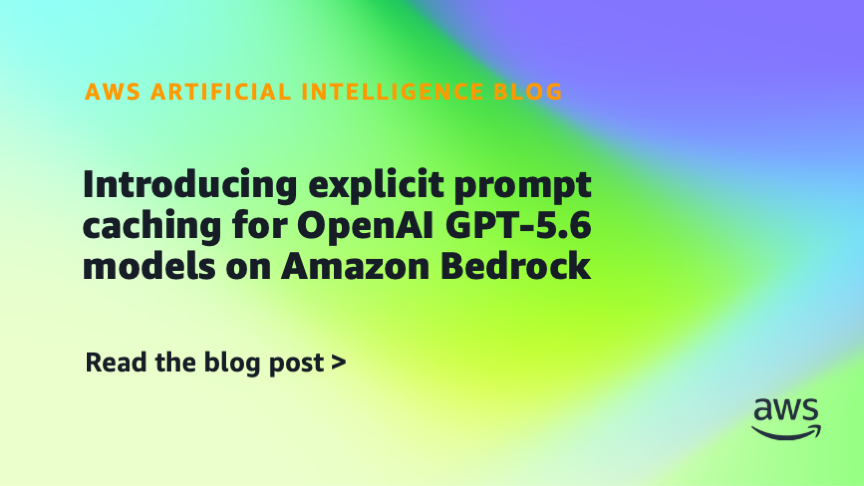
OpenAI GPT-5.6 models launch on Amazon Bedrock with prompt caching

OpenAI GPT-5.6 models launch on Amazon Bedrock with prompt caching

Key takeaway

  • OpenAI's three new GPT-5.6 models are now available on Amazon Bedrock with a new explicit prompt caching capability that discounts cached input tokens by 90 percent.

  • The feature is designed for agentic workflows where system instructions, tool definitions, and reference documents repeat across many requests, allowing developers to achieve net cost savings once cached reads represent roughly 20 percent of input token volume.

3 Key Points

  1. What happened

    OpenAI's GPT-5.6 Sol, Terra, and Luna models are now generally available on Amazon Bedrock with a new explicit prompt caching feature. Cached input tokens are billed at a 90 percent discount and remain available for reuse for 30 minutes.

  2. Why it matters

    The three-tier model family addresses different workload needs—Sol for complex reasoning and coding, Terra for balanced production use, and Luna for fast, high-volume tasks like classification. Explicit caching gives developers precise control over which prompt portions repeat across requests, lowering costs in agentic workflows where system instructions and tool definitions recur.

  3. What to watch

    A stable prefix of at least 1,024 tokens qualifies for caching. Workloads reach net cost savings once cache reads make up roughly 20 percent of input tokens flowing through the cache. GPT-5.6 Sol is available in US East (N. Virginia) and US East (Ohio); Terra and Luna are additionally available in US West (Oregon).

In Depth

Read the full story

OpenAI's three new GPT-5.6 models—Sol, Terra, and Luna—are now generally available on Amazon Bedrock, OpenAI's managed endpoint on AWS. The models are served through the OpenAI-compatible Responses API on the bedrock-mantle endpoint. Sol is designed for the most complex reasoning and agentic coding work, Terra for balanced everyday production workloads, and Luna for fast, high-volume tasks such as classification and summarization. Customers access the models via short-term bearer tokens generated from AWS credentials, allowing code to remain free of long-lived secrets.

Alongside the model launch, OpenAI and AWS are introducing explicit prompt caching for GPT-5.6, a capability that gives developers precise control over which portions of a prompt are cached and reused across requests. Cached input tokens are billed at a 90 percent discount compared to uncached tokens, while cache writes are billed at 1.25 times the uncached input rate. Cached prefixes remain available for reuse for 30 minutes. The feature is designed for write-once, read-many patterns typical of agentic workflows, where system instructions, tool definitions, and reference documents repeat across many calls. A workload lowers its net input cost once cache reads make up roughly 20 percent of the tokens flowing through the cache.

Two caching modes are available. Implicit caching, the default, is enabled automatically with no code changes required; Amazon Bedrock places a cache breakpoint and tunes it for you. Explicit caching gives developers direct control by marking the exact end of a reusable prompt prefix through the prompt_cache_breakpoint parameter. A stable prefix must contain at least 1,024 tokens. Developers can set up to 4 breakpoints per request across input_text, input_image, and input_file blocks, and use prompt_cache_key to route requests to the same cache and prompt_cache_options to control caching mode and time-to-live. Every response reports cache behavior in the usage.input_tokens_details object, breaking down cached_tokens (read at a 90 percent discount) and cache_write_tokens (written at 1.25× the uncached rate).

GPT-5.6 supports adjustable reasoning effort levels—none, low, medium, high, and xhigh, with medium as the default. Higher levels allocate more reasoning to harder problems; none gives the lowest-latency path for straightforward tasks. The body recommends that teams upgrading from GPT-5.5 or GPT-5.4 start with the same effort level they use today, then test one level lower, since GPT-5.6 is more token-efficient and many workloads maintain quality at a lower effort setting. The models support streaming, function calling, and strict JSON schema output through the Responses API. Availability is limited to US regions: GPT-5.6 Sol is available in US East (N. Virginia) and US East (Ohio), while Terra and Luna are additionally available in US West (Oregon).

Context & Analysis

OpenAI's GPT-5.6 launch on Amazon Bedrock extends the frontier model family to AWS's managed service platform, giving customers pay-per-token pricing alongside AWS security and governance controls. The introduction of explicit prompt caching addresses a specific pain point in agentic workflows, where system instructions, tool definitions, and reference documents remain static while user queries change on every call. By allowing developers to mark exactly where the reusable prefix ends, explicit caching offers more predictable hit rates than implicit caching, which Bedrock automates on its own. The pricing structure—90 percent discount on reads, 1.25× on writes—is designed to reward write-once, read-many access patterns typical of agent loops that call the same model repeatedly within a 30-minute window.

The three-tier model hierarchy reflects OpenAI's strategy of letting customers choose reasoning intensity per workload. GPT-5.6 also supports adjustable reasoning effort levels (none, low, medium, high, xhigh), allowing operators to balance latency and quality; the body notes that GPT-5.6 is more token-efficient than earlier versions, so many workloads can maintain quality at a lower effort setting than they used on GPT-5.5 or GPT-5.4. Availability varies by region—Sol in two regions, Terra and Luna in three—constraining initial adoption to US deployments.

FAQ

How much does caching cost?
Cached input tokens are billed at a 90 percent discount. Tokens written to cache are billed at 1.25 times the uncached input rate. Cached prefixes stay available for reuse for 30 minutes.
What are the three GPT-5.6 models and what are they for?
GPT-5.6 Sol handles the most complex reasoning and agentic coding work. GPT-5.6 Terra covers balanced everyday production workloads. GPT-5.6 Luna handles fast, high-volume tasks such as classification and summarization.
When does explicit caching become cost-effective?
A workload lowers its net input cost once cache reads make up roughly 20 percent of the tokens that flow through the cache.
Amazon AI BlogRead Original Article

Get the latest Large Language Models news every morning

AI-summarized, only the topics you pick — one digest a day via Email, Slack, or Discord.

Free · takes 30 seconds · unsubscribe anytime

Related Articles

Next articleWire maker PLPC stock surges 28% on Q2 earnings beat

The AI news that matters, in one minute each morning.

Sign up free