What happened
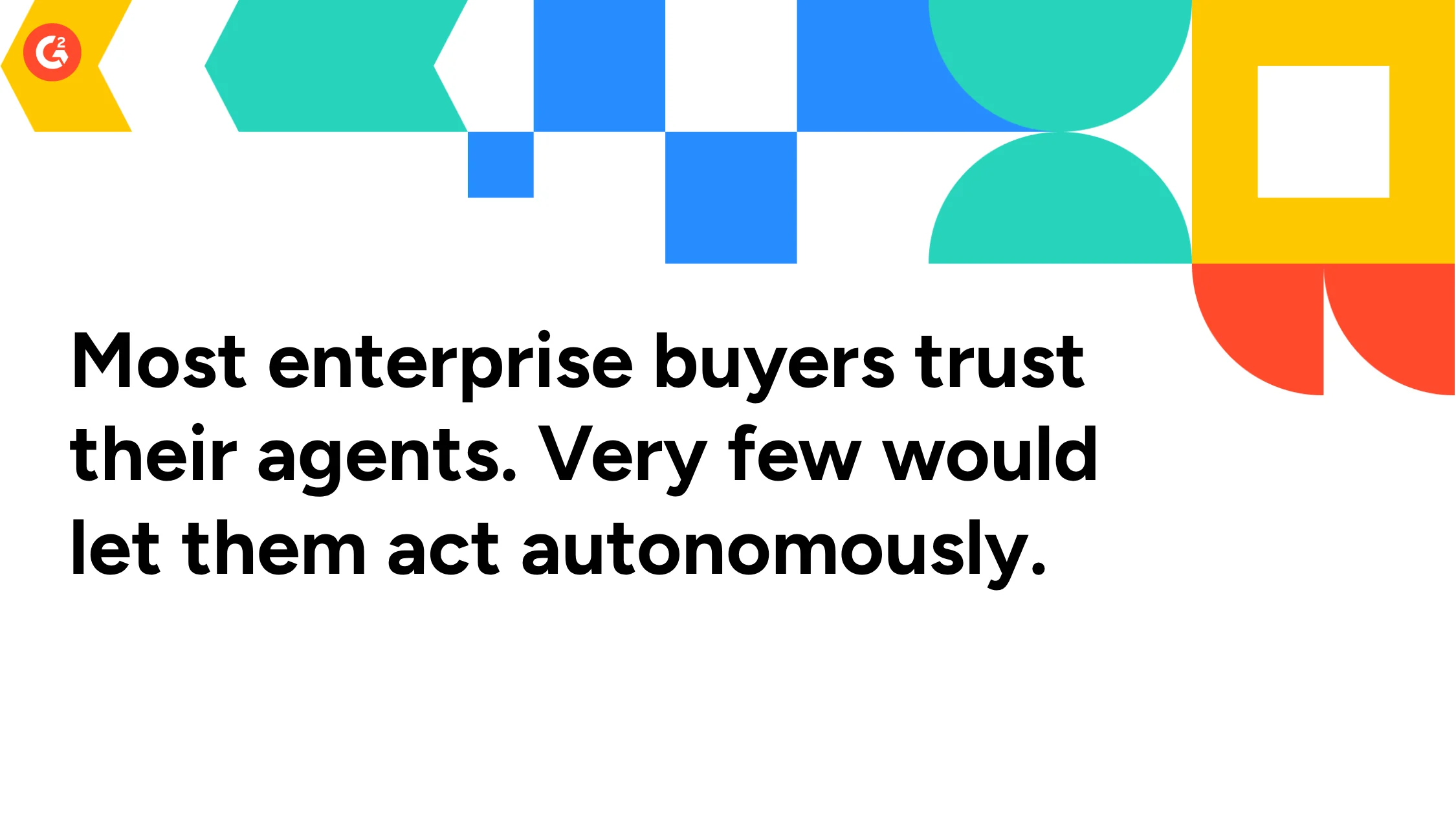
G2 analyzed 3,222 enterprise reviews from 2025 to 2026 and found that while 77% trust their AI agents, only 7% would give them total autonomy. Enterprise reviews more than doubled, from 983 to 2,239.
Why it matters
Trust and autonomy are different questions—trust covers whether the agent does its job well, while autonomy decides whether anyone checks its work before it acts—so most enterprises keep a human in the loop, according to G2.
WHO IT HITSEnterprise software sellers pitching AI agents must now lead with guardrails and control features rather than full autonomy, since the buyers signing off—admins and executive sponsors—are the least willing to grant it.
Summaries like this, every morning.
G2's review data shows enterprise adoption of AI agents deepening even as buyer enthusiasm cools. Reviews more than doubled to 2,239 in 2026, and 53% of reviewers now use their agent most or every time, up from 47% in 2025. Yet the average recommend score slipped from 9.24 in 2024 to 9.04 in 2026, with setup and complexity named in 25% of dislikes and praise for integration falling from 30% to 21%.
The autonomy gap has a concrete cost. G2's 2026 AI Agents Report calls it the Distrust Tax: 31% of organizations spend six or more hours a week overseeing agents, and 45% say oversight and rework eat up more than a quarter of the gains. Setup and shallow adoption compound the problem—average full adoption fell from 68% in 2024 to 55% in 2026.
Even high scorers keep the leash on. Reviewers who rated their agent 10 out of 10 still described building guardrails and gradual rollouts, and only 15% of those who trust their agent "very much" would grant total autonomy. Sanders' advice—sell steady, repeatable gains and a clear path to more autonomy—reflects a market where control, not capability, is the bottleneck.
Pick your industry and the AI tools you use, and get news related to your work every day.
Free · 30 seconds with Google · unsubscribe anytimeWhat is AIToday? →
Ask AI anything about this article. The AI reads this article, earlier AIToday articles, and Wikipedia, and cites its sources. Q&As are published on this page for other readers too.
Verra, founded by Kashyap Nathan and Christopher Farrington, raised $5 million in seed funding led by Kearny J…

Education Minister Sarah Al Amiri said Mira will launch in March for parents in UAE public schools, letting th…

A Zenn writer asked Claude Code to build a small Japanese library-lending Copilot Studio agent using PAC CLI…
Levent Alpöge published a 17-million-line Lean proof of the Riemann hypothesis, made with Claude; the Lean Foc…

UK-based Agon raised a $70 million Series A led by Northzone, with Lakestar, XYZ, Lux Capital, Global Founders…
BrightAI raised $97 million led by Smith Point Capital, with existing backers Khosla Ventures, Inspired Capita…