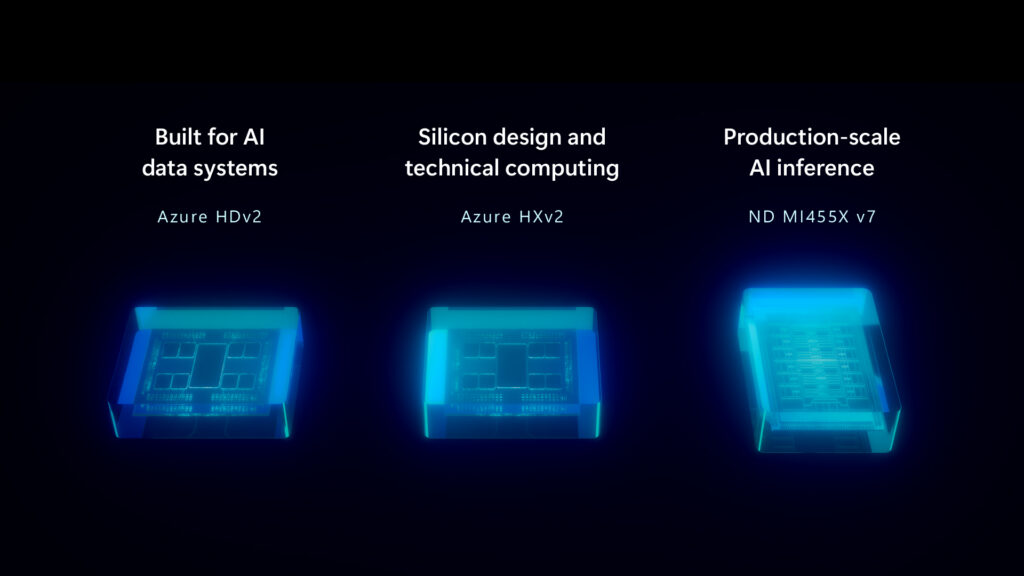
Microsoft is expanding Azure's AI and high-performance computing infrastructure by integrating AMD's latest Helios AI platform and next-generation EPYC processors. The move delivers three new virtual machine offerings optimized for data processing, chip design, and AI inference — addressing the industry's growing need for specialized compute as AI workloads scale. AMD and key partners like Synopsys have already validated the performance of Azure's existing HX systems for demanding engineering and AI workloads.
Summaries like this, in your inbox every morning.
Sign up free →What happened
Microsoft is bringing AMD's Helios AI platform and next-generation EPYC processors to Azure, powering three new offerings — HDv2 VMs for data processing, HXv2 VMs for chip design, and ND MI455X v7 VMs for AI inference workloads.
Why it matters
AI workloads are scaling faster than existing infrastructure can support, and customers need specialized tools for different tasks. These new Azure offerings let businesses pick the right compute for their specific AI workflow — whether that's data preparation, chip design, or inference — while maintaining cost and energy efficiency.
What to watch
HDv2 features nearly 500 physical 6th Gen AMD EPYC CPU cores, 4 terabytes of RAM, and 32 terabytes of local NVMe storage; HXv2 offers 176 AMD 6th Gen EPYC cores with clock frequency over 5 GHz and 50% more addressable cache per core. AMD and Synopsys have both highlighted strong adoption of existing Azure HX infrastructure for chip design and simulation.
Microsoft announced a significant expansion of its Azure cloud infrastructure, integrating AMD's Helios AI platform and next-generation EPYC processors to address the accelerating complexity of AI workloads. The company emphasized that AI systems are scaling faster than any single infrastructure approach can support, driven by the proliferation of AI models, agent-driven workloads, and surging compute demand.
The expansion delivers three new Azure virtual machine offerings. Azure HDv2 is purpose-built for AI data systems, featuring nearly 500 physical 6th Gen AMD EPYC CPU cores, 4 terabytes of RAM, 32 terabytes of local NVMe storage, and 400 Gb Azure Boost networking. Microsoft positioned this offering as solving a critical bottleneck: AI accelerators depend on high-density, power-efficient CPU compute to process data and coordinate workloads at scale. Without this capacity, the company noted, training jobs lack sufficient data and agents cannot perform tasks effectively.
Azure HXv2, the second offering, is optimized for electronic design automation and technical computing. Building on the earlier HX platform launched with AMD in 2023, HXv2 features 176 AMD 6th Gen EPYC CPU cores running at clock frequencies exceeding 5 GHz, 50% more addressable cache per core, and VM sizes offering up to 4 terabytes of RAM. The system also includes 800 Gb InfiniBand connectivity to enable large-scale simulations. HXv2 targets firms developing AI-capable silicon, supporting not only RTL simulation workloads through AMD's 3D V-cache technology but also scientific simulation, engineering analysis, and distributed memory applications.
Mark Papermaster, Executive Vice President and CTO of AMD, highlighted the practical impact: "Engineering teams are pushing the limits of simulation, chip design and scientific computing... Azure HX is an important platform for scaling complex EDA workloads, and we're excited about Azure HXv2, which is designed to deliver even greater performance and scalability." Synopsys, a key EDA software partner, reported that its collaboration with Microsoft on HX-series infrastructure has enabled customers to extend workloads beyond traditional constraints and accelerate design cycles while maximizing quality.
The third offering, ND MI455X v7, is powered by the AMD Helios rackscale solution and designed specifically for production-scale AI inference, including reasoning, search, and agentic workloads. Together, these three options allow Azure customers to select the right compute for their specific AI workflow — data processing, chip design, or inference — while maintaining focus on cost and energy efficiency. Microsoft highlighted customer choice as a core design principle underpinning its approach to heterogeneous cloud infrastructure.
Microsoft's expansion of Azure with AMD's latest processors reflects a fundamental shift in how cloud infrastructure must be designed: no single approach can meet the diversity of modern AI workloads. The company is explicitly positioning Azure as a heterogeneous platform — one that combines AMD silicon, Microsoft's own purpose-built systems, and flexible architecture — to give customers options rather than forcing them into a single path.
The three new offerings each address a specific bottleneck. HDv2 tackles data processing and agent coordination by pairing nearly 500 CPU cores with 4 terabytes of RAM and massive local storage — the body notes that without sufficient CPU capacity, training jobs lack data and agents lack capacity to operate at scale. HXv2 targets the growing semiconductor design market, where firms are racing to build AI-capable chips; the 50% increase in cache per core and support for large-scale simulations reflect the real demands AMD and Synopsys customers have reported. ND MI455X v7 rounds out the portfolio for inference and search — the workloads that directly power AI services end-users interact with.
The repeated emphasis on customer choice and open architecture signals Microsoft's strategy: by integrating AMD's innovations alongside its own silicon and providing specialized tools for different tasks, Azure aims to become the default platform for organizations building diverse AI systems. The quotes from AMD's Mark Papermaster and Synopsys's Shankar Krishnamoorthy are not casual endorsements but indicators of existing production adoption, suggesting these new offerings build on proven demand rather than speculative need.
AI-summarized, only the topics you pick — one digest a day via Email, Slack, or Discord.
Free · takes 30 seconds · unsubscribe anytime
No comments yet. Be the first to share your thoughts!
Log in to join the discussion
Get curated AI news from 200+ sources delivered daily to your inbox. Free to use.
Get Started FreeFree · takes 30 seconds · unsubscribe anytime
1 minute a day. The AI essentials.
200+ sources · Email / LINE / Slack
