What happened
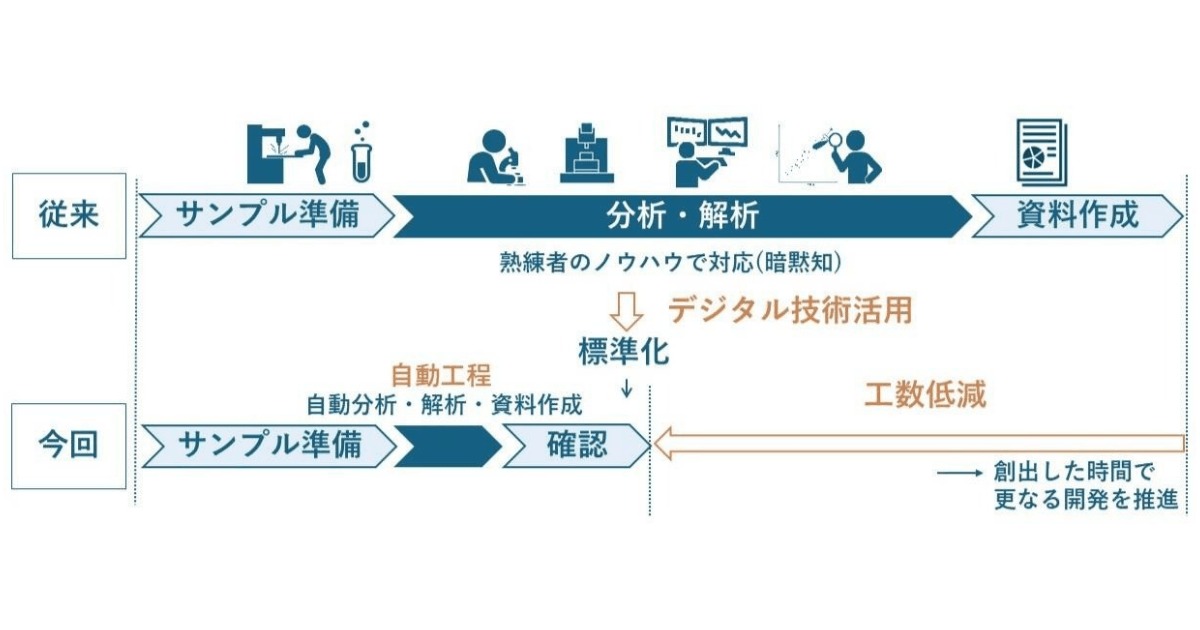
Toyota Industries said it developed AI that automates the full fracture-surface analysis workflow, trained on 10 years of veteran technicians' image data and paired with automated electron-microscope control.
Why it matters
Individual analyses that took 8 to 20 hours now take around 2 hours, and whole jobs from request to report drop from 1–2 weeks to 2–3 days.
What to watch
The company plans to begin applying the technology to actual analysis work by fiscal 2027.
WHO IT HITSThis lands mainly on materials and quality engineers who investigate metal failures, such as in automotive development and prototyping, who could see the long manual steps of fracture analysis compressed from weeks to days.
Summaries like this, in your inbox every morning.
Toyota Industries traces its materials research back to a department founded in 1947, giving it roughly 80 years of accumulated know-how in analyzing metals such as iron and aluminum. The new technology draws directly on that history, using image data from the past 10 years of veteran technicians' analyses to train the AI. Fracture-surface analysis matters because it traces the cause of a break at the nanoscale, helping improve design conditions and material selection for metal products such as automobiles. That work had depended heavily on experienced specialists, and the company frames standardization and efficiency as pressing needs as electrification and automation speed up product development.
The system goes beyond judging images. When an observation sample is set on the electron microscope, it automatically carries out the main steps of the analysis, finding traces of the damage cause that may be only about 1 micrometer across within a fracture surface a few centimeters in diameter. Toyota Industries also built what it calls MLOps, a setup that continuously learns from new analysis data gathered during operation to improve the model's reliability. The company says that, according to its own research, this is the first technology in the world to automate the entire fracture analysis workflow.
Pick your industry and the AI tools you use, and get news related to your work every day.
Free · 30 seconds with Google · unsubscribe anytimeWhat is AIToday? →
Ask AI anything about this article. The AI reads this article, earlier AIToday articles, and Wikipedia, and cites its sources. Q&As are published on this page for other readers too.
Hewlett Packard Enterprise stock is down 5% at $55.87

The Motley Fool argues Amazon is the AI company of the two, since AWS was just 21% of first-half 2026 revenue…

OpenAI is launching the Rosalind Academic Plan, offering eligible research labs at US universities up to 30 fr…

Vercel data published Thursday shows TypeSafe AI's Jev, a lightweight decision model for choosing among predet…

Chunghwa Telecom president Rong-shy Lin said the shift from conversational AI to autonomous AI agents is resha…

CoreWeave fell 5% in premarket trading Friday and was on track to finish the week down 15%, after rebounding f…


