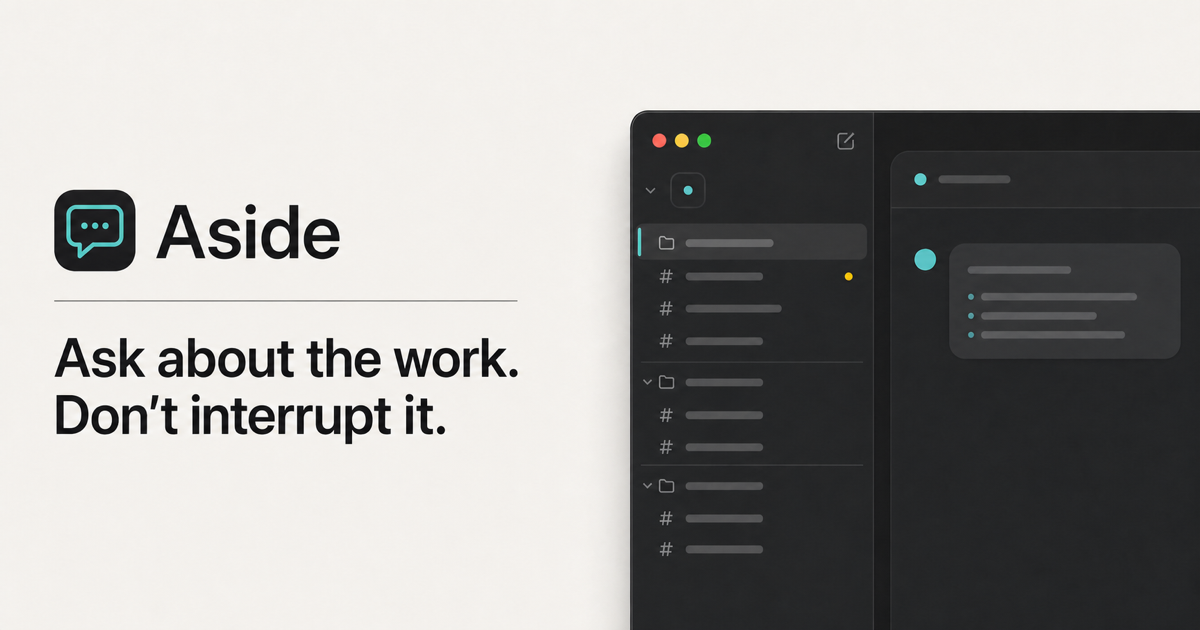
Aside is a new macOS application that sits beside your coding agents (Codex, Claude Code, and Pi) and lets you ask a separate AI model questions about what those agents are doing—why they chose a path, what changed, what they need next—by reading their local transcripts. It operates read-only, never controlling agents, and keeps your search index, chat history, and sensitive context on your Mac; you can also choose a local Ollama model to avoid sending any transcript context to the cloud.
Summaries like this, in your inbox every morning.
Sign up free →What happened
Aside, a macOS utility, launched as a read-only observer that finds transcripts from Codex, Claude Code, and Pi coding agents already running on your Mac and lets you open a separate chat session to ask a second model why an agent chose a path, what changed, or what it needs next.
Why it matters
Coding agents now run in parallel, but human attention does not. Aside indexes search prompts, replies, commands, file paths, and failures locally on your Mac—letting you find context from what happened inside a thread rather than just its title—and persists a separate conversation per session without launching, steering, or merging agent contexts.
What to watch
Aside is open-source (MIT license), runs as a signed macOS menu-bar utility, keeps thread indexes and side-chat history entirely local with user-only permissions, and can delegate to ChatGPT or Claude accounts already connected to Codex or Claude Code—or to a local Ollama model if you want model context to stay on-device.
Aside is a native macOS utility that installs to the Applications folder and lives in your menu bar. It discovers transcripts from three coding agents—Codex, Claude Code, and Pi—that are already running on your Mac and presents them in a unified list. Developers can pick a session and open a separate chat window to ask an observer model questions about what happened inside that agent's work.
The interface prioritizes what needs attention. When a live session starts waiting for input, Aside can send a Mac notification. Direct input requests and likely questions rise to the top of the session list. Developers can search across all agents—through prompts, agent replies, commands, file paths, failures, and previous side chats—without leaving your machine; the searchable index is stored locally with user-only permissions. Subagent work (from Codex and Claude Code) folds beneath the task that spawned it, preserving its own transcript and side-chat record.
Each session keeps its own persistent conversation and model choice. Close Aside, switch projects, and return to where you stopped. Critically, Aside does not launch agents, steer them, or merge their context. It reads their local transcripts and offers a second conversation about the work. When you choose a cloud model—ChatGPT (via your existing Codex account) or Claude (via your existing Claude Code account)—Aside sends only that session's transcript to the chosen model, after redacting common credential patterns first. Your login stays with the vendor; Aside never reads OAuth tokens or imports API keys from your shell. Alternatively, you can choose an installed Ollama model to keep all context entirely local.
Aside is open-source under the MIT license, with source code available on GitHub. After the first signed install, Aside downloads future signed updates inside the app and prompts you to restart when one is ready. The read-only boundary is enforced at the architectural level: Aside cannot send a message to an agent, edit a project, or run a command. The tool is designed to answer a simple question—what changed, why did the agent choose that path, what does it need next—without introducing the complexity and risk of orchestration.
Aside addresses a concrete friction point in the emerging world of AI coding agents: multiple agents running in parallel on a developer's machine, but the developer's attention still being singular. Rather than attempting to orchestrate or merge agent contexts—a complex and risky operation—Aside takes a simpler, safer approach: it remains a pure observer, reading the transcripts agents already keep locally and opening a secondary conversation thread where a developer can ask clarifying questions or probe the reasoning behind each agent's choices.
The design reflects a privacy-first stance. All indexing, search, and chat-session history remain on the user's Mac with user-only file permissions. When a developer chooses a cloud model (ChatGPT or Claude), Aside redacts credential patterns before sending only the scoped session transcript. The option to use a local Ollama model removes the cloud step entirely. Credentials are never copied; Aside delegates to existing OAuth accounts already connected to Codex or Claude Code. This boundary—read-only observer, not operator—is enforced at the architectural level: Aside cannot edit a project, run a command, or send a message to an agent.
The open-source release under the MIT license and the signed, autoupdate-capable macOS bundle suggest confidence in the tool's security model and an intent to let developers audit the code that reads their agent transcripts. The placement in the menu bar rather than the Dock signals a supporting role—a sideline tool that stays present but unobtrusive.
AI-summarized, only the topics you pick — one digest a day via Email, Slack, or Discord.
Free · takes 30 seconds · unsubscribe anytime
No comments yet. Be the first to share your thoughts!
Log in to join the discussion


Get curated AI news from 200+ sources delivered daily to your inbox. Free to use.
Get Started FreeFree · takes 30 seconds · unsubscribe anytime
