What happened
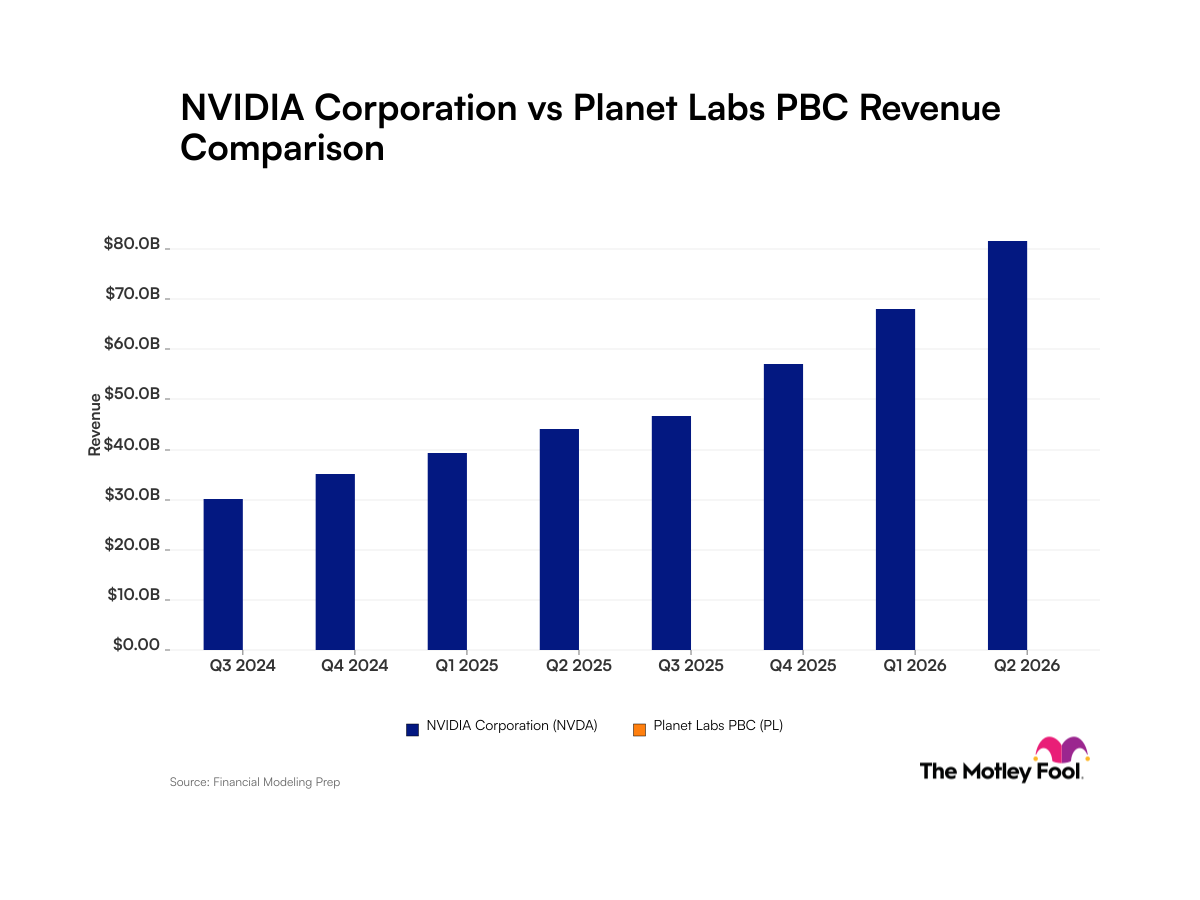
Nvidia reported $81.6 billion in revenue for Q2 2026 (ended April 26), up 85% year-over-year, while Planet Labs PBC generated $94.2 million for the same period, up 42% year-over-year. Nvidia achieved a 72% net income margin; Planet Labs posted a -148% net income margin. Nvidia expects revenue to accelerate to $91 billion next quarter, while Planet Labs forecasted $102 million to $107 million for its next quarter.
Why it matters
The two companies represent vastly different scales—Nvidia's $81.6 billion quarterly revenue dwarfs Planet Labs' $94.2 million—but both are experiencing strong sequential growth driven by distinct markets. Nvidia's expansion reflects surging demand for AI semiconductors; Planet Labs' growth stems from its space-based geospatial data business and a secured eight-figure government contract extension. For investors, these trends signal robust customer demand in emerging high-growth sectors.
What to watch
Planet Labs' backlog rose 72% year-over-year to over $900 million, indicating sustained future revenue; Nvidia expects its next-quarter revenue to nearly double from the prior year's $46.7 billion. Both companies report rising quarterly revenue each period, though Nvidia's trajectory is accelerating far more steeply.
Summaries like this, in your inbox every morning.
Nvidia and Planet Labs operate in fundamentally different business segments, yet both demonstrate the commercial momentum underpinning their respective markets. Nvidia, which provides advanced graphics, computational, and networking solutions, has achieved extraordinary scale—its $81.6 billion Q2 2026 revenue represents an 85% year-over-year increase. The company commenced full production of its new hardware architecture, Vera Rubin, even as it navigated regulatory scrutiny over export controls. Its forward guidance to $91 billion next quarter signals an acceleration trajectory that reflects explosive demand for AI semiconductors.
Planet Labs, by contrast, operates at a vastly smaller revenue base ($94.2 million in Q2 2026) but is also expanding rapidly, posting 42% year-over-year growth. The company generates revenue by deploying satellite constellations for geospatial data services and has secured an eight-figure government contract extension. Notably, Planet Labs' backlog grew 72% year-over-year to over $900 million, indicating that future revenue growth is already contracted. While the company currently operates at a loss (a -148% net income margin), its backlog and growth rate suggest the space-based economy is emerging as a genuine commercial opportunity.
For investors tracking these two businesses, the contrast is instructive: Nvidia's profitability (72% net income margin) combined with accelerating scale reflects mature, high-margin AI infrastructure demand, while Planet Labs' negative margin offset by substantial backlog growth reflects an earlier-stage company still scaling to profitability within an expanding sector.
For example, today's edition would include:
AI-summarized, only the topics you pick — one digest a day via Email, LINE, or Slack.
Free · 30 seconds with Google · unsubscribe anytimeWhat is AIToday? →
Ask AI anything about this article. Q&As are published on this page for other readers too.
AbbVie entered a multi-year collaboration with Iambic to apply the Enchant and NeuralPLexer AI models to small…

Intel shares jumped about 10% on Monday, as Melius Research initiated a Buy rating, Tigress Financial raised i…

Sandisk customers are expanding multi-year commitments as inference requirements rise, strengthening the signa…
Dell said it booked a record $60.9 billion in AI-server orders and $16.4 billion in AI-server revenues in the…
AMD hit a major milestone, and AI stocks blazed higher

Meta introduced its Muse AI agent, triggering a rally in Intel and fellow chip stocks, while AMD reached a $1T…

