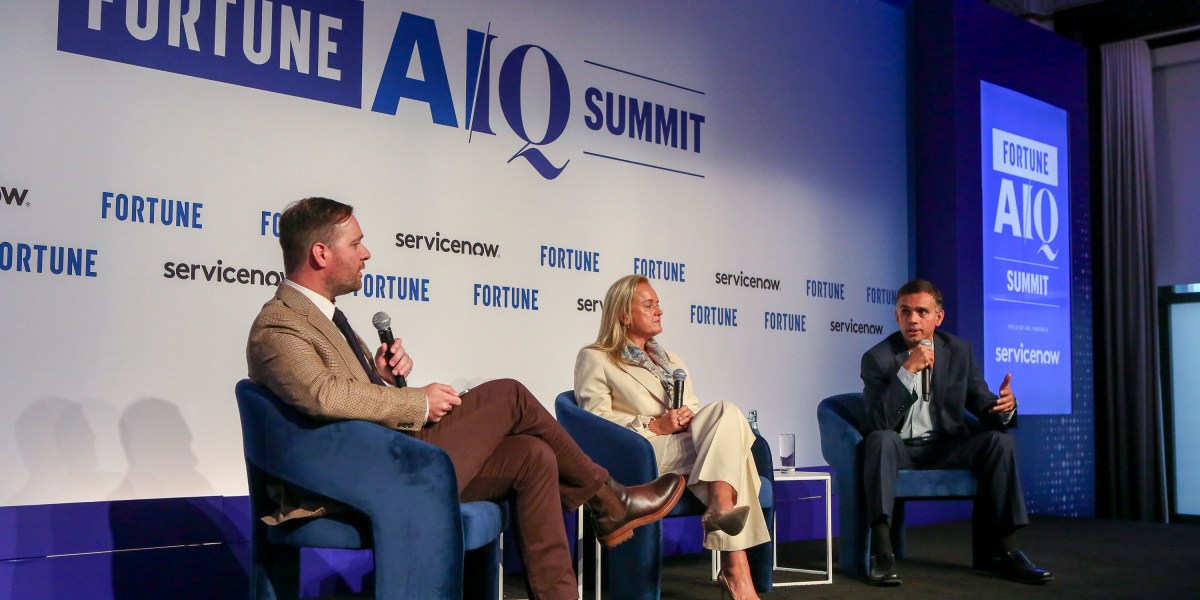
What happened
At Fortune's inaugural AIQ Summit, Bank of America's Hari Gopalkrishnan said AI is evaluated across 16 risk dimensions and warned that rushing to AI where deterministic models would do is a common and costly mistake. S&P Global's Sally Moore said the company helped a major global bank cut time to market roughly sixfold and lift accuracy from about 60% to 98%.
Why it matters
Bank of America's approach suggests AI pays off when it is tied to a specific client need and monitored continuously, while S&P Global's client results suggest the payoff can come as faster delivery and higher accuracy rather than only cost savings.
What to watch
The test is whether continuous governance — guardrails, evaluation and monitoring for unintended consequences — holds up in high-stakes uses such as fraud models or customer service, where the downside is compliance and reputational risk. Watch whether traceability back to the original IP becomes a standard requirement.
WHO IT HITSThis lands on risk, compliance and data governance teams at banks and other regulated firms, who will be asked to show that AI outputs are traceable and continuously monitored, and on AI product owners deciding whether simpler, deterministic models are the better fit.
Summaries like this, in your inbox every morning.
The Fortune AIQ Summit session came the same week as Fortune and ServiceNow's release of the Fortune AIQ 75, a ranking of Fortune 500 companies generating measurable impact from AI. That pairing is the context for how the two executives framed the subject: not whether AI can be deployed, but whether it can be trusted with decisions affecting customers, markets and the economy.
Gopalkrishnan's argument at Bank of America is essentially a sequencing one. He said the company evaluates AI implementations across 16 risk dimensions including privacy, bias, workforce implications and intellectual property, and that the starting point is the client need rather than the model. His caution cuts against the instinct to attach AI to every workflow: he said one of the biggest mistakes is rushing to AI when deterministic models can do the job just as well, and he suggested the most expensive error may be funding a sophisticated AI solution where simpler technology would yield a more reliable, lower-risk return. Where AI is warranted, he described governance as continuous — guardrails, evaluation and monitoring for unintended consequences — with failures like a fraud model that disadvantages certain demographic groups or a chatbot that serves customers with particular accents framed as customer, compliance and reputational risks, not merely technology problems.
Moore's account from S&P Global supplies the complementary half: data and provenance. The client example she cited — bringing time to market down roughly sixfold and accuracy on multi-data-set work from about 60% to 98% — is a concrete instance of combining proprietary intelligence, subject-matter expertise and implementation support. Her point that accuracy alone is not enough, because high-stakes applications require tracing an AI output back to the underlying data and IP, points to where the harder work may sit. The open question is whether continuous governance and traceability can be delivered at the pace the client-work results imply, or whether they become the bottleneck that decides which deployments are judged worth the risk.
Pick your industry and the AI tools you use, and get news related to your work every day.
Free · 30 seconds with Google · unsubscribe anytimeWhat is AIToday? →
Ask AI anything about this article. The AI reads this article, earlier AIToday articles, and Wikipedia, and cites its sources. Q&As are published on this page for other readers too.
The Motley Fool argues Amazon is the AI company of the two, since AWS was just 21% of first-half 2026 revenue…

Hewlett Packard Enterprise stock is down 5% at $55.87

Anthropic gave six METR staffers hardware, office space and internal tools, putting them roughly on par with i…

Cammarata reinterprets InceptionV1's cat-car neuron as a V-shape detector, not two unrelated concepts

Vercel data published Thursday shows TypeSafe AI's Jev, a lightweight decision model for choosing among predet…

Chunghwa Telecom president Rong-shy Lin said the shift from conversational AI to autonomous AI agents is resha…


