What happened
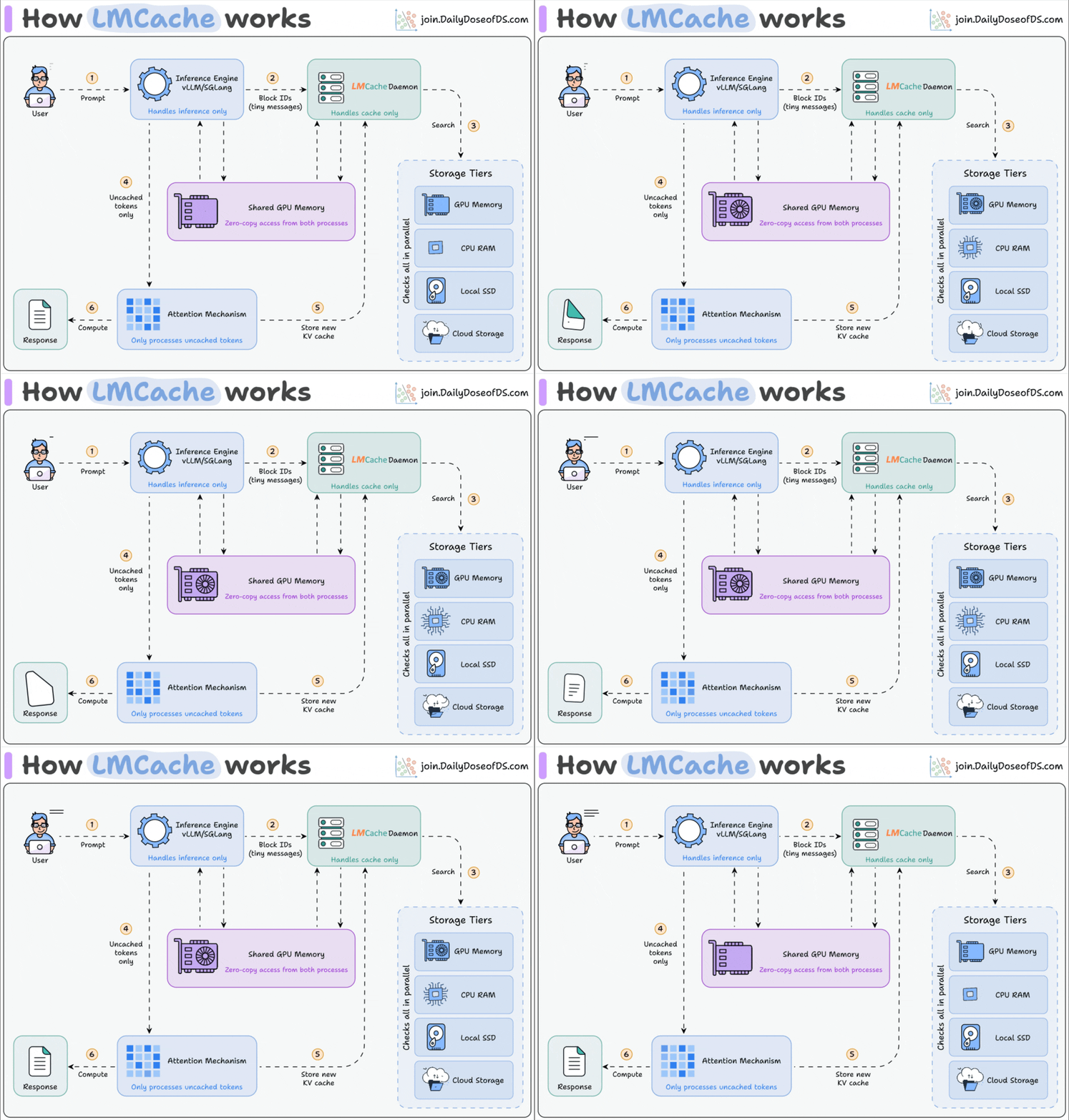
Stanford researchers found ~62% of what's sent to an AI agent on every call is repeated content, and LMCache, an open-source project (10k+ stars), moves cache management outside the inference engine, delivering up to 14x faster time-to-first-token on H200 GPUs.
Why it matters
Because most of what agents process is redundant re-sent context, separating cache I/O from inference lets teams avoid paying to recompute identical prompts and tool definitions, addressing the cost overruns behind Gartner's forecast that 40% of AI agent projects will be cancelled by 2027.
Summaries like this, every morning.
The cost problem LMCache targets is structural rather than a matter of per-token pricing. Even as token prices fell, agentic workflows re-send the same system prompts, tool definitions, and documents at every step, so volume outran the price cuts and total bills rose. Uber's experience illustrates the pattern: after rolling out Claude Code across its engineering org, it burned through its entire 2026 AI budget in just 4 months, and Gartner forecasts that 40% of AI agent projects will be cancelled by 2027 because of cost overruns alone.
Prompt caching was the industry's first answer, and it works well when the start of a request never changes: Anthropic's own implementation gives a 90% cost reduction on cached input tokens, with hit rates of 60 to 85% achievable for stable workloads. But prefix caching requires an exact, byte-for-byte match, so multi-document RAG, reordered documents, and growing conversation histories all trigger full cache misses. Alibaba Cloud's production data shows the waste: 10% of KV cache blocks serve 77% of all hits.
LMCache's architectural split addresses the performance side, and CacheBlend, which won the EuroSys 2025 Best Paper Award, addresses the matching limitation by selectively recomputing only the few tokens that carry cross-document connections. The engineering details suggest production readiness rather than a prototype: Prometheus and OpenTelemetry integration, a Kubernetes operator, and failure modes where neither a cache crash nor an engine crash takes the whole system down.
Pick your industry and the AI tools you use, and get news related to your work every day.
Free · 30 seconds with Google · unsubscribe anytimeWhat is AIToday? →
Ask AI anything about this article. The AI reads this article, earlier AIToday articles, and Wikipedia, and cites its sources. Q&As are published on this page for other readers too.
In a Honeywell STEM Week interview, Katie and Diviya traced their paths from a WWII "Rosie" grandmother and ma…

Charles Schwab unveiled generative AI assistants — thinkorswim Assistant and Charley — and added support for e…
Uber's internal AI 'skills' marketplace grew from one entry in October 2025 to more than 5,000 a year later, w…

Justice Nye Perram dismissed the driver's Federal Court bid to quash the Fair Work Commission's ruling and ord…

Joe Liemandt has put $1 billion from Trilogy and ESW Capital into TimeBack, an AI program now used by his for-…

Kioxia developed the KIOXIA GP2 Series, which reaches over 18 million IOPS in 512-byte random reads — about 2x…