What happened
Intel released llm-scaler-vllm:0.21.0-b2 in August 2026, adding Multi-token Prediction (MTP) and LoRA Serving support for Qwen3.6-27B, Qwen3.6-35B-A3B, gemma-4-31B-it, and gemma-4-26B-A4B-it models, as well as support for per-block quantized models Qwen3.6-27B-FP8 and Qwen3.6-35B-A3B-FP8.
Why it matters
LLM Scaler enables developers and enterprises to run state-of-the-art generative AI models—for text, image, and video—natively on Intel Arc Pro B60 and B70 GPUs using standard frameworks like vLLM and ComfyUI, rather than relying solely on NVIDIA or other vendors' hardware.
What to watch
The platform now supports 60+ models across text generation (including DeepSeek, Qwen, Llama, Mistral, Gemma), multi-modal vision models, embedding and reranking models, and omni models for image, video, and audio generation. Omni Serving provides OpenAI-API-compatible endpoints for image and audio tasks.
Summaries like this, in your inbox every morning.
LLM Scaler represents Intel's strategy to enable its Arc Pro GPUs as viable alternatives for generative AI workloads. Rather than building proprietary software, the platform leverages open-source frameworks (vLLM, ComfyUI, SGLang Diffusion, Xinference) to ensure compatibility and ease of adoption for developers already familiar with these tools. The August 2026 release adds Multi-token Prediction and LoRA Serving—two features that improve both inference speed and fine-tuning capabilities—extending the platform's utility for both deployment and model customization.
The breadth of supported models has grown substantially: the platform now covers major open-weight models from OpenAI (GPT-OSS), Qwen, DeepSeek, Llama, Mistral, Gemma, and others, spanning text, vision, embedding, and omni (multimodal) architectures. Quantization options (INT4, FP8, MXFP4) allow operators to trade off precision for memory and speed, a critical capability for running larger models on GPU memory-constrained systems. The Omni Serving mode, which exposes image and audio generation via OpenAI-compatible APIs, lowers integration friction for applications already built on that interface.
Pick your industry and the AI tools you use, and get news related to your work every day.
Free · 30 seconds with Google · unsubscribe anytimeWhat is AIToday? →
Ask AI anything about this article. The AI reads this article, earlier AIToday articles, and Wikipedia, and cites its sources. Q&As are published on this page for other readers too.
Cammarata reinterprets InceptionV1's cat-car neuron as a V-shape detector, not two unrelated concepts

Google Deepmind's Gemini 4 Argon scored 97.5 percent on ARC-AGI-3 at a cost of $4,800, second only to GPT-6 As…
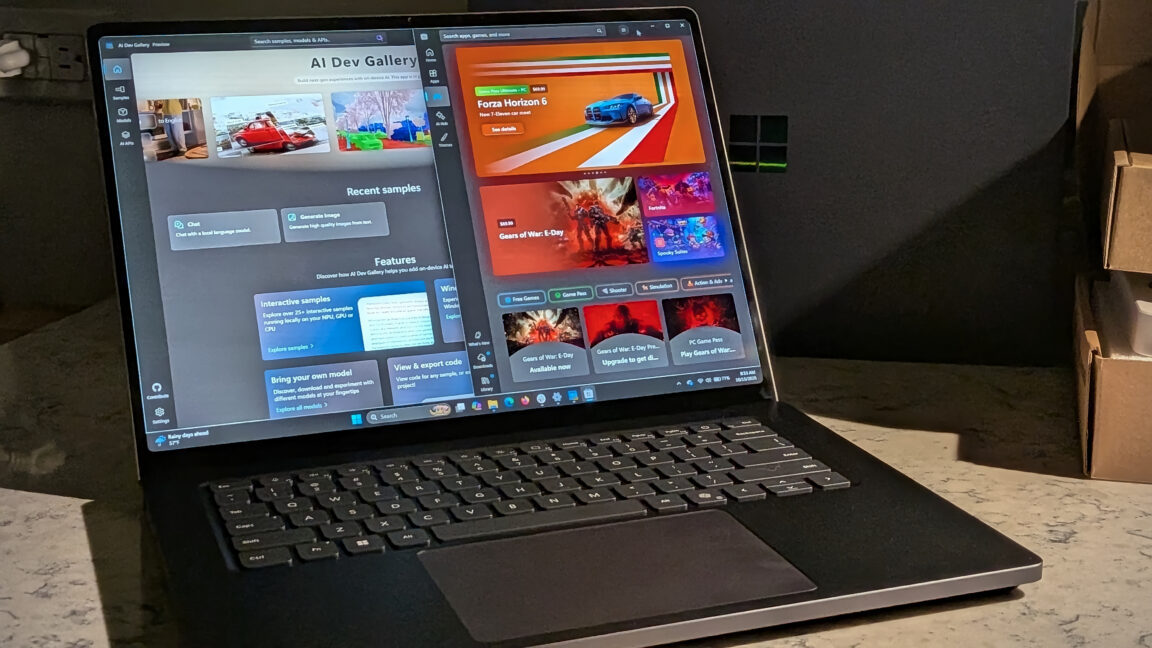
Microsoft's Surface Laptop Ultra, using Nvidia's RTX Spark platform, starts at $2,599 (up to $5,899)
Meta's new commercial terms, effective October 30th, appear to let it crawl and train AI on content from websi…
Vercel data published Thursday shows TypeSafe AI's Jev, a lightweight decision model for choosing among predet…
Reflection AI introduced Beam, an open-weight model for agentic coding and long-horizon tasks, with 501 billio…