What happened
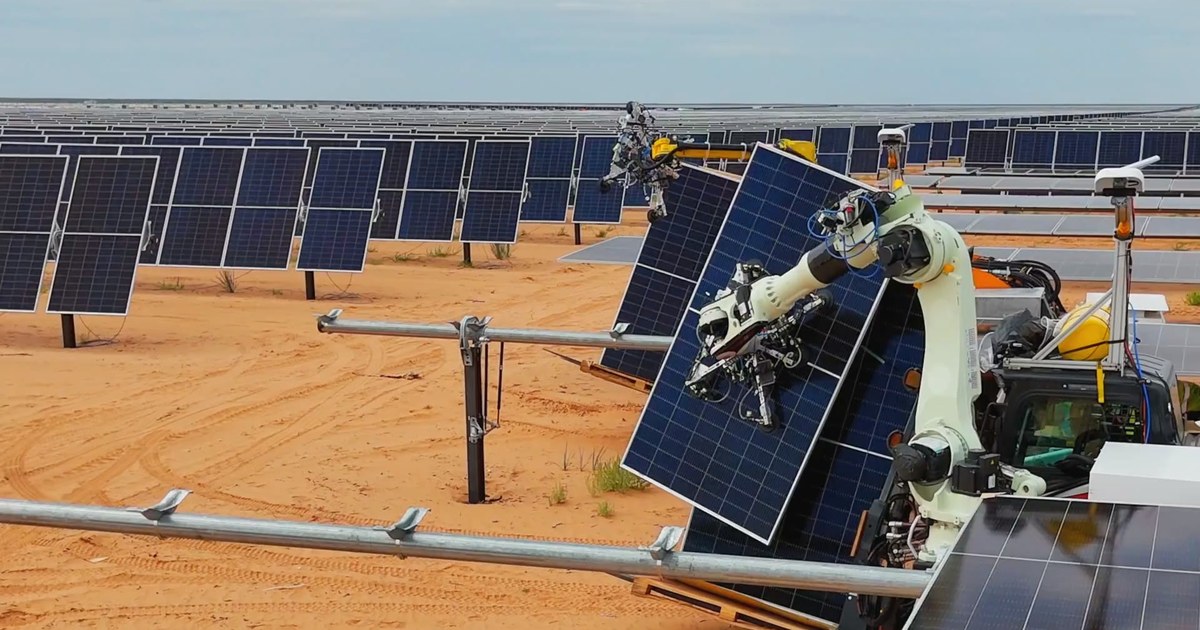
Gritt, an AI-robotics system, is now operating on-site at multiple jobsites with some of the largest engineering and construction firms in the US. The company handles pick-and-place, transport, and assembly work on solar, concrete, and rebar projects, and is expanding into verification and planning tasks.
Why it matters
Construction is a sector where labor-intensive, repetitive physical work dominates, and Gritt's deployment signals that AI-driven automation is moving from labs into real-world infrastructure projects. The system achieves a 4× efficiency gain without added labor, which could reshape how major construction projects are executed and staffed.
What to watch
Gritt has deployed to 7+ jobsites already and is expanding beyond solar into data center and large infrastructure work. The company is backed by investors including Obvious Ventures, Union Square Ventures, and First Round Capital, and is actively hiring to scale the team.
Summaries like this, in your inbox every morning.
Gritt represents a shift in how AI and robotics are being commercialized: rather than targeting consumer or office environments, the company is embedding its technology directly into the construction industry, partnering with major US engineering and construction firms. The article emphasizes that Gritt is not a single-purpose tool but rather a unified AI backbone that handles five distinct construction jobs—pick-and-place, assembly, transport, verification, and planning—using the same underlying intelligence. This breadth is significant because it suggests the company has built a generalizable spatial-reasoning capability trained on what it describes as "one of the world's largest troves of spatial and operational data," allowing it to adapt across different materials and environments (dust, heat, cold, varied terrain).
The 4× efficiency gain without added labor is the core business claim; if validated, it would address a persistent pain point in construction, where labor scarcity and productivity have long been structural constraints. The company's focus on starting with solar, then expanding to data centers and large infrastructure, suggests a deliberate go-to-market strategy targeting high-volume, standardized work first. Backing from investors including Union Square Ventures and First Round Capital indicates institutional confidence in the approach, though the article does not disclose funding amounts or valuation.
Pick your industry and the AI tools you use, and get news related to your work every day.
Free · 30 seconds with Google · unsubscribe anytimeWhat is AIToday? →
Ask AI anything about this article. The AI reads this article, earlier AIToday articles, and Wikipedia, and cites its sources. Q&As are published on this page for other readers too.
Vinci4D provides chip-design simulation software that trains on physics equations instead of customer data, an…

SEMI President and CEO Ajit Manocha told DIGITIMES that the semiconductor industry reached the US$1 trillion r…

CoreWeave fell more than 25% this week, its debt yield briefly rose above 16% on Thursday, and SK Hynix droppe…

Nvidia's AI Enterprise lists at $4,500 per GPU annually, and paid subscriptions add supported software, securi…

Anthropic told investors this week that it is making 85% gross margins, a figure the columnist calls a cash co…
Modal Labs, an AI infrastructure provider, raised $750 million in a Series D led by Accel at a $15.75 billion…