What happened
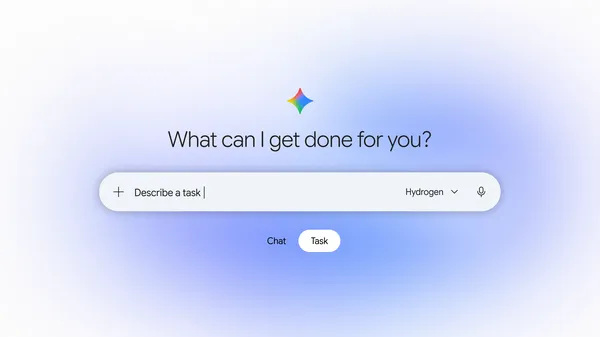
Google is rolling out Gemini 4 Hydrogen free of charge for hundreds of millions of people in the U.S., Japan, Korea, Canada, Australia, and India, letting the assistant call dealerships, analyze utility bills, and complete Instacart orders.
Why it matters
Because emails, calendars, passwords, photos, files, and payment cards already live inside Google's ecosystem, Gemini can act on that data without sending it elsewhere, which Google is positioning as its main advantage as a personal assistant.
WHO IT HITSGoogle's hundreds of millions of existing account holders in the six launch countries get a free assistant that can act on their email, calendar, and payment cards. Businesses that receive Gemini's calls can opt out, and developers can apply to join the Connected Apps Platform.
Summaries like this, every morning.
Google's pitch rests on a simple data-location argument: if your emails, calendar, passwords, photos, files, and payment cards already sit inside the Google ecosystem, Gemini can act on them without shipping that sensitive data elsewhere. The examples Google offers are deliberately mundane — a minivan's check-engine light, a surprise $389 electric bill traced to a heat pump kicking on around 4 p.m. during peak pricing, a USB-C charger, a nearly empty fridge before a morning departure. Each shows the assistant reaching into a different Google product: Maps and Calendar for the dealership appointment, Password Manager for the utility portal, Shopping Graph and Google Pay for the charger, RCS and Instacart for groceries.
On security, Google says tasks run in a hardware-isolated virtual machine dedicated to the account and never shared, with sandboxing, prompt-injection filters, and Google Safe Browsing limiting which links Gemini can open. Gemini is designed to pause and ask for confirmation before critical steps such as clicking "Buy," though routine actions like adding cereal to a grocery cart can be set to "Always allow." Google also acknowledges limits: tasks may fail or miss the mark, and on some sites Gemini can make it most of the way through and then hand the screen back for the final click.
The company frames the web's adaptation to personal assistants as an open question, noting that bots were blocked by default for decades because most were malicious, and that it is partnering with major websites and security providers on verifiable standards. Gemini connects with more than 60 popular apps today, and Google Wallet is expanding to iOS starting today.
Pick your industry and the AI tools you use, and get news related to your work every day.
Free · 30 seconds with Google · unsubscribe anytimeWhat is AIToday? →
Ask AI anything about this article. The AI reads this article, earlier AIToday articles, and Wikipedia, and cites its sources. Q&As are published on this page for other readers too.
Microsoft introduced Copilot Workspaces, a collaborative space in its Frontier early-access program where Word…
Earlier in November, Meta chief AI officer Alexandr Wang shared an AI-generated clip on Instagram promoting Mu…

At a roundtable after his Microsoft Ignite keynote at San Francisco's Chase Center, Satya Nadella said he is "…
On Tuesday's earnings call, interim CEO Colette Kress said Nvidia remains committed to open source AI, citing…
AT&T COO Jeff McElfresh said agentic AI is driving a fundamental shift in bandwidth direction

Microsoft unveiled new AI models for coding and cybersecurity, taking on Anthropic and OpenAI